
Arresting a Chant Won’t Arrest the Problem
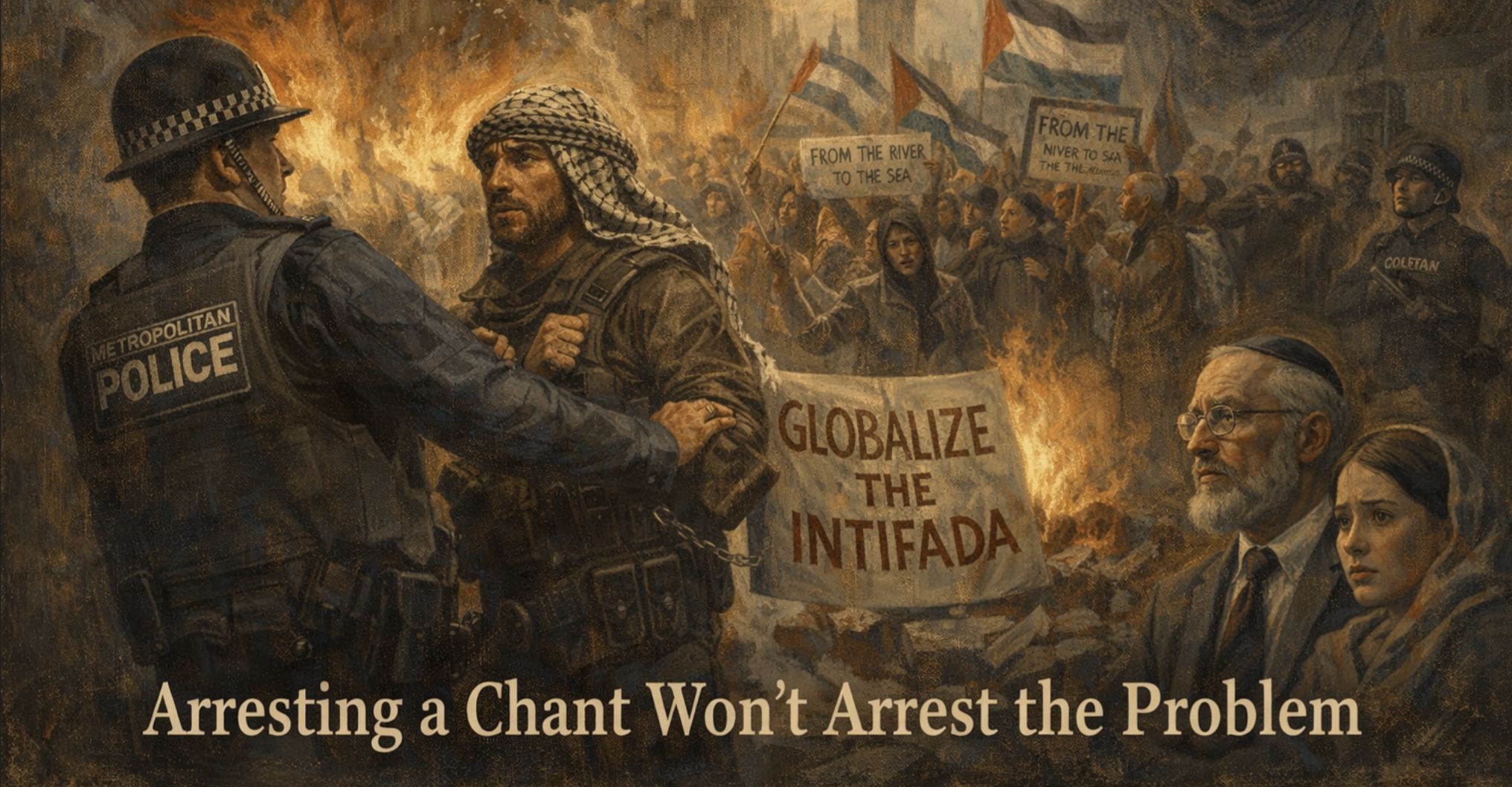
When two of Britain’s most senior police leaders announce a tougher line on chants and placards such as “globalise the intifada,” it is tempting to file it under “about time” and move on. In one sense, it is exactly that: a welcome acknowledgement that words used on our streets are not neutral, that context matters, and that intimidation has real-world consequences. The Metropolitan Police and Greater Manchester Police have explicitly said they will “act decisively and make arrests” where this slogan is used at future protests or in a targeted way.
But in another sense, the announcement raises a harder question: what, precisely, has been solved?
The police are candid about the environment that prompted this shift. Their joint statement describes a surge in antisemitic hate crime since 2023, intensified protests, rising online abuse, and a level of fear that forces Jewish children to attend schools “behind fences” with security and routine patrols – an abnormality no democratic society should accept as a permanent condition. The police also state that “current laws are inadequate” and welcome the Home Secretary’s decision to commission Lord Ken Macdonald KC to review public order and hate crime legislation.
That admission – laws inadequate – is the crux. Because if the law is inadequate, then arrests, however symbolically satisfying, may be little more than a pressure-release valve.
The police are not prosecutors. Arrest is not charge; charge is not prosecution; prosecution is not conviction. The Guardian reports that police chiefs said they have “consistently been advised by the CPS” that many phrases causing fear in Jewish communities do not meet prosecution thresholds; the CPS itself did not confirm that the new approach will hold up in court.
This is not a technical quibble. It goes to the heart of whether the decision is a genuine operational breakthrough or an attempt to demonstrate responsiveness – an appearance of care without the machinery to deliver lasting results.
If officers arrest more demonstrators but cases routinely fail at the charging stage, the public will be left with the same anxiety and an additional layer of cynicism. Communities will ask, reasonably: so what? And police will find themselves accused of doing too little by those at risk, and too much by those who feel their protest rights are constrained – while the underlying problem continues, repackaged for the next weekend’s march.
The chant matters. The intimidation is real. But slogans are the exhaust, not the engine.
Britain is not merely wrestling with a set of provocative words. It is wrestling with a deeper radicalism that has been permitted – politically, culturally, and legally – to fester in plain sight. The police themselves are effectively conceding this. Their position is not “we have always had the tools.” Their position is: the context has changed, the threat has escalated, and our current laws do not properly equip us.
This is the point that ought to concentrate minds in Westminster.
When a democracy can identify “terrorism” in statute, but cannot coherently define the ideological activity that systematically primes people for terrorism, it creates a permissive zone for professional ideologues. Those ideologues are often careful. They learn the legal thresholds. They skate just below incitement. They wrap calls for coercion in ambiguity. They use implication, insinuation, and repetition. They build a moral universe in which violence becomes defensible – then normal – then laudable.
The joint policing decision is, in effect, an attempt to police one part of that ecosystem. But it cannot be the centrepiece of a national strategy.
The UK’s challenge is not simply “hate crime” versus “terrorism” as two separate categories. It is the connective tissue between them: the systematic cultivation of an ideology that negates rights, legitimises coercion, and treats democratic order as an obstacle to be overcome.
The government-commissioned “Operating with impunity” legal review was explicit about this structural weakness: extremists can operate lawfully because the law is not designed to capture the specific activity of hateful extremism, even when it creates conditions conducive to hate crime, terrorism, or other violence.
That is the real scandal – not that a slogan is being acted upon now, but that so many ideological entrepreneurs have been able to operate for so long in the wide space between “lawful” and “safe.” We have permitted an environment where radicals can recruit, groom and indoctrinate while staying just on the right side of the criminal line, until the day someone crosses it with a weapon.
If that sounds abstract, it is not. The police statement itself frames the policy shift as a response to targeted attacks and heightened fear. In other words, we are tightening the rules not because the ideology has become less dangerous, but because the consequences have become harder to ignore.
There is a temptation – especially in politics – to treat this as a public order story: one chant, one decision, one new line in the sand. But if this remains a policing story, it will fail.
The real task is legislative and strategic: Britain needs a proper, rights-compatible legal definition of ideological extremism – political, religious, or otherwise – so that we are not perpetually waiting for threats to mature into crimes before the state can respond.
A definition is not a gag. It is a line. Done properly, it can be the opposite of overreach: it can reduce arbitrariness by making clear what is in scope and what is protected. The government’s 2024 policy definition already moves in this direction by framing extremism around violence/hatred/intolerance aimed at undermining democratic rights and freedoms. The question now is whether Westminster has the seriousness to place a usable version of that concept on a statutory footing – with explicit safeguards for free speech, faith, journalism, academic inquiry, and peaceful protest.
If we are serious about prevention, the statute must focus on conduct and intent, not identity; on rights-negation and democratic subversion, not the mere holding of unpopular views; on mobilisation towards coercion, not robust political disagreement. It must apply evenly – against any ideology that seeks to recruit people into a worldview where violence is permissible and rights are conditional.
It would be a profound mistake to interpret the present debate as a niche communal concern. Antisemitism is a barometer: when it rises, it rarely rises alone. The same radicalising mechanics that target Jews today will target other minorities tomorrow; the same ideology of coercion that bullies one community will erode the safety of all communities.
Britain’s liberal order depends on the idea that rights are not tribal, and that the rule of law is not optional. Ideological extremism attacks both. It trains people to see democracy as fraud, pluralism as weakness, and violence as virtue. It corrodes civic trust, fuels intimidation in public spaces, and makes “living openly” feel like a provocation rather than a right.
So yes: the police decision is progress. It is also an indictment – of the years in which we treated radicalising language as mere noise; of the reluctance to confront ideologues who have built their influence precisely by operating just below the criminal threshold; and of a political culture that too often confuses “not illegal” with “not dangerous”.
If this announcement is merely a rhetorical pivot – arrests without prosecutions, theatre without law – then the country will find itself right back here, after the next attack, with the same arguments and a deeper public exhaustion.
The gap between what must be done and what is now, belatedly, being conceded remains vast. Closing that gap requires something more ambitious than policing protest optics. It requires a coherent legal framework that names the problem upstream – ideological extremism in its operational form – so that Britain can prevent violence without sacrificing the freedoms that extremists, of every stripe, seek to destroy.