


Stephen J Stern PhD
As a Kid, I Was Sure Thanksgiving Was a Jewish Holiday
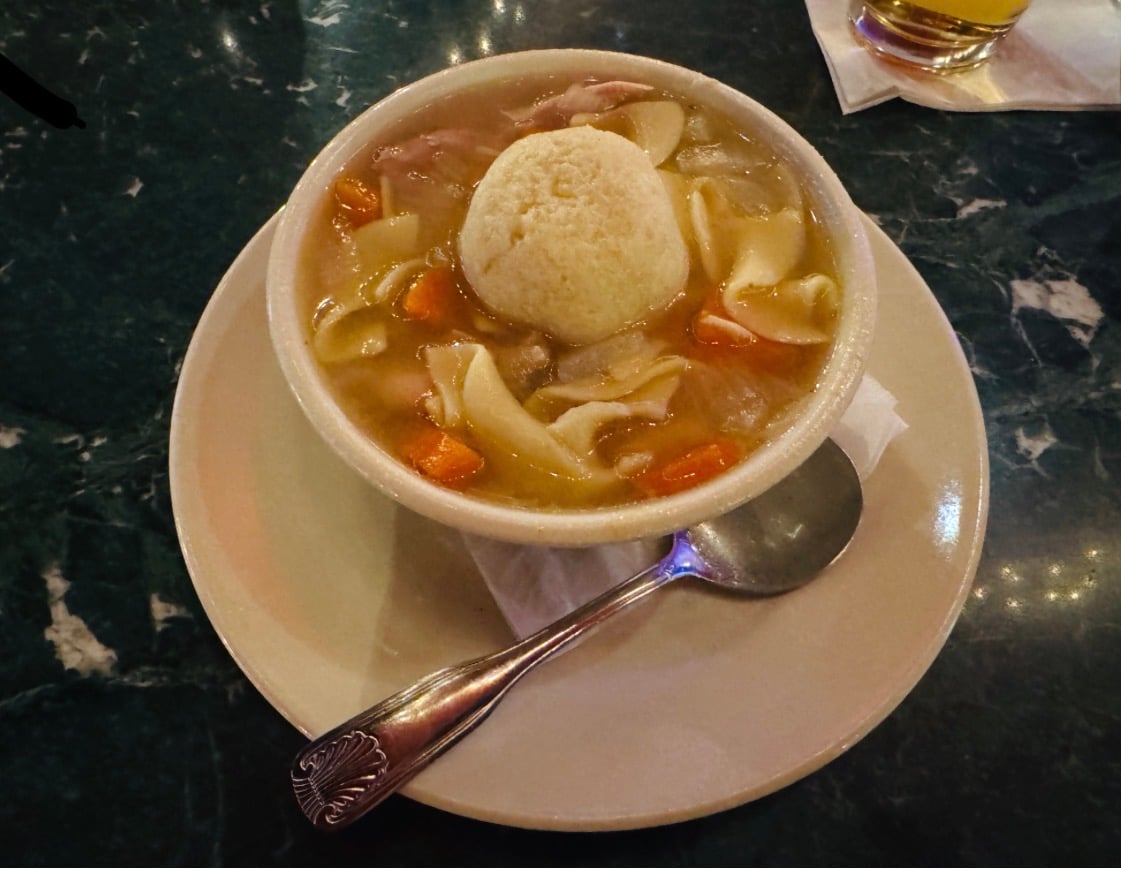
Jewish thanksgiving with Matzah ball soup. Wikimedia.
I was sure Thanksgiving had to be a Jewish holiday. I grew up in an observant Jewish home, and for those first few years, it had to be explained to me over and over that Thanksgiving was an American holiday. I still had to keep kosher, so I could only eat Thanksgiving dinner at someone else’s house if they kept kosher, too. I hated that rule.
I was often invited to my non-Jewish friends’ homes for Thanksgiving. That I couldn’t go made me feel different, like I wasn’t 100 percent American. Kashrut was sometimes a social obstacle in my small world. Nevertheless, I’m glad that I had that feeling growing up. It taught me that difference is part of America. The way we celebrated Thanksgiving drove that home for me, from what we ate to what we talked about.
We serve Cornish hens at our Thanksgiving dinner. No turkey. We have matzoh ball soup, kugel, egg noodles, hard-boiled eggs, salad, nondairy pumpkin pie, and nondairy apple pie. No cranberry sauce or stuffing. It’s a Jewish Thanksgiving.
What’s it like being Jewish at Thanksgiving in America? For many of us, it’s our favorite American holiday. We love it! We’re invited to other people’s houses, and we invite non-Jews to ours. Thanksgiving and the Fourth of July are occasions when we feel at home in an American tradition. We embrace these holidays, and in celebrating them in our own way, we feel embraced by them.
When you grow up in an observant Jewish home, the holidays you celebrate around the table are usually Jewish. Thanksgiving is an American holiday, and at our house it feels as natural to sit down to that meal as it does to sit down to any of our holiday meals. Some of the food is the same, too.
At our Thanksgiving table, we talk about what happened to the people who were already here, countering what I was taught in school with many other Jewish kids, that it was a happy, thankful meal with Native Americans and the near starving newly arrived colonists. That familiar story leaves out what happened to Native peoples. Since 1970, Indigenous people and friends have gathered to observe a National Day of Mourning and honor Indigenous ancestors on Cole’s Hill in Plymouth, Massachusetts, overlooking Plymouth Rock.
When Jews elsewhere wonder about our standing in this country, Thanksgiving shows that we are Americans, Jewish ones. Sadly, many Jewish tables this Thanksgiving will talk about rising antisemitism in the United States and how unwelcome it makes us feel, echoing some feeling from childhood. Those aren’t easy discussions. That’s why Thanksgiving matters so much this year. For a day or two, it reminds us who we are and that we belong here.
I often speak about Israel. In some of the political activist groups I’ve been part of, I’ve been questioned as if I personally had to answer for Netanyahu. In those conversations, I felt as though some Christians and post-Christians were asking me, as a Jew, to answer for a history of Christian colonialism they wanted to distance themselves from. It made me feel as though my standing as a fellow citizen was conditional because I’m Jewish. I know other Jews who have felt that way, too.
But like last year and the year before and the year before that, we will sit down with family and friends, pass the kugel, and feel at home. There’s room at that table for Americans of every creed, religion, and ethnicity. That’s one of the things I love about Thanksgiving.