
An Aging Jewish Feminist
Assembling the Entire Community: Va-Yakhel/Pekudei
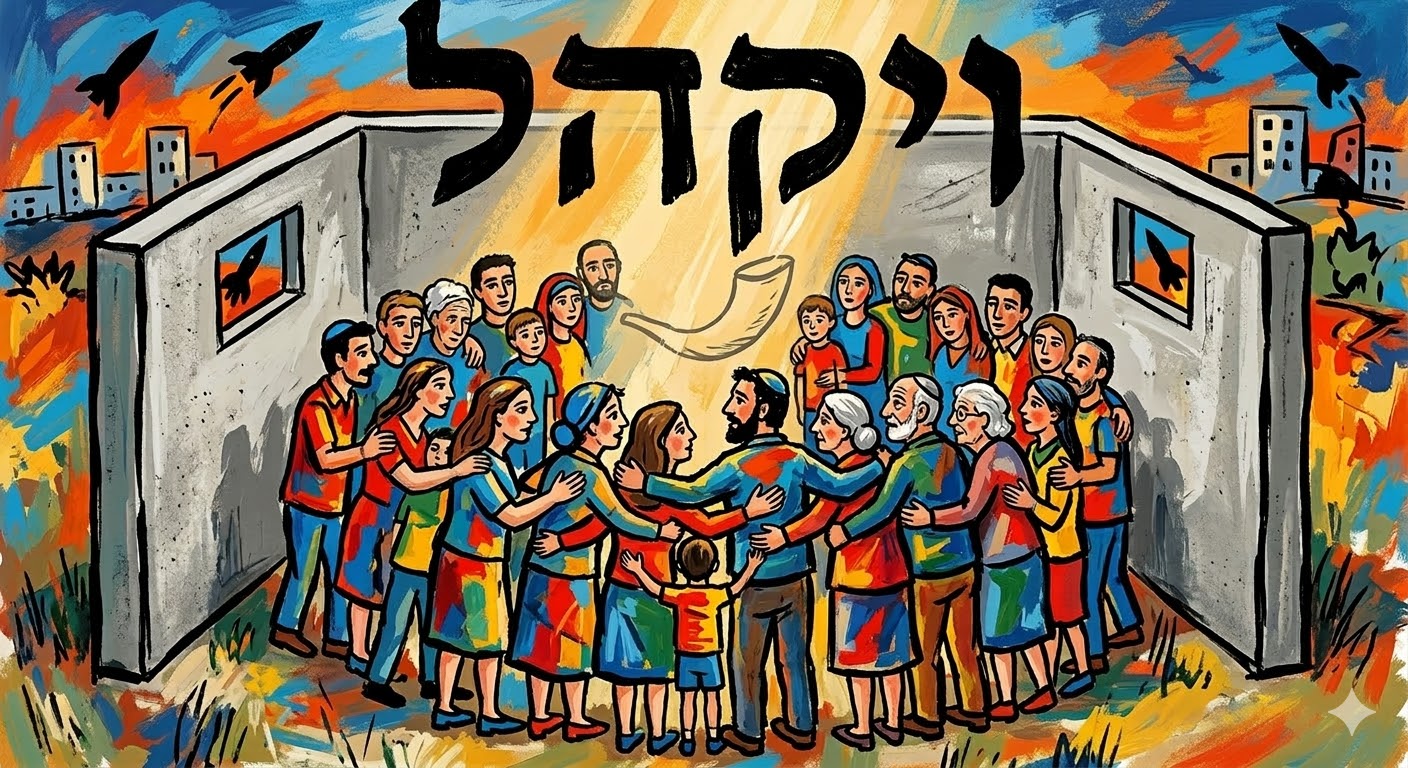
The irony of this week’s double parsha is not lost on me. I am writing these words from the mamak—the merhav mugan komati, the safe room on my floor. Each floor in our building has three such shelters, which must make where I live one of the safest places in Israel. Here we are, “assembled” again and again—morning, night, and sometimes at four in the morning—each time the sirens send us running to the safe room. Over this week we’ve learned each other’s names, our children’s and grandchildren’s stories, what we did before retirement. There are no secrets here when you’re bonding under fire. And just as suddenly as we gather, the alert ends and we disperse—only to reunite hours later for yet another impromptu assembly.
With this in mind, the opening words of Va-Yakhel strike me as both deeply timely and painfully ironic:
“And Moses convoked/gathered/assembled (vayakhel) all the community of the Israelites and said to them: ‘These are the things that the LORD has charged to do. Six days shall tasks be done, and on the seventh day there shall be holiness for you, an absolute sabbath for the LORD. Whoever does a task on it shall be put to death. You shall not kindle fire in all your dwellings on the sabbath day’” (Exodus 35:1–3).
The Or HaChaim (Chaim ibn Attar,1696–1743) offers several reflections on these verses. He notes that work performed during the six days should not only be permitted but viewed as a mitzvah; that one who sanctifies the Sabbath can trust that their weekday labors will be blessed; and that the success of our work depends on our observance of the holy day. “The Sabbath,” he writes, “is the soul of the world.”
Today, in Israel, where fears of religious coercion run deep, it’s sobering to read a verse that prescribes death for Sabbath violators. One shudders to think what might happen if a zealous leader–and there are too many of those around today in our part of the world–were to take such words literally. Yet other voices remind us that pikuach nefesh docheh et haShabbat (BTYoma 85b)—saving life overrides the Sabbath. In times like these, that principle resonates deeply: many observant Jews feel it is their moral duty to keep their phones on, especially when loved ones are serving in the front lines, or living in areas where missiles are landing.
GATHERING AND UNITY
Before the war, we too were an assembled people—protesting, marching, and arguing weekly in city squares across the nation. Robert Alter points out that the phrase “Moses assembled all the community” reverses the earlier “the people assembled against Aaron” (Exodus 32:1). Then, assembling led to chaos (the golden calf); now, it is for divine purpose.
Today, remarkably, we again gather—but this time in unity. People who once distrusted each other now cooperate instinctively, donating blood, bringing goods to people whose homes have been destroyed, standing together for the soldiers. It recalls the Israelites bringing their gold offerings for building the Tabernacle—each person contributing freely from the heart.
Yet Alter’s closing words on these double portions echo ominously for our own times. He reminds us that even as the Israelites finished building the Tabernacle—a moment of harmony and achievement—they still faced “a destiny of wandering through arduous wasteland toward a promised land not yet visible.” Our journey, too, feels unfinished, our unity fragile, our horizon uncertain.
PEKUDEI: COMMAND AND OBEDIENCE
When we return the Torah scroll to the ark, we sing the verse every Jewish child knows:
“Torah tzivah lanu Moshe, morashah kehilat Yaakov” — “The Torah that Moses commanded us is the heritage of the congregation of Jacob” (Deuteronomy 33:4).
And in Pekudei, the phrase “as God commanded Moses” appears eighteen times. In the portion (Tetzaveh) before the Golden Calf, Moses’s name was not mentioned. Who truly commands—God or Moses? Who leads—the divine, or the human intermediary? These questions feel especially alive in today’s political climate, both here and abroad, where authority and power are constantly in tension.
Nachmanides (Ramban 1194-1270) praises Bezalel, the artisan, for intuitively understanding God’s will as Moses had received it. Bezalel’s wisdom was such that even when Moses reversed God’s order of instructions, Bezalel followed the divine plan as originally intended.
Rashi, by contrast, says the repetition of “as God commanded Moses” in this week’s parsha, serves to remind us that Moses took no credit for himself.
Rabbi Zalman Sorotzkin (1880-1966) in his commentary Oznaim Latorah adds that this constant repetition in Pekudei corrects for Moses’s absence in the previous parasha, Tetzaveh, where his name is conspicuously missing. Together, these readings highlight a crucial point: repetition safeguards against idolatry of the leader. If the text did not stress that all was done “as God commanded Moses,” people might begin to see Moses himself as divine. Perhaps this is also why his burial place remains unknown—to prevent hero-worship from hardening into faith misplaced. And let’s not forget that when Moses disappeared for forty days, the people felt as if God abandoned them and that’s why Aaron made them another God to replace Moses.
Perhaps it is necessary, to repeat the phrase “As God commanded Moses” 18 times at the end of the book of Exodus. Yet, we sing Torah Tzivah Lanu Moshe –Moses is the one who commanded the teachings (torah) to us–when we dress the Torah scroll after reading it. Surely, we all are living in a world where it is dangerous to have popular leaders commanding us and changing the game, as they grab power which they should not have.
STRENGTH AND UNCERTAINTY
As we reach the end of Exodus, we proclaim together, “Chazak, chazak, ve-nitchazek”—be strong, be strong, and may we be strengthened. Strength, in this moment, feels like resilience born of community.
Sitting again in the mamak, I wonder how long this unity will last once the immediate danger subsides. Will we return to the verbal stone-throwing that has scarred our society for so long For now, though, we are a kehillah—assembled, gathered–held together by shared fear but also by shared purpose. May we stay that way even when the sirens stop.
Related Topics
Related Posts