An Aging Jewish Feminist
At Eighty-Three: Choose Life, Not Certainty
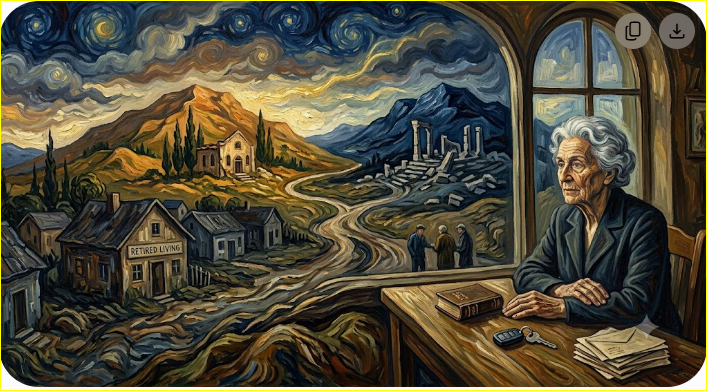
When I turned eighty, I wrote that it was a moment of truth. Today I turn eighty-three. What is different this time? At eighty-three, the truth is harder—and less comforting.
This is the first birthday I I am spending without friends or family. I am in a new home, where no one knows that today is my birthday. Around me, everything feels marked by age: First of all, the retirement village I am living in. Second, all of my closest friends are old. the house I am selling, even my car is old. Aging is no longer something I reflect on—it is the condition of my life.
And yet, what set me thinking this week was not only my own age. A friend of mine recently celebrated her bat mitzvah at eighty-three, making up for what she never had as a girl. It made me reflect on my own passage of time—not as a single event, but as an accumulation of blessings and losses.
This week’s parsha, Re’eh, begins with a stark formulation: blessings and curses are placed before us, on separate mountain: “See, I set before you today a blessing and a curse.” But life, as I have experienced it, is not so neatly divided. Blessing and curse are intertwined. The loss we experience as we age can feel like a curse, yet it also brings perspective. Even death—so often feared—can be a release when suffering becomes unbearable. The Torah’s neat categories collapse under the weight of lived experience.
Much has changed since I turned eighty, especially my move to protected, independent living. At the time, I wrote that my priorities were shifting: I had less patience for nonsense, less tolerance for hypocrisy, especially in the political sphere. That has not changed. If anything, it has intensified. When I see the brazenness of leaders who act without shame, I wonder: what is left that can still shock me? Reading recent public statements in which religious language is used to make sweeping claims about the relative value of human lives or someone invoking the Bible to claim that one Jewish life is worth millions of Palestinian lives is no longer considered newsworthy. Whether one agrees or disagrees with the political context, such rhetoric raises difficult questions about how sacred texts are understood and applied.
Parshat Re’eh itself contains passages that are not easy to read. Before the Israelites even settle the land, they are commanded to destroy: tear down the altars, smash the sacred sites. Not negotiate. Not understand. To erase the forms of worship of those who lived there before them. We often interpret these passages historically, as part of an ancient context very different from our own. And yet, these texts remain part of our tradition, and they continue to challenge us. Interestingly, the Torah seems to acknowledge the limits of total erasure. Even after the nations are supposedly wiped out, the Israelites are warned not to inquire about their practices—as if the other still exists, lurking, tempting, threatening. You cannot erase a people and then pretend they were never there.
The parsha also introduces the idea of centralizing worship in one chosen location. This too has consequences—economic, social, and political. A priestly class will emerge. Power will concentrate. Pilgrimage will reshape society. And, inevitably, the sacred center itself risks becoming an idol.
These biblical structures are not abstract. Their echoes are with us still. We live in a world shaped by absolutist thinking—by the desire to separate blessing from curse, good from evil, us from them. But such clarity is often illusory, and its consequences dangerous.
We are living in a moment when moral certainty has become a substitute for moral responsibility. Everything is framed as absolute: absolute justice, absolute victimhood, absolute righteousness. There is no room for ambiguity—only for slogans.
There is tension everywhere—within society, within politics, within ourselves. We may feel that we have avoided catastrophe, but nothing has truly been resolved. The sense of waiting, of suspended dread, persists.
At the same time, we see the human cost more clearly than ever. Soldiers return from war carrying visible and invisible wounds. The number seeking psychological help has skyrocketed. Trauma does not end on the battlefield; it follows people home, into their families, into their lives. This is what we now call moral injury— the rupture that occurs when a person’s actions, or even their survival, violate their own moral framework. This is not weakness. It is the human conscience refusing to be silenced.
Parshat Re’eh, read honestly, is not a comfortable text. It forces us to confront the consequences of absolute thinking—the danger of dividing the world into pure blessing and pure curse, pure good and pure evil.
And now we stand at another threshold: moving from the month of Av into Elul, the season of selichot— a period traditionally devoted to introspection and forgiveness. But forgiveness for what? Are we truly sinners, or simply human beings who fall short, who act imperfectly in an imperfect world?
We recite long lists of transgressions, confessing collectively. Some are serious; others are almost trivial. At times, it feels as though we have created a culture of guilt. We say “we have sinned” so often that the words lose meaning. Meanwhile, the sins that actually matter—the ones that shape lives, policies, and moral realities—remain largely unspoken. It is easier to confess to minor failings than to confront the systems we sustain and the ideologies we justify.
And yet, introspection is necessary. We have to figure out how to balance with compassion, honesty, and with a recognition of our own humanity. Perhaps this is the real challenge of this season: not only to ask forgiveness, but to affirm life. Not only to examine our failures, but to acknowledge our capacity for growth, for joy, for connection.
The Torah ultimately offers not a simple division between blessing and curse, but a call to awareness: “Choose life.”
At eighty-three, I understand this differently than I did before. Life is not pure blessing, nor pure curse. It is a mixture—fragile, complicated, and precious.
And in that mixture, we are still asked to choose. But what if the real danger lies in believing that the choice is simple? That we can clearly separate blessing from curse, good from evil, us from them? Because once we believe that, we can justify almost anything. It is easier to ask God for forgiveness than to ask hard questions of ourselves.
At eighty-three, I am no longer interested in that kind of religion. I am not interested in a Judaism that teaches me to say “I am guilty” while ignoring the real sources of harm around me. I am not interested in texts that are treated as sacred when they comfort us yet ignored when they challenge us. And I am certainly not interested in a political culture that uses those texts to justify dehumanization.
“Choose life.”
Not “choose power.”
Not “choose certainty.”
Not “choose superiority.”
Choose life.
If that command means anything, it must mean rejecting the idea that one life is worth more than another. It must mean confronting the parts of our tradition that have been used to justify violence—and refusing to let them define us.
At eighty-three, I have fewer illusions. I no longer believe in clean moral categories, and I no longer trust easy answers. But I still believe in the necessity of choosing. At eighty-three, I am still learning what that choice requires
Related Topics
Related Posts