
Author David Margolick Sets His Majestic Sights on the King of Television Comedy
Margolick’s newest book published Nov. 11 is a biography of trailblazing comic icon Sid Caesar and includes rare interviews with Mel Brooks and Woody Allen – “a slice of American Jewish cultural history.”
By Allan Ripp

NEW YORK – From his bright, plant-filled “tiny” two-bedroom apartment on West 68th Street in Manhattan, David Margolick has a picturesque view of water towers, brownstone rooftops and backyard gardens, with an open sky and the landmarked Majestic co-op apartment house a few blocks away, completing what he calls “my generic postcard perspective of New York.”
To run into Margolick on Columbus Avenue or Broadway is likewise to encounter a classic Upper West Side traveler, his arms laden with bags from Zabar’s or Fairway and perhaps a giant sack of planter’s dirt. Often shouldering a backpack and with a mop of silver hair, he looks like an aging grad student, when in fact he’s one of America’s preeminent journalists and nonfiction writers.
Over a prolific, if unsplashy career spanning nearly 50 years and four Pulitzer nominations, Margolick has done it all, with an extensive highlight reel. A onetime reporter for the National Law Journal and American Lawyer, he spent 15 years as a metro and legal affairs correspondent for the New York Times, creating a must-read weekly “About the Bar” column and covering headline stories including the O.J. Simpson trial (he earned his J.D. from Stanford Law).
It was the Simpson assignment that in 1996 led to an offer by Vanity Fair editor Graydon Carter to become a contributing writer, with Margolick given ample time (and expense account) to turn in four pieces a year for two decades – long-form gems including award-winning coverage of the Bush v. Gore election recount litigation as well as one of the first in-depth profiles of Israel’s Benjamin Netanyahu in 1996, before he was Prime Minister (he wrote another in 2012). Other profiles included Ariel Sharon, legal lion David Boies (“The Man Who Ate Microsoft”), Tony Blair, disgraced lobbyist Jack Abramoff and a pre-scandal Eliot Spitzer.
In between his magazine work, he’s regularly churned out book reviews, essays, op-eds and even obituaries for the Times, Wall Street Journal, both the New York and London Review of Books and elsewhere, on recurring themes such as Supreme Court showdowns, Jewish intellectual history, civil rights and baseball (Margolick grew up a Red Sox fan in Northern Connecticut – check out his recent guest essay in the Times deriding Yankees fans).

He’s also authored nine books, from his dive into the epic probate contest between heirs to the Johnson & Johnson fortune (Undue Influence, published in 1993) to a “biography” of the haunting Billie Holiday anti-lynching ballad Strange Fruit (2001), the latter growing out of a Vanity Fair feature. Beyond Glory (2002) traced the parallel histories of boxing legends Joe Lewis and Max Schmeling against the gathering storm preceding World War II, while Elizabeth & Hazel (2011) filled out the story of two young women – one black, the other white – famously photographed during the forced integration of the Little Rock public schools in 1957.
No matter the topic, even when discoursing on arcane areas of the law, Margolick is incapable of writing anything but fluid, coherent and enjoyable prose.
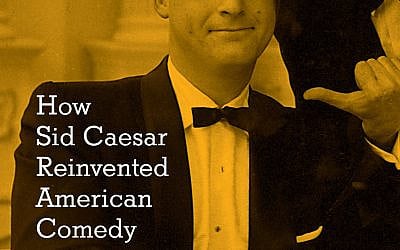
Now comes his latest title from Schocken/Penguin-Random House, published Nov.11. It’s a biography of pioneering television comic Sid Caesar, whose Your Show of Shows and Caesar’s Hour helped launch the writing careers of Neil Simon, Mel Brooks, Larry (M*A*S*H) Gelbart and Woody Allen, and whose push-the-envelope style of ensemble sketch comedy helped birth Saturday Night Live.
The 400-page When Caesar Was King actually dates to 2000 when Margolick attended a testimonial dinner emceed by Alan King honoring the original King of TV Comedy. But it wasn’t until 2008 that he signed on to do a book, originally conceived for a series called Jewish Encounters.
“There are so many facets of Jewish life that are sad and agonizing – I wanted something that would make me laugh,” he recalls. “Groucho Marx was taken so I picked Sid Caesar. Little did I know then that his life had a lot of darkness in it.”It was also a life fairly unexamined. Although he died at 91 in 2014, Caesar had long been out of the public eye. Margolick first remembers seeing his subject as a flummoxed dentist chasing fortune in It’s a Mad, Mad, Mad World (1963) and later as the goofus athletic coach of Rydell High in the 1978 movie version of Grease.
“I thought, what’s the big fuss? I knew about Your Show of Shows but it was never syndicated like I Love Lucy or Dick Van Dyke,” he explains. “It was only when I started going back to the old broadcasts that I realized what a legend and comic genius he was, a master of facial pantomime, pidgin languages and brilliant characters. He was lionized by the people who worked with him and those who’d been exposed to his prime output in the 1950s. Mostly embraced by comedy nerds in recent years, Sid was a towering figure who’d largely become forgotten.”
Margolick had two extended interviews with Caesar in 2008 – he was by then generally confined to bed at his home in Beverly Hills, wearing a gaping hospital gown that would have made for a great bit back in the day, perhaps with sidekicks Howard Morris as the batty doctor and Imogene Coca playing the prying nurse.
“He’d lost a lot of weight and energy from so many years abusing pills and alcohol,” Margolick shares. “He wasn’t funny anymore but his head was clear. I knew I had to get to him fast before he lost it all. I was able to capture everything on an old-fashioned cassette recorder.”
He also landed rare interviews with some of Caesar’s former accomplices, notably Carl Reiner, Woody Allen and Mel Brooks, along with disciples Billy Crystal, Conan O’Brien and Al Franken. Franken recalled once being complimented by a German ambassador for his spot-on German accent in an SNL skit, which Franken confessed he channeled from Caesar’s Spreken ze Deutsch double-talk on Your Show of Shows.
Concerned that Allen and Brooks might shortchange him when they spoke – “as if they were double-parked” – Margolick encountered the opposite. “Both Woody and Mel were profoundly indebted to Sid and wanted to acknowledge how important he was to their careers,” he says. “Mel in particular freely admitted, ‘No Caesar, no Brooks.’” (Margolick believes Brooks’ oft-told account of being dangled outside a hotel window by the much larger Caesar during an argument was “highly embellished.”)
Allen, who joined Caesar’s writers’ group near the end of its run, tells a story about collaborating with Brooks and Emmy-winning writer Mel Tolkin for one surefire segment, “and some network apparatchik thought the bit needed a laugh track,” Margolick cracks, as if.

Curious viewers can YouTube their way to some of Caesar’s classic routines including “The Commuters,” “The German General,” “The Italian Chef” and “This is Your Life,” a 1954 11-minute send-up of sappy reunion shows popular at the time that Margolick calls “the longest continuous laugh ever aired on TV.” But to mine the larger lode of Caesar gold he watched hundreds of hours of material split between the Library of Congress, the Paley Center for Media on West 52nd Street, (formerly the Museum of Broadcasting) and UCLA, which houses Caesar’s personal collection of tapes dating from the late 1940s.
“You come away appreciating what a highwater mark those early days were in the history of television, and a precursor to the great era of mediocrity that followed,” Margolick says, adding that both the Paley Center and Film Forum have scheduled selected showings of Caesar’s sketches in November and December, plus Q&As with the author.
“TV in the late 40s and 50s was confined to a few markets like New York, while programming was created for a sophisticated audience by highly urbane – mostly Jewish – writers and performers,” he continues. “It wasn’t long before the networks lowered their sights to appeal to the ‘common denominator’ in the hinterlands, with shows like Gomer Pyle and Beverly Hillbillies.” He points out the irony that Caesar’s Saturday night slot on NBC was essentially knocked off by Lawrence Welk, whose square polka parties on ABC began to draw higher ratings.
“It didn’t help that Sid kept doing take-offs of Welk’s show – he was trying to fight against where the medium was headed,” he adds.

For the record, Margolick does not write at a “glacial pace” – in fact, he produced three other books while plugging away at the Caesar project. One of those was The Promise and the Dream (2018), another of his two-track biographies examining “the untold story of Martin Luther King, Jr. and Robert F. Kennedy.” But he avows that his latest work is his most personal.
“It’s a slice of American Jewish cultural history that means a lot to me,” he says. “I grew up and reveled in that world and still feel the connection strongly. Writing about Sid felt more of an extension of who I am than previous books.
Approaching 74, Margolick isn’t quite done with famous Jews from the 1950s. With Caesar finally completed, he’s focusing on another long-gestating book, about renowned “miracle worker” virologist Jonas Salk, who in 1952 developed the first safe polio vaccine, which went into widespread inoculation in 1955. (Caesar makes a cameo here as well, as the two icons of medicine and mirth met by chance, Woody Allen-like, at a Chinese restaurant in Paris.)
Commissioned by Yale University Press as part of its Jewish Lives series, the Salk book is expected to publish later in 2026. If he gets stuck while writing at the desk in his West 68th Street study, Margolick knows just where to turn for inspiration.

Allan Ripp runs a press relations firm in New York.