Bratslav Tailors
Bratslav Tailors — בראַסלעווער שנײַדערס
The Shoah destroyed not only Jewish worlds, but many of the people who should have taught us how to inherit them.
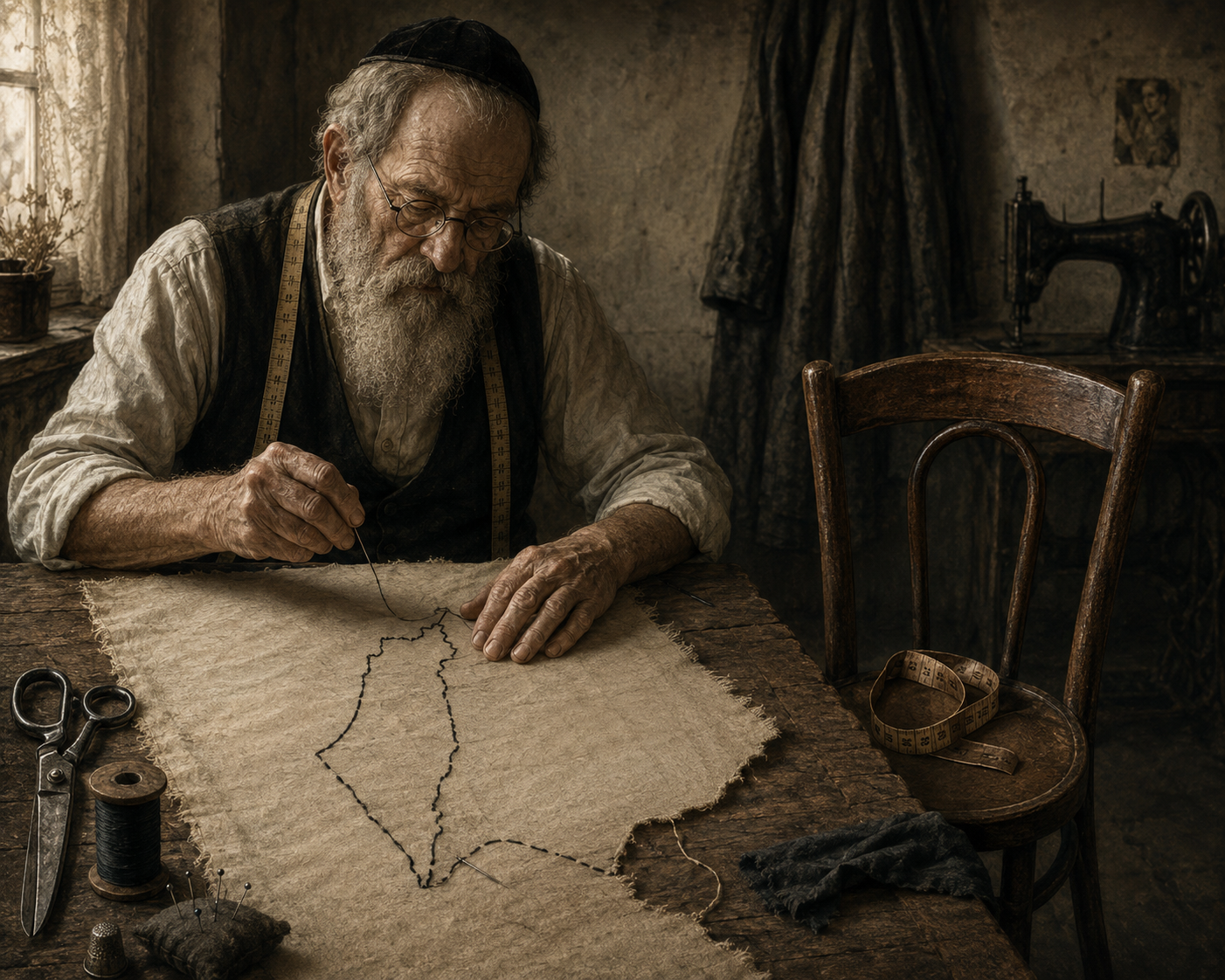
The tailors of Bratslav are gone.
This does not depend on whether we can recover every name, identify every workshop, or prove that each remembered figure belonged to a municipal register. A world can disappear more completely than its inhabitants can be individually documented. The absence is not made less real by the incompleteness of the archive.
They are gone: the men and women who cut cloth, threaded needles, measured bodies, bargained over prices, trained apprentices, closed their workshops before Shabbat, repeated familiar jokes, and argued about matters now impossible to reconstruct. The world in which those gestures were mutually intelligible is gone with them.
To say that they were tailors is already to say more than that they made clothes. A craft joined a hand to a tool, a household to an income, an apprentice to a master, and a Jewish vernacular to the ordinary judgments through which work became recognizable as well or badly done. A sewing machine could mean the fragile possibility of marriage, a home, and a future. The possession of a craft could be the last available claim to dignity in a society prepared to deny it.
The workshop was not merely a room. It was a relation.
There are catastrophes that destroy lives, and catastrophes that destroy worlds. The Shoah did something still more difficult to describe: it damaged the conditions under which a destroyed world could be inherited.
This question has acquired renewed urgency since October 7. Jewish communities are again debating security, vulnerability, sovereignty, memory, and the meaning of “Never Again.” Yet these debates often assume that the central inheritance of the Shoah is a lesson that can be translated into policy: defend yourselves, trust no one, recognize danger early, preserve Jewish power.
Those lessons may be necessary. But something more fundamental was lost.
Millions of Jews were murdered. Among them were the parents, teachers, rabbis, skeptics, artisans, workers, neighbors, eccentrics, rivals, and adversaries who should have transmitted the internal differences of Jewish life to those who came after them. Languages disappeared. Local forms of study, humor, authority, irreverence, ritual, argument, work, and ordinary recognition vanished with their speakers.
What survived was therefore not simply a diminished tradition. Jewish communities inherited the absence of those who should have taught them how to inherit.
Inheritance is often imagined as a bridge between a world that existed and those who come after it. But after the Shoah, the bridge was not merely broken in the middle. One of its banks had disappeared.
Texts, names, objects, photographs, melodies, recipes, and practices remained. Yet much of the living world that had given them density and internal reference had been annihilated. The object survived, but not always the gesture by which it was handled. The melody survived, but not the room in which its meaning was understood. The sentence survived, but not necessarily the voice capable of distinguishing tenderness from irony, authority from parody, devotion from habit.
A document can establish that someone lived. A photograph can preserve a face. Testimony can identify a place, a name, a transport, a hiding place, or a moment of destruction. But none can restore the obligations, quarrels, tonalities, silences, expectations, and minor recognitions through which a person once belonged to a world.
This does not diminish testimony. It establishes its gravity. The greater its precision, the more clearly testimony demonstrates that accuracy is not restoration. It prevents the rupture from being denied. It cannot make the rupture disappear.
Memory may allow a destroyed culture to persist and continue to act. But persistence is not yet inheritance. Memory can preserve traces. Inheritance requires a relation in which distinctions can be demonstrated, disputed, corrected, and passed on.
The missing teacher is not one more missing item in the archive. The teacher is the missing relation through which the archive becomes usable.
A pattern may survive without the knowledge of how the cloth should be cut. A recipe may survive without the judgment of when the dough is ready. A melody may survive without the ear capable of recognizing when reverence has become parody. A religious practice may survive while the arguments that once limited, complicated, or redirected it have been forgotten.
The destruction therefore affected not only what could be transmitted, but the conditions of transmissibility themselves.
For this reason, post-Shoah Jewish disorientation cannot be adequately described as an identity crisis. It is a crisis in the conditions of transmissibility.
An identity crisis suggests uncertainty about self-definition. It implies that a community no longer knows who it is and therefore requires a stronger narrative, better education, renewed affiliation, more persuasive institutions, or more emotionally compelling symbols.
The problem is deeper. The destruction damaged the place from which Jewish life could once be transmitted without first being translated into a declaration of identity.
A form of life does not exist merely because its members can define it. It exists because it transmits distinctions, obligations, rhythms, limits, habits of attention, forms of disagreement, and ways of recognizing what matters without having to explain everything from the beginning.
When that capacity is damaged, self-description expands. A community begins to speak more insistently about who it is because the conditions under which it could simply continue to be have been fractured.
Identity becomes loud when transmission has become uncertain.
This helps explain the ease with which Jewish life now enters ready-made political and cultural narratives.
In the diaspora, Jewishness may be translated into liberal universalism, conservative patriotism, progressive activism, religious revival, therapeutic vocabulary, educational programming, or communal resilience. In Israel, it may be translated into sovereignty, security, military obligation, religious exemption, demographic continuity, settlement, national technology, or historical return.
None of these forms is necessarily false. Each may contain courage, intelligence, necessity, loyalty, or responsibility. The danger begins when one surviving fragment claims to have restored the whole.
The state may present sovereignty as repaired continuity. Religion may present itself as an untouched refuge. Political affiliation may become a substitute for inherited form. Memory may be treated as a certificate of moral authority. Survival may be presented as proof that everything essential survived.
But sovereignty cannot recreate murdered communities. Security cannot restore destroyed languages. Ritual cannot recover those who would have disputed its interpretation. A flag cannot return the tonalities of a vanished neighborhood. Memory cannot replace those who should have taught the next generation how to remember.
A state may gather fragments, defend lives, build institutions, teach texts, and sustain Jewish existence. It cannot declare itself the completed form of Jewish inheritance.
The inheritance after catastrophe is therefore double. There are texts, practices, names, institutions, obligations, and fragments that survived. There is also the absence of those who should have transmitted what did not.
This is why “Never Again,” however necessary, cannot carry the entire meaning of the Shoah.
“Never Again” is directed toward the future. It demands vigilance, defense, resistance, and the refusal of renewed dehumanization. Its moral force must not be weakened. Jewish vulnerability is not imaginary, and the need to defend Jewish lives did not disappear with the establishment of Israel.
But prevention cannot repair transmission. Military power cannot return a murdered world. The capacity to survive another attack does not mean that the damage to continuity has been overcome.
Since October 7, this distinction has become especially difficult to preserve. The massacre was real. Jewish fear is real. The persistence of antisemitism is real. The responsibility of a state to protect its citizens is real.
Precisely because these realities are not inventions, they do not require mythology for their defense.
Memory must not become an instrument that automatically validates every action undertaken in the language of survival. Historical vulnerability cannot become permanent moral innocence. The absence left by the murdered cannot provide immunity from criticism, erase the suffering of others, or transform every exercise of power into an act of remembrance.
To use the Shoah as an argument that ends every argument is to convert the murdered into political capital.
Yet the opposite demand is equally false. To tell Jews to “move on,” “normalize,” or treat the Shoah as an ordinary historical memory is to assume the authority to decide how long a destroyed structure of inheritance may remain consequential. It appropriates absence by declaring that its political, ethical, and psychological effects have lasted long enough.
One position appropriates the dead for present power. The other appropriates their absence in the name of historical closure.
An honest language must refuse both.
It must refuse to speak in the name of all Jewish pain. It must refuse to sentimentalize that pain or transform it into innocence. It must also refuse the comforting fiction that history becomes past merely because decades pass.
There is no single Jewish response to this inheritance. Survivors, descendants, Israelis, diasporic communities, religious Jews, secular Jews, converts, and Jews whose families entered Jewish life through different histories do not carry the same absence in the same way.
The destruction itself was not evenly inherited. Some families retained language but lost place. Others retained ritual but lost interpretation. Some inherited names without stories, stories without names, photographs without voices, or practices whose internal disputes had vanished. Others entered Jewish life later and encountered the rupture not as family memory but as an already structured absence within the community they joined.
No biography grants sovereignty over the dead. No government, rabbinate, museum, political camp, or communal institution can claim to embody everything that was lost. No single arrangement of Jewish life possesses the completed meaning of Jewish continuity.
The difficult task after the Shoah is therefore not to reconstruct a complete Jewish identity. It is to recognize that not everything can be reconstructed, and that a continuity declaring itself complete may itself become a form of forgetting.
Jewish communities can build, defend, study, argue, celebrate, govern, dissent, migrate, return, and begin again. None of these acts becomes false because the rupture remains. But none abolishes the rupture either.
Continuity does not require the denial of rupture. It requires the refusal to falsify it.
The tailors of Bratslav will not return because we invoke their memory. Their workshops may be reconstructed as rooms, inventories, photographs, museum displays, or works of art. They cannot be restored as worlds.
Even the most faithful reconstruction remains a reconstruction of relations whose internal recognitions are no longer fully available to us. We may reproduce the tools, recover the names, imitate the cuts, and preserve the surviving garments. We cannot restore the moment in which an older hand interrupted a younger one before the cloth was cut incorrectly.
What was destroyed was not only knowledge. It was the living possibility of correction.
Our obligation is therefore not to pretend that we have restored what was destroyed. It is to inherit without claiming possession, to continue without declaring the rupture closed, and to resist every politics, religion, or morality that presents one surviving fragment as the whole.
The Shoah did not leave Jewish life only with memory. It left it with the absence of those who should have taught the next generation how to inherit.
Fidelity begins by refusing to falsify that absence.
Yochanan Schimmelpfennig