


Aviva Siegel Survived to Tell: We Need to Listen
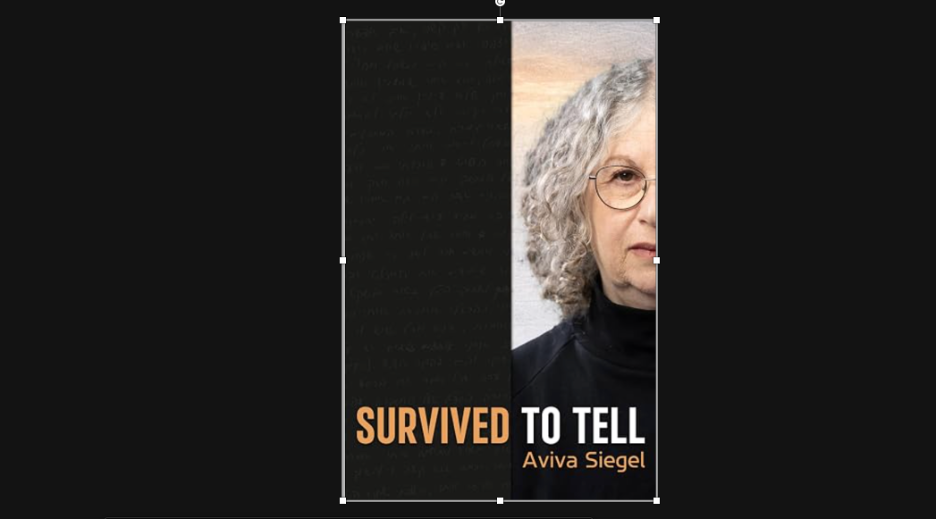
Aviva Siegel’s Survived to Tell is an extraordinary book: harrowing, courageous, deeply humane – and one of those rare works that I believe Israelis, and Jews everywhere, have a responsibility to read. Indeed, anyone who seeks a better future for Gaza, who wants to understand the nature of terror and what happened on October 7 and its aftermath, would be well advised to read this important book.
There are many wonderful things about belonging to an ancient people. There are also responsibilities. One of them is the obligation to bear witness.
The Book of Deuteronomy (4:9) commands: “Take utmost care and watch yourselves scrupulously, so that you do not forget the things that you saw with your own eyes.” It then adds an equally important instruction: “Make them known to your children and to your children’s children.”
The original context is the revelation at Mount Sinai. But the underlying principle is deeply embedded in Jewish tradition: memory is not simply an intellectual exercise. It is a moral responsibility.
That is why every Tisha B’Av we read the Book of Lamentations and remember the destruction of Jerusalem. It is why every Passover we tell our children about an exodus that took place thousands of years ago. It is why Zikaron BaSalon – intimate gatherings where Holocaust survivors share their stories – has become such a meaningful Israeli institution.
Three years after October 7, 2023, we have only begun to develop the rituals through which this generation’s catastrophe will enter our collective memory. But it starts with testimony: listening to those who were there.
That is the first reason Aviva Siegel’s memoir matters so much.
On October 7, Hamas terrorists abducted Aviva and her husband Keith from their home in Kibbutz Kfar Aza. Aviva spent 51 days as a hostage in Gaza. After her release, she spent another 433 days fighting for Keith’s freedom. Her book tells us what those 51 days as a Hamas prisoner were like.
To be perfectly honest, part of me did not want to know.
Like so many Israelis, after October 7 I attended too many funerals, watched too many grieving families on television, and spent too many Saturday evenings demonstrating for the return of the hostages. For a long time, Israel seemed trapped in a kind of national purgatory – a paralysis of grief, anger, guilt and helplessness. Eventually, emotional exhaustion sets in. Now, when there is finally a measure of respite, who wants to go back?
Aviva’s book reminded me that bearing witness does not require us to remain permanently immersed in grief. But it does mean we cannot simply turn away because remembering has become uncomfortable.
Show, don’t tell
When I was in high school in North Carolina, I had an exceptional English teacher whose mantra for a rather opinionated and excessively wordy teenager was: “Show! Don’t tell!”
It remains the best writing advice I ever received. It is one reason The Diary of Anne Frank and Elie Wiesel’s Night allow us to apprehend a small corner of the Holocaust experience.
And it is one of the great strengths of Survived to Tell.
Over the book’s 200-plus pages, Aviva does not spend much time telling us what captivity means. She shows us, in extraordinary and at times excruciating detail.
She remembers the card games played to pass the time; the condition of the hostages’ hair and filthy clothing; sleepless nights in houses that seemed about to collapse under earsplitting bombardment; morsels of food shared and stowed away for emergencies; the endless waiting; rare opportunities to wash; the shifting information and disinformation supplied by captors; the constant abuse and the ever-present danger of a lynching.
These are not necessarily the details that make newspaper headlines. But they allow us to begin imagining what being a hostage in Gaza actually meant.
At times the narrative is repetitive. Days resemble previous days. The same anxieties and physical discomforts recur. But that, too, is part of the story. Alongside physical deprivation and terror, prisoners face a monotony that those of us who have never experienced captivity can scarcely comprehend.
By taking us through a fraction of that experience day by day, Aviva manages to deliver something of the hostage experience into our consciousness – and our hearts.
More than a book documenting deprivation, Survived to Tell is a story of camaraderie that consistently defeats the dehumanizing environment and never-ending ailments the hostages face.
Apparently, this is what Israelis do best under stress. The intergenerational friendships, support and tender care surely helped many endure such brutal captivity. Here Aviva is at her best, chronicling how total strangers, under the worst possible conditions, almost instantaneously became a family. Dozens of acts of kindness – standing guard so someone need not navigate a dark toilet alone at night, ongoing grooming to preserve a semblance of humanity, intervening with a particularly nasty captor – together form a gentle island of decency in an otherwise vicious and unforgiving place.
And we also get to watch Aviva’s love for her husband Keith grow.
Rediscovering a childhood friend
For me, there was another dimension to reading the book. Because of their and their family’s unwavering advocacy, Keith’s American origins, and their manifest decency, Keith and Aviva Siegel became familiar to people around the world, as did their message.
Keith and I were close friends as children in the United States. Somehow, despite both eventually making our lives in Israel, decades passed without our reconnecting.
Aviva’s book, in a sense, reintroduced me to my childhood friend, allowing me to see the person he had become and how he navigated the unimaginable circumstances of captivity.
I was completely unsurprised by the man Keith grew up to be. As readers meet him through Aviva’s eyes, he emerges as remarkably kind and selfless, even under circumstances in which survival might reasonably have overwhelmed every other consideration.
One episode particularly affected me. After an extended period without washing, Keith finally had an opportunity for an inconceivable luxury: a hot shower. Realizing that the warm water supply was limited, he chooses to bathe in cold water so Aviva could have that tiny measure of comfort.
I put the book down for a moment to breath.
In ordinary circumstances, giving someone your hot shower seems like a trivial gesture. During such an ordeal, when virtually every comfort has been stripped away, it becomes an awe-inspiring act of love.
When I finally reached Aviva’s description of her release and return to Israel, tears were streaming down my face. Having spent so many pages accompanying her through the minutiae of imprisonment made the joy of liberation overwhelming.
It also gave me a modest sense of validation. For 843 days, so many of us felt that we could and should be doing more for the hostages. Looking back, Israeli society’s commitment to them is one chapter from the past few years about which we can be proud. Aviva’s account and response to that solidarity is, by itself, worth the read.
Remembering without surrendering the future
There is another reason this book matters.
October 7 changed Israeli attitudes profoundly. It certainly affected mine. Reading Aviva’s description of captivity is a painful reminder of the depth of hatred Israelis face across the border. Anyone seriously thinking about Gaza’s future needs to confront that reality.
Yet one of the things I admire most about Aviva is that even in the midst of her nightmare, she could look at the impoverished and bedraggled children of Gaza and feel compassion. She understood that they, too, were prisoners, trapped in circumstances they had not chosen.
That capacity for empathy after everything she endured is remarkable.
Recognizing the hatred that produced October 7 and recognizing the humanity of Palestinian children are not contradictory positions. If we ever hope to break the cycle, we must somehow hold both ideas simultaneously.
If Israelis focus exclusively on the dangers posed by the worst of our neighbors, we risk condemning our children to a future of permanently living by the sword.
They deserve better. So do we.
But building a different future cannot begin with forgetting the past. We need to understand what happened, what produced it and what people experienced when the unthinkable suddenly became their reality.
That is why testimony matters.
One of the most powerful qualities of Survived to Tell is that Aviva does not tell readers what political conclusions they should draw. Fundamentally, this is an apolitical book.
She simply tells us what happened.
And that is enough.
The title captures something essential about Aviva’s decision to write. She survived. Then she fought relentlessly for Keith’s freedom. After he finally came home and they lobbied relentlessly on behalf of remaining hostages, she undertook another difficult task: returning to those memories so the rest of us might understand.
No one could reasonably have asked this of her after everything she endured.
But she did it anyway.
Aviva Siegel has fulfilled the ancient Jewish responsibility to transmit memory. Now the responsibility passes to us
We cannot really understand the horror of being abandoned in Kfar Aza on October 7. We cannot know firsthand what it meant to spend weeks or months or years as a hostage in Gaza. But we can listen to those who were there. We can allow their testimony to disturb us – but also to inspire us. And we can ensure that what happened becomes part of the story we tell our children and our children’s children.
Aviva Siegel survived to tell.
We have an obligation to listen.