

Babyn Yar: When history becomes a battlefield
On September 29 and 30, 1941, nearly 34,000 Jews were murdered at Babyn Yar in Kyiv by Nazi Germany in just two days. Men, women, children, and elderly people were shot to death in one of the largest and most brutal massacres of the Holocaust.
Over the following two years, Babyn Yar became the site of the murder of tens of thousands more people by the Nazis. In total, approximately 100,000 people were killed there – Jews, Roma, prisoners of war, and civilians.
Eighty-five years have passed, yet Babyn Yar is not merely a chapter in the history books.
It is also a story about the struggle that begins after the guns fall silent: the struggle over memory, over facts, and over the right to call the victims by their names.
For decades, the Soviet regime sought to obscure the specifically Jewish character of the massacre. For many years, no memorial was established at the site that explicitly acknowledged the identity of the tens of thousands of Jews murdered there. When a Soviet monument was finally erected in 1976, its inscription referred to the victims in general terms and did not state that tens of thousands of Jews had been murdered there because they were Jewish.
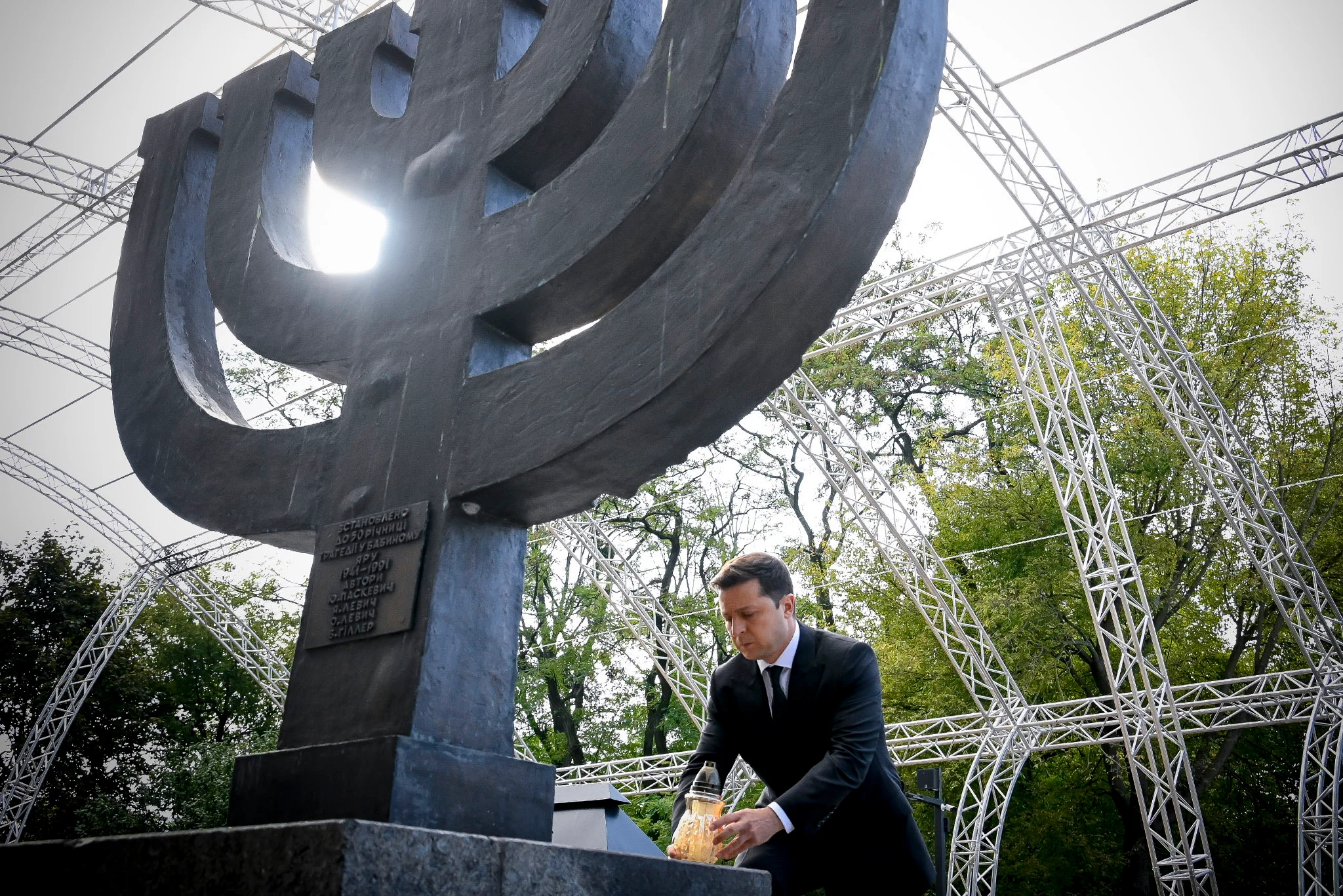
Only after Ukraine gained its independence was a menorah-shaped memorial erected at Babyn Yar in 1991 in memory of the Jewish victims.
That distinction matters.
Independent Ukraine chose to restore the story that others had tried to erase. It chose to identify the victims, preserve their memory, and make the site part of the shared remembrance of the Ukrainian and Jewish peoples.
But history does not always remain in the past.
On March 1, 2022, just days after the beginning of Russia’s full-scale invasion of Ukraine, a Russian missile struck the Babyn Yar area during an attack on Kyiv. A place that had become an international symbol of remembrance for the victims of Nazism once again found itself in the midst of war.
The symbolism is particularly painful.
Russia is waging its war against Ukraine while repeatedly invoking terminology from the Second World War and portraying its invasion as a fight against “Nazism.” At the same time, sites associated with Jewish memory and the Holocaust have been damaged during the war, including Babyn Yar and the Drobytsky Yar memorial near Kharkiv.
This is one of the reasons why the struggle for historical truth is not an academic debate.
When a state uses history to justify its actions in the present, our responsibility to defend the facts becomes even more important.
This year, that responsibility is also reflected in the “Diplomacy of Memory” project launched by the Ministry of Foreign Affairs of Ukraine. Its purpose is to strengthen the role of Ukrainian diplomacy in preserving historical truth and confronting attempts to distort it.
For us, this is not a theoretical message.
Even during the war, Ukraine continues to preserve Jewish communal life and protect religious freedom. Every year, tens of thousands of Hasidic pilgrims travel to Uman for Rosh Hashanah. In 2025, approximately 40,000 pilgrims arrived in the city, a record number during the years of war.
I believe this, too, is meaningful when we speak about Babyn Yar.
Memory is not merely a ceremony, a wreath, or a speech delivered on an anniversary. Memory is measured by the way a country treats the people who live in it today, by the way it protects their freedom of religion, and by its willingness to preserve history even in wartime.
The Jewish people know better than many others how dangerous it becomes when a lie is repeated so often that it begins to be accepted as truth.
Therefore, on the anniversary of Babyn Yar, we must remember not only the tens of thousands of lives that were extinguished there.
We must also remember that the struggle over their memory did not end in 1941.
For decades, the Soviet Union tried to obscure their identity. Today, once again, there is a struggle over how Ukraine’s history is presented to the world.
Eighty-five years after Babyn Yar, our duty is simple: to remember the victims by name, to defend the facts, and to allow no one to rewrite history.