London based entrepreneur, cybersecurity analyst doing a PhD in AI
Bal Tashchit (בַּל תַּשְׁחִית): The Rabbinic Limit
Restraint balances Aggression in the Torah
Amalek, Halakhah and the Courage of Rabbinic Leadership
Few passages in the Hebrew Bible have provoked more argument, discomfort and serious reflection than the command concerning Amalek.
To the modern reader, these verses are among the most difficult in Scripture. They cannot be made easy by pretending that they are not there. Yet one of the defining achievements of Rabbinic Judaism was precisely its refusal to leave such texts standing alone, without legal boundaries or moral safeguards.
The Sages did not erase the verses.
They surrounded them with Halakhah.
They placed Scripture inside a living legal tradition, governed by the Oral Torah, judicial reasoning, precedent, historical knowledge and centuries of scholarly debate.
The Rabbis did not ask only, “What does the verse say?”
They also asked, “How is this command to be understood within the whole of Torah, and how may it be applied without violating the justice that Torah itself demands?”
That second question changed everything.
The Rabbis Narrowed the Command.
The first limitation was historical.
The Mishnah in Yadayim 4:4 and the Babylonian Talmud in Berakhot 28a record that Sennacherib, king of Assyria, displaced and intermixed the nations he conquered.
This was not merely an observation about ancient imperial policy.
It became a legal principle.
If the nations identified in the biblical text could no longer be distinguished with certainty, then commandments directed towards those particular nations could no longer be applied in practice. Jewish law does not permit certainty to be replaced by suspicion, assumption or political convenience.
The medieval commentator Rabbi Ovadiah of Bartenura explains that the intermingling of the nations meant that the peoples mentioned in Scripture were no longer identifiable.
The consequence is considerable.
If Amalek cannot be identified, then no person, government or political movement may simply appoint a contemporary enemy to take Amalek’s place.
Maimonides preserves the command concerning Amalek as part of the Torah. Yet he does not identify any contemporary nation as Amalek, nor does he authorise private individuals or later generations to make such a determination for themselves.
The command remains within Scripture.
Its practical application becomes historically constrained.
A command requiring certainty cannot be carried out where certainty has disappeared.
Peace Before War
Maimonides deepened this restraint.
In the Mishneh Torah, Hilchot Melachim 6:1, he writes:
One does not wage war against any person in the world before first offering peace.
The Hebrew is striking in its breadth:
אין עושין מלחמה עם אדם בעולם עד שקוראין לו לשלום
The obligation is not introduced as a polite gesture after the decision for war has already been made. It comes first.
Maimonides applies this principle broadly. Even the nations associated with the biblical conquest narratives must be offered peaceful terms before military action begins. This includes the Seven Nations discussed in the Torah.
The movement of the law is unmistakable.
It moves from conquest towards negotiation.
It moves from immediate destruction towards the possibility of reconciliation.
It makes violence the final option, not the first.
This is a remarkable legal development because it demonstrates that the biblical narrative does not operate as an unrestricted military instruction. It enters a legal framework in which authority, procedure, opportunity for peace and moral discipline matter.
Halakhah Over Literalism
Rabbinic Judaism has never been a tradition of biblical literalism alone.
The Written Torah is interpreted through the Oral Torah. Verses are understood through legal reasoning, precedent, commentary and the accumulated judgment of generations of scholars.
Historical description is not automatically legal prescription.
The Rabbis repeatedly asked whether a command could still be applied, under what conditions it could be applied, who possessed the authority to implement it, and what procedural safeguards governed its use.
This method prevented ancient wars from becoming unrestricted precedents for every future conflict.
It also means that Scripture cannot properly be reduced to a collection of useful quotations.
There is no authentic rabbinic method of selecting whichever verse suits a political narrative while ignoring the rest of the legal and moral tradition. The same warning applies to Muslim leaders. Neither Judaism nor Islam permits a leader to invoke one part of revelation while discarding every inconvenient command that surrounds it.
This is particularly important when political leaders appeal to religious texts selectively.
Some leaders quote verses concerning Amalek while supporting other positions that classical Torah law regards as prohibited. A political party may invoke Scripture in one debate while disregarding it in another, including on questions of sexual conduct, family law or public morality.
Modern interpretations may differ, and political parties will inevitably adopt positions shaped by contemporary society. Yet it would be difficult to argue that Moses, David, Solomon or the prophets of Israel understood revelation as something that could be divided according to electoral convenience.
The same standard must be applied to Muslim leadership.
A Muslim leader cannot appeal to the Qur’an when it strengthens his political position and then disregard it when it restrains his power.
Judaism and Islam remain among the principal religious traditions that preserve a rigorous rejection of shirk and shituf, alongside the surviving Sabean Mandaean tradition of Iraq. Both traditions also insist that revelation must be approached as a coherent moral whole.
Selective obedience is not fidelity.
It is politics wearing the clothes of religion.
The Qur’anic Warning Against Selective Scripture
The Qur’an addresses this danger directly:
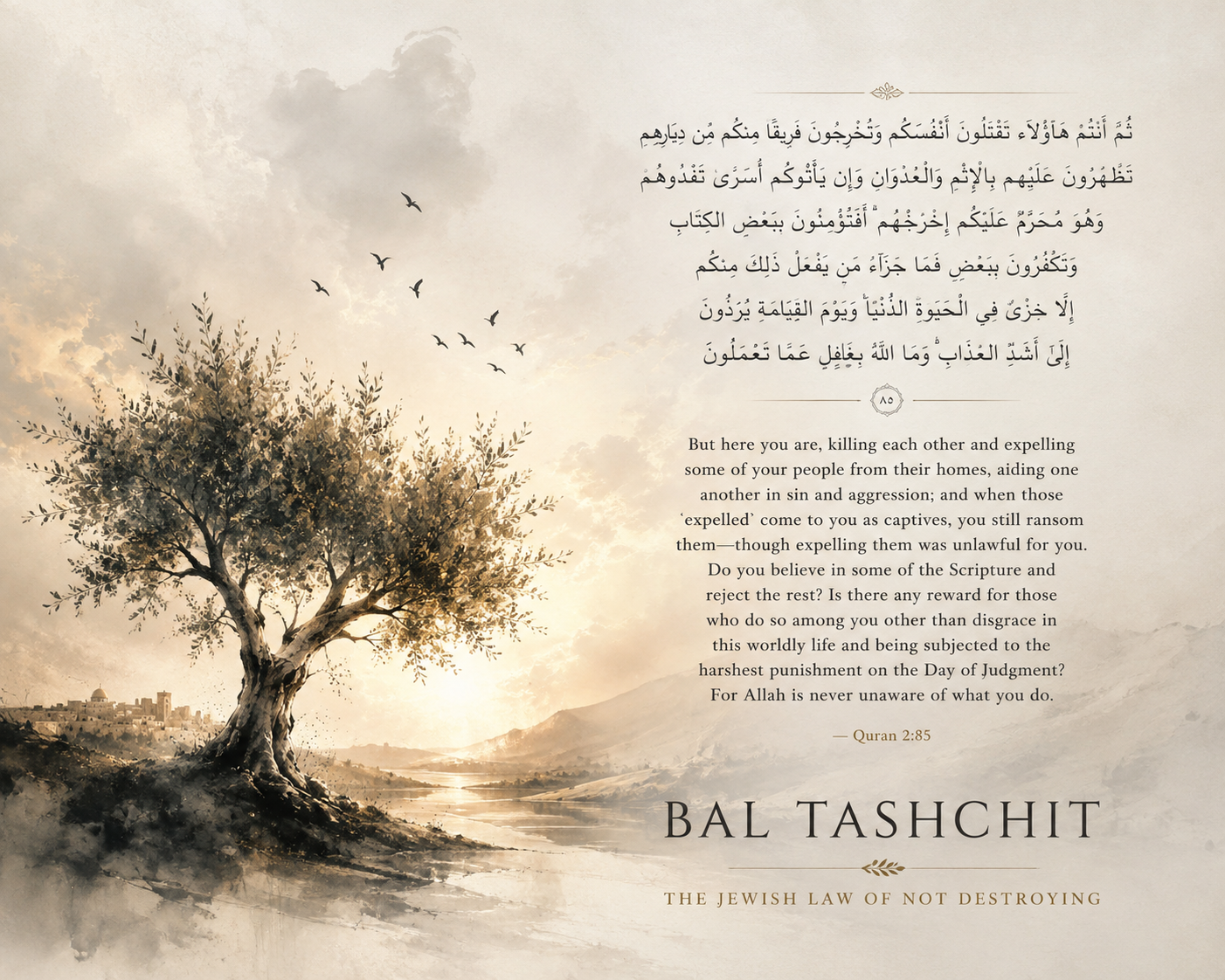
“Then, you are those same ones who are killing one another and evicting a party of your people from their homes, cooperating against them in sin and aggression. And if they come to you as captives, you ransom them, although their eviction was forbidden to you. So do you believe in part of the Scripture and disbelieve in part? Then what is the recompense for those who do that among you except disgrace in worldly life; and on the Day of Resurrection they will be sent back to the severest of punishment. And Allah is not unaware of what you do.”
Qur’an 2:85
The verse addresses communities from among the Children of Israel who fought one another while allied with opposing groups. They participated in killing and expulsion, then observed another part of their law by ransoming captives.
The problem was not that they possessed Scripture.
The problem was that they divided it.
They obeyed the portion that suited them and violated the portion that restrained them.
The verse remains striking because violence rarely stays within the boundaries drawn for it by political leaders. Once the cycle begins, it develops its own appetite.
Today the conflict may be described as Israel against Palestine. Tomorrow, the same habits of fear, vengeance and political absolutism may turn groups within Israel against one another.
The beginnings of such internal division are already visible across the region. Rivalries between Saudi Arabia and Iran demonstrate how quickly conflict can spread beyond its original borders, drawing states, factions and communities into wider confrontation.
The leaders responsible for these decisions must ask a plain question:
How many people will die?
They must ask another:
Who will remain to govern if everyone is dead?
A World Consumed by War
There are several major wars taking place simultaneously, including those involving Ukraine, Israel and Palestine, Sudan and Iran.
Meanwhile, the climate crisis remains unresolved.
Plastic pollution continues to spread through oceans, food chains and human bodies.
Thousands of humanitarian emergencies remain neglected because governments that describe themselves as civilised and educated cannot prevent themselves from hurling increasingly sophisticated ballistics at one another.
Was this the purpose of education?
Is this the moral compass that technological civilisation has produced?
No person who reads the news honestly can avoid the bitter taste left by the conduct of many elected world leaders.
They speak of progress while repeating behaviour older than civilisation itself.
Chimpanzees fight territorial conflicts and civil wars. If certain forms of modern human warfare were mapped onto chimpanzee behaviour, the most obvious difference would sometimes be the sophistication of the weapons.
The moral reasoning would not necessarily be more advanced.
In some cases, it might be worse.
A chimpanzee cannot launch a ballistic missile. It cannot calculate the destruction of a city from an air conditioned command room. It cannot compose a speech in which devastation is renamed necessity.
Human beings can do all these things.
That is not evidence of moral superiority.
It is evidence that intelligence without restraint can make brutality more efficient.
This behaviour does not define humanity at its best.
Judaism and Islam must therefore recover the moral courage within their own traditions and use it to restrain those who turn revelation into an instrument of violence.
Bal Tashchit: The Tradition of Restraint
The same rabbinic method appears clearly in the principle of Bal Tashchit.
The Torah commands during siege warfare:
“When you besiege a city for a long time, making war against it in order to take it, you shall not destroy its trees by wielding an axe against them. You may eat from them, but you shall not cut them down. Are the trees of the field human, that they should be besieged by you?”
Deuteronomy 20:19
At first glance, this may appear to be an agricultural regulation.
The Rabbis transformed it into one of Judaism’s most important ethical principles.
The Sifrei Devarim treats the verse as a prohibition against needless destruction.
The Babylonian Talmud, including Kiddushin 32a and especially Bava Kamma 91b to 92a, extends the principle beyond fruit trees.
Maimonides codifies this expansion in Hilchot Melachim 6:8 to 10:
“Not only one who cuts down fruit trees, but whoever breaks vessels, tears garments, demolishes a building, stops up a spring, or destroys food in a destructive manner violates the prohibition of Bal Tashchit.”
Notice what has happened.
A law protecting trees during a siege becomes a general legal principle restricting unnecessary destruction itself.
The Rabbis expand the protection.
They do not expand the destruction.
A fruit tree is not merely timber. It is food, livelihood, shade, inheritance and the promise that life may continue after the soldiers have gone.
A spring is not merely water. It is the survival of the people who remain.
A building is not merely stone. It may be a home, a school, a place of worship or the labour of generations.
Bal Tashchit therefore asks not only whether destruction can be carried out, but whether it is necessary, proportionate and morally defensible.
The question is no longer simply, “Can this be destroyed?”
It becomes, “What right have we to destroy what life will need tomorrow?”
The War Against Amalek
The obvious objection returns.
What of Amalek?
Here, once again, Rabbinic Judaism narrows rather than expands the scope of violence.
The Mishnah does not instruct Jews to search through later history for people who may be labelled Amalek.
The Talmud states that Sennacherib mixed up the nations.
That statement carries enormous legal consequences. If the ancient national identities no longer survive in a verifiable form, then Amalek cannot be identified.
No government may repair that absence of knowledge by inventing certainty.
No preacher may transform political anger into genealogy.
No soldier may be ordered to treat an entire modern population as though it were an ancient biblical nation merely because a leader has chosen a dramatic word.
Maimonides goes further by requiring peace to be offered before war.
Even those nations most closely associated with biblical conquest are first presented with peaceful terms.
Violence is therefore placed behind law, procedure and the possibility of reconciliation.
The biblical account remains part of sacred history.
It does not become a blank cheque for modern warfare.
Mercy Before Judgment
The Rabbis also placed the Thirteen Attributes of Mercy at the centre of Jewish religious life.
These attributes, revealed in Exodus 34, became among the defining expressions of God’s character in Jewish worship.
The Talmud in Rosh Hashanah 17b depicts God teaching Moses these attributes after the sin of the Golden Calf.
This matters.
The centre of Jewish worship is not the conquest of Joshua.
It is the mercy revealed to Moses.
Judgment exists, but mercy is recited.
Power exists, but restraint is taught.
The tradition remembers that after failure, betrayal and idolatry, the divine response included a renewed covenant and a revelation of compassion.
Seen separately, each rabbinic interpretation may appear technical.
Seen together, they reveal a pattern.
The Rabbis limited violence.
They expanded peace.
They restricted destruction.
They historicised conquest.
They made Amalek legally unknowable.
They required offers of peace.
They transformed a law about fruit trees into a general prohibition against needless destruction.
This was not an accidental collection of rulings.
It reveals the moral direction of Rabbinic Judaism.
Maimonides in the Muslim World
There is another historical detail worth remembering.
Moses ben Maimon, known as Rambam or Maimonides, spent much of his life in the Muslim world. He eventually served as a physician within the courtly world of Sultan Salah al Din al Ayyubi, known in the West as Saladin, and his family in Egypt.
This did not diminish Maimonides’ commitment to Judaism.
It demonstrated the confidence of a Jewish sage who could remain rooted in Halakhah while living, writing and serving within a Muslim society.
His legal works do not encourage perpetual hostility towards surrounding peoples.
They insist upon law, procedure, offers of peace, proportionality and moral discipline.
A reader approaching this history with common sense must ask a simple question.
How could Rambam practise Judaism, teach Torah, write his legal code and serve within a Muslim governorate if Judaism required endless hostility towards Muslims?
Are we expected to believe that Rambam understood Judaism less clearly than the political leaders of the present day?
The suggestion is difficult to sustain.
One of the greatest legal authorities in Jewish history developed his mature thought not in isolation from the Muslim world, but while living within it.
That reality should give us pause.
It also reminds us that coexistence is not a modern invention forced upon religious traditions from outside. Jews and Muslims have argued, traded, translated, studied, governed and lived beside one another for centuries.
Their history contains conflict, but it also contains intellectual partnership.
Defending The Torah or Defending Politics
A necessary distinction must be made.
Are leaders defending the Torah, or are they defending a political position?
These are not the same thing.
A state is not identical to the Torah.
A political party is not identical to Judaism.
A government policy is not identical to Halakhah.
The same political party may invoke biblical authority in matters of war while supporting social positions that classical Torah law regards as prohibited, including same-sex sexual conduct.
Modern Jewish movements interpret these questions differently, and contemporary states must govern diverse populations. Yet the inconsistency remains when a leader presents himself as a strict biblical literalist in one political context and as a flexible modernist in another.
The point is not to turn this article into a debate about sexuality.
The point is consistency.
A person cannot claim that one difficult biblical command must be applied in the most literal possible manner while insisting that other biblical commands must be reinterpreted, historicised or set aside.
That is precisely the sort of selective use of revelation condemned by both Jewish and Islamic moral reasoning.
The same criticism applies to Muslims.
A Muslim leader cannot speak of divine law when demanding obedience from the public, then forget divine law when it restrains his own ambition, wealth or violence.
The integrity of religion depends upon refusing such manipulation.
Preserving the Shared Tradition
As a practising Muslim, I am in favour of preserving the Torah and the scholarly tradition that surrounds it.
The shared intellectual inheritance of Rabbis, Faqihs and Imams is a treasure and a light to the world.
A great deal of modern legal reasoning, moral philosophy, ethical thought and scientific discipline emerged from cultures shaped by these traditions.
There are also striking similarities between the modern scientific practice of citation and the Islamic science of isnad in Hadith transmission.
Both are concerned with sources.
Both ask who reported a claim, how it was transmitted and whether the chain of authority can be trusted.
Hadith scholarship, however, developed systems of classification, biographical evaluation, transmission and authentication whose detail often exceeds the scrutiny applied to many modern scientific citations.
The purpose of this comparison is not to diminish science.
It is to remind us that religious scholarship was never merely a collection of unexamined sayings.
It developed rigorous methods for determining what could be attributed to authority and what could not.
The same seriousness should govern the use of Torah and Qur’an in political speech.
This is not a party political argument.
It is an argument about the integrity of Judaism and Islam.
Heroism in the Rabbinic Tradition
The greatest heroes of Rabbinic Judaism were not only those who defended Israel with physical courage.
They were those who defended the Torah with wisdom.
Rabban Yohanan ben Zakkai preserved Judaism after the destruction of the Second Temple, not through military victory, but through learning, legal renewal and the creation of a future beyond catastrophe.
Rabbi Akiva taught hope amid devastation.
Maimonides transformed centuries of debate into a coherent legal code that continues to shape Jewish life.
Their heroism lay in ensuring that the Torah would guide history rather than be consumed by it.
They understood that a religious tradition may survive the loss of armies, buildings and political power.
It cannot survive the loss of its moral intelligence.
This is why rabbinic leadership requires courage.
It is easy to repeat a frightening verse to an angry crowd.
It is harder to explain the legal limits that surround it.
It is easy to turn an enemy into Amalek.
It is harder to admit that Halakhah does not permit the identification.
It is easy to praise destruction as strength.
It is harder to protect a tree, a spring, a home or a child when the crowd is demanding vengeance.
Yet that harder path is precisely where moral leadership begins.
The Question for Our Generation
Every generation inherits difficult texts.
The greatness of a legal tradition is not measured by whether such texts exist. It is measured by the wisdom with which they are interpreted.
Rabbinic Judaism’s genius was its refusal to allow ancient wars to become timeless and unrestricted mandates.
It subjected those passages to history, law, authority, procedure and ethical restraint.
As Professor Moshe Halbertal has observed in his studies of Jewish ethics and warfare, the rabbinic project was not to erase difficult biblical texts. It was to contain them within a legal tradition that distinguished sharply between ancient biblical history and normative Halakhic practice.
That distinction remains one of Rabbinic Judaism’s defining achievements.
The challenge for every generation is therefore the same.
It is not whether we can quote Scripture.
It is whether we possess the courage to interpret it with the discipline, restraint and moral seriousness of the Sages who preserved it.
The leaders of the present age would do well to remember that power without law becomes appetite, and Scripture without interpretation becomes a weapon in the hands of whoever shouts loudest.
The Rabbis did not abandon Scripture.
They taught generations of Jews how to live faithfully with it.
They showed that difficult passages must never be wielded without the safeguards of Halakhah.
They left behind a legacy not of unrestricted violence, but of legal restraint, moral responsibility and the pursuit of peace whenever peace remains possible.
The Torah’s enduring legacy is not the expansion of violence.
It is the discipline of restraint.
Related Topics