
What Israel’s Rear-Area Wars Can Teach South Korea
What Israel’s Rear-Area Wars Can Teach South Korea
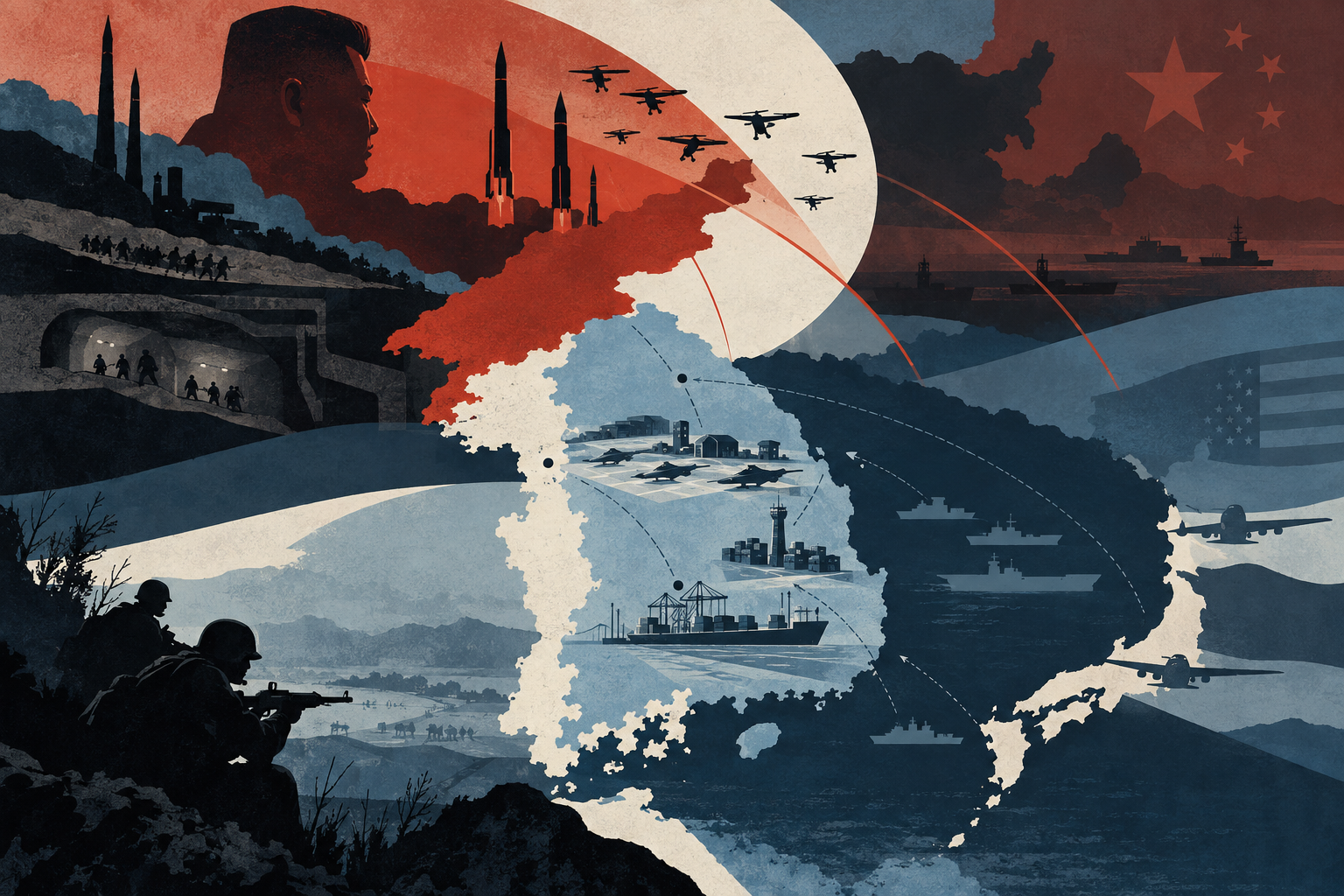
South Korea is now faced with a problem that Israel has been grappling with: how to prevent adversaries from transforming the rear area into another frontline.
Strictly speaking, the analogy contains limitations. While Israel has primarily confronted Iran-backed non-state actors such as Hezbollah, South Korea is at loggerheads with a nuclear-armed power that possesses considerable conventional forces, ballistic missiles, and strong special operations capabilities. Nonetheless, the comparison remains useful. In a future conflict, Pyongyang could conduct provocations with the most effective combination of missile attacks, drone saturation, sabotage, cyber operations, and infiltration using nuclear escalation as leverage.
North Korea’s participation in the Russo-Ukrainian war makes the challenge even more serious. Pyongyang is increasingly being exposed to a battlefield in which drones are not used as standalone weapons but as part of a larger system that links reconnaissance, artillery, infantry, electronic warfare, and precision-guided munitions (PGMs). This means that North Korea would likely integrate its accumulated lessons from the European frontlines into its longstanding strategy for paralyzing South Korea’s rear.
Therefore, the central question for Seoul is not how to protect every air base, port, command center, and logistics facility. Rather, it is how to ensure that the loss of any one of them does not cripple the functions on which the war effort depends.
Israel’s Lesson
Israel confronted a similar issue after the 2006 Lebanon War. Hezbollah developed tunnels that crossed the border in order to facilitate penetration into northern Israel during a larger conflict, which potentially enabled infiltration by land to be conducted concurrently with rocket fire and skirmishes along the border.
Israel did not wait for another war to discover how serious the threat had become. It developed specialized intelligence and detection capabilities and, in 2018, commenced Operation Northern Shield to identify the tunnels and neutralize them. Amidst the confusion of war, Israel attempted to destroy an operational option before Hezbollah could exploit it.
The same logic was applied to Israel’s broader Campaign Between the Wars, or Mabam, which sought to limit Iran’s military entrenchment in Syria and disrupt weapons transfers to Hezbollah through intelligence operations, air raids, cyber activities, and secret operations.
Despite the campaign not rooting out either threat, it did complicate adversaries’ plans, impose additional costs, and reduce their ability to convert military capabilities into strategic effects. Such an approach is directly relevant to South Korea.
The Rear as a Battlefield
For many decades, North Korea’s special operations forces have been expected to attack South Korea’s air bases, ports, command posts, and communication networks. As South Korea’s military capability improved over time, direct type of infiltration such as the 1968 Blue House raid and the 1996 Gangneung submarine infiltration incident have not been witnessed in the past three decades. However, the experience obtained from Ukraine could make once seemingly unpalatable options potentially more effective and implementable from Pyongyang’s standpoint.
In a future conflict, say, an attack on a South Korean air base could be conducted by combining various types of means and capabilities—a ballistic missile strike against a runway, a drone that detects surviving equipment, electronic warfare targeting communications, cyber warfare vis-à-vis networks, and the infiltration of special operations forces exploiting the chaos caused by these attacks. A recent wargaming result indicates that South Korean air base protection against North Korean swarm drones would demand dedicated resources.
South Korea should thus redefine the meaning of rear-area defense. The criterion for success should be the continuity of military functions that the facilities in the rear area support, rather than the survivability of these facilities per se.
For example, the effectiveness of defense at air bases should be evaluated by whether they could generate continuous sorties even after a coordinated attack. Likewise, a command post should be assessed by whether operational control could rapidly be transferred to an alternative location. A logistics system should be judged by whether fuel, ammunition, and reinforcement forces could be moved unceasingly when a major node is compromised.
This necessitates more than a mere emergency plan on paper. Major exercises should premise a situation in which crucial facilities are unavailable, and commanders should conduct operations by bypassing these facilities. If runways cannot be used, aircraft should be dispersed. A damaged logistics hub should reroute supplies. If a command center loses its function, command should migrate elsewhere.
The Nuclear and Taiwan Problems
South Korea has additional complexity that Israel has not confronted in the same form: disruptions in the rear area could unfold alongside nuclear blackmail.
North Korea could threaten Washington in order to delay US reinforcement, while warning Tokyo not to support US operations within Japanese territory in accordance with OPLAN 5055, which outlines US-Japan joint actions in the event of a Korean contingency. Even if Pyongyang intends to achieve its objective through a political decoupling among the US, Japan, and South Korea, which does not require an immediate use of nuclear weapons—the Atlantic Council wargaming scenario assumed North Korea would use a low-yield nuclear strike against a South Korean naval base in a dual contingency—such activities could increase the perceived cost of cooperation among the three democracies.
If a Taiwan contingency occurs at the same time, the problem would become even more serious. In this particular scenario, US intelligence assets, aircraft, submarines, logistics capacity, and high-level attention could already be committed elsewhere. To exploit such strain, North Korea does not need to officially coordinate with China.
This possibility should be factored into South Korea’s preparation for wartime operational control (OPCON) transition. Future certification exercises for a ROK-led combined command should assume circumstances in which some US capabilities are either delayed, redeployed, or temporarily unavailable.
Japan Is Part of the Rear
South Korean decision makers should think beyond the Korean Peninsula. In a future Korean contingency—that takes the form of a large-scale military conflict—the strategic rear could be expanded to Japan.
As evidenced by the 1950-53 Korean War, USFJ, ports, air bases, logistics infrastructure, and facilities related to United Nations Command operations within Japan could constitute part of the reinforcement network supporting South Korea. A temporary disruption may be sufficient to slow down the reinforcement at a critical moment.
This creates practical requirements for Washington, Tokyo, and Seoul. They would need procedures to maintain the flow of troops and supplies when parts of the network are under attack. To meet the challenge, the creation of a new alliance structure is not a sine qua non. There are ways to develop practical solutions for intelligence sharing, altering logistics routes, infrastructure recovery, and reinforcement continuity by using the existing trilateral defense consultations.
Such solutions should later actually be tested. Exercises should presume a situation where Japanese and South Korean infrastructure is damaged concurrently, and planners should search for alternative methods to transport aircraft, troops, fuel, and ammunition. A strike on a single node should divert the network, instead of crumbling it altogether.
Before the War Begins
Israel’s experience does not offer a blueprint to South Korea in a literal sense, since the surroundings—adversaries, geography, alliance structure, and nuclear environment—are notably different. Nonetheless, it does provide one strategic principle. The most disadvantageous moment to figure out how enemies try to disrupt the rear is after the war has begun. South Korea therefore needs a campaign before the contingency.
That means continuously studying how North Korea could combine infiltration, missiles, drones, cyberattacks, and electronic warfare, ensuring alternative means for critical military functions, and testing these alternatives under increasingly unfavorable conditions. It also means preparing the ROK-led command system to function better with less US support than planners would expect and guaranteeing that the reinforcement network through Japan can withstand disruption. It is deterrence by denial, but with a more demanding standard.
To make denial credible, adversaries need to have reasons to believe that even their successful attacks will fail to produce their intended political or operational effects. Realistically speaking, South Korea cannot safeguard every critical runway, command post, port, fuel depot, and logistics facility.
The more important task is to make the military system harder to paralyze: when one facility disappears, another assumes the function; when one capability becomes unavailable, commanders already know what can replace it. Before Pyongyang fully grasps how resilient the existing US-ROK defense mechanism is, Seoul should take necessary measures to strengthen the rear area and minimize the room for Pyongyang’s miscalculation in an era of multi-contingency.