


Practical Spirituality - Slow and Steady
Balak 2: Sympathy for the Devil
Pleased to Meet You, Won’t You Guess My Name?
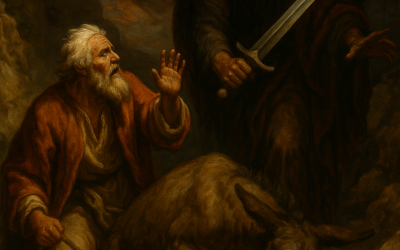
The Bilaam story is, let’s face it, a bit odd. Bilaam—part wizard, part prophet, part snake oil salesman—is on a donkey ride to spiritual disaster, and smack in the middle of the road stands a being we’re told is Satan. As opposition, but also as an angel of Mercy.
Yes, Satan, sent on a mission of mercy from Hashem Himself, so to speak.
Mercy?! Really?
That’s what Rashi says. And as this is the first time the word “satan” appears in the Torah, the Malbim and others point out that the first time a word is used, teaches us the primary definition of the word. See also the Malbim on the word “Tov” (Good) as it functions in the Creation story.
When the Malbim writes that the first time a word shows up in the Torah is the real definition, it means that is the words soul, its essence. And here it is: “satan,” for the first time, not some devil with horns, but a divine emissary sent by Hashem Himself. Not Elokim, the strict Judge, but HaShem, the Name of mercy. Wrap your head around that.
So what do we do with the whole demonic portfolio the Sages later give the satan? Tempter, prosecutor, angel of death? How can the same being be the one who trips you, then tattles on you, then kills you?
Unless… that’s all part of the mercy. All part of free-will.
Let me explain, but I’m going to need to tell you a story first. A parable, paralleling Bilaam.
Joe Drunk and the Liquor Store Angel
Joe is ten days into his sobriety. He glances at his watch.
Ten minutes before closing. Just ten. That sacred window where all is possible: salvation… or damnation. And Joe Drunk—paunchy, balding, reeking of sweat and stale desperation—is sprinting like a walrus on a treadmill to make it.
“One drink won’t kill me,” he wheezes. “Medicinal! Stress management! Good for the liver!”
Right.
The neon glow of his personal Sinai beckons: the liquor store. He can already taste the beer. Smell it. Feel the cool bottle in his trembling hand. Joe Sober is in there somewhere, tied to a chair in the basement of his brain, gagged and ignored.
And then—wham! The pavement slaps him. Hard. Scraped knees, torn pants, glasses crooked. Divine intervention in the form of a busted sidewalk. He mutters, “Maybe God doesn’t want me to drink tonight…”
The store is yards away. But something shifts. The craving’s still there, but a chill crawls up his spine.
Maybe this was a test.
But Then Again…
He limps forward anyway. Five minutes left. The devil’s got him in a chokehold, whispering, “One more store, just a bit farther…”
He gets to the door. Locked. The clerk inside—apathetic, unmoved, mildly amused—points to the all-night liquor palace across town. An hour’s walk. Minimum. Joe stares at the glass. Rage, shame, longing. All of it.
And that’s when the real voice kicks in—not the drunk one, not the schemer. The quiet one. The reason Satan blocked him… it is Joe’s yetzer tov, his desire to be good.
“Three signs,” it says. “I closed the store. I tripped you. I put the other one far away. What else do you need?”
It’s Bilaam and the donkey all over again. Three blocks. Three warnings. Three acts of mercy disguised as obstacles.
And yet? God doesn’t stop him. Because that’s the deal. You can choose. Always.
The Get-Out-of-Hell Card
But the Rabbainu Bachya quotes our Sages and teaches us something amazing, and hope-inspiring.(Bamidbar 22:34)
Bilaam said to the angel of the Lord: ‘I sinned;’” our sages in” Tanchuma Balak 10 state that this verse is proof that if someone confesses his guilt by saying “I have sinned,” the angel no longer has permission to touch him.
So… you can stop the Satan in his tracks with a single phrase. Not a fancy one. Not a chant. Just this:
“I’ve made a HUUUUGE mistake!”
That’s it. But you have to mean it. Like Rabbi Bachya says… if it’s real, heartfelt, you get help. Angels shift
gears. Mercy hits the override button. But if it’s fake? If it’s lip service while your feet are still headed to the liquor store? Then the Accuser sharpens his pen and writes your name in bold.
Why We Almost Prayed the Whole Parsha of Balak Every Day
At one point, our Sages almost added the whole Balak saga into the daily prayer service. No joke. They wanted us to remember every single day: you’re not in charge of blessings or curses. Only God can flip a curse into a benediction. Only God can wake the spiritually dead and slap sense into a drunk prophet or a stubborn donkey. And most of all, only God is our true Protector and Saviour.
But they didn’t make us say it every day. Too long, too much. Instead, they slipped the idea into our bones some other way. In every struggle, every blocked path, every late-night fall in the street.
Every time we stumble and say – oh – maybe I need to slow down and think about what I’m doing.