


Where history exposes power and moral failure
Banality in the Booth: Arendt, Hausner, and Afterlife of Eichmann’s Trial
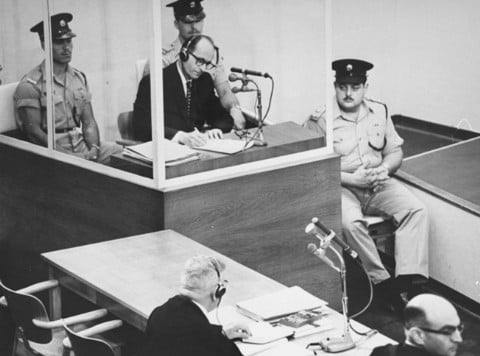
Adolf Eichmann takes notes during his trial in Jerusalem, 1961. Source: United States Holocaust Memorial Museum, via Wikimedia Commons. Public domain; released by the Israel Government Press Office.
Banality in the Booth
Adolf Eichmann spent much of his trial inside a glass booth. The enclosure protected him from attack while allowing the judges, journalists, witnesses, and spectators to study him at close range. He sat behind bulletproof glass in a dark suit, wearing headphones, consulting papers, and occasionally bending toward counsel. The man accused of organizing the deportation of millions looked like someone who had been placed at the wrong desk in a government office. The appearance would become part of the historical argument.
Gideon Hausner refused to let Eichmann’s physical mediocrity determine the dimensions of the case. When the Israeli attorney general delivered his opening address on April 17, 1961, he said that six million accusers stood with him. They could not enter the witness box, identify the defendant, or describe what had happened after the trains arrived. Hausner therefore called survivors who testified about ghettos, shootings, deportations, camps, hiding, hunger, resistance, murdered children, and families erased almost completely from Europe. Many had never encountered Eichmann. Their evidence placed his department inside the catastrophe it had helped administer.
Hannah Arendt considered much of this testimony historically important and legally misplaced. A criminal court had jurisdiction over Eichmann, not over the Holocaust as a whole. The prosecution had to establish his conduct and responsibility under the charges before it. Hausner used that jurisdiction for a much larger public purpose. The trial taught the destruction of European Jewry to an Israeli population that had often received survivors with ignorance, suspicion, or the old vocabulary of passivity. It allowed survivors to speak under the authority of the state established three years after the war’s displaced Jews had begun arriving in Palestine. It also recast the Holocaust as a crime against the Jewish people after Nuremberg had treated Jewish annihilation within the broader prosecution of Nazi aggressive war and crimes against humanity.
Eichmann gave Hausner the defendant he required, though the history presented in the courtroom repeatedly exceeded the acts of the man sitting behind the glass. Arendt considered that excess a corruption of the court’s function. Hausner considered it part of the reason the trial had to occur in Jerusalem. Their dispute concerned evidence, jurisdiction, Jewish memory, Israeli sovereignty, survivor testimony, and the authority to decide what kind of history a criminal proceeding could contain.
“The banality of evil” later floated away from that dispute. It is now routinely presented as Arendt’s general theory that ordinary people commit atrocities through obedience, bureaucratic habit, or a failure to think. The phrase appears whenever an official looks insufficiently demonic, a cruel policy arrives on institutional letterhead, or another photograph of Hitler begins circulating online. It has become convenient enough to survive almost any application, which is usually what happens when a difficult historical proposition is converted into something that fits beneath an image.
Arendt’s initial observation concerned the grotesque disproportion between Eichmann’s crimes and the language he produced in court. He relied upon clichés, official formulations, professional vanity, poor memory, mangled Kant, and narrow descriptions of departmental competence. He presented himself as a diligent subordinate whose work had acquired murderous consequences elsewhere in the hierarchy. His speech made genocide sound like an administrative misunderstanding involving several ministries and an unfortunate quantity of rolling stock.
The complete surviving record makes that performance considerably easier to see. Before Israeli agents captured him in Argentina, Eichmann had spent years among former Nazis. During the conversations organized by Willem Sassen, he discussed the Final Solution with men who required no assurance that he had merely obeyed orders. He defended the cause, boasted about his role, corrected accounts that denied him sufficient importance, and regretted that the destruction had not been completed. He was still managing his reputation, but the desired reputation was different. Among Nazis in Buenos Aires, proximity to the Final Solution conferred stature. Before judges in Jerusalem, the same proximity supported a death sentence.
Arendt knew portions of the Sassen material, some of which entered the proceedings, but she did not have the complete archive later examined by David Cesarani and Bettina Stangneth. Stangneth’s reconstruction of Eichmann’s Argentine life demonstrated how carefully he constructed the Jerusalem version of himself. His officious speech remained real; so did his ideological commitment. He had learned to make each useful before a different audience.
The District Court rejected his effort to disappear into the chain of command. Its judgment reconstructed his work in the Central Offices for Jewish Emigration, his position in the Reich Security Main Office, his negotiations with German ministries and occupied governments, his authority over deportation arrangements, and his conduct during the destruction of Hungarian Jewry in 1944. The evidence showed a man who interpreted policy, defended his jurisdiction, threatened Jewish representatives, solved logistical problems, and continued pressing deportations while parts of the Nazi leadership were beginning to calculate the consequences of defeat.
The administrative record did not reduce his responsibility; it located it. Deportation required definitions of Jewishness, confiscated property, addresses, assembly points, railway agreements, guards, timetables, diplomatic pressure, occupied officials, and decisions about how many people could be forced into a wagon. Eichmann’s office worked within that system and helped connect its parts. The division of labor made murder possible across a continent without making the laborers interchangeable or innocent.
Arendt accepted Eichmann’s conviction and execution. Her proposed judgment would have condemned him for participating in a political project that presumed the authority to decide which peoples could inhabit the earth. His obedience offered no defense because he had accepted the objectives of the system he served and acted to advance them. Thoughtlessness, as Arendt used the term, described his inability or refusal to examine what he was doing from any position beyond the rules and ambitions governing his career. It did not remove his agency.
The popular history of “banality” nevertheless fastened upon his ordinariness. Eichmann had a wife, children, career grievances, digestive complaints, and no physical quality remotely proportionate to the destruction described in court. None of this was unusual among perpetrators. Himmler worried about his health. Rudolf Höss lived with his family beside Auschwitz. Commandants, policemen, civil servants, railway officials, industrialists, lawyers, and guards ate meals, received salaries, quarreled with superiors, sought promotion, and returned home. Those details place the perpetrators within human life, where they had always been. They do not determine the strength of a person’s antisemitism, the extent of his knowledge, or the amount of initiative he exercised.
Much of the original controversy around Eichmann in Jerusalem concerned matters that the famous phrase now obscures. Arendt’s treatment of Hausner, survivor witnesses, Jewish councils, Zionism, and Israeli public memory produced the deepest anger. Gershom Scholem accused her of lacking Ahavat Yisrael, love of the Jewish people. She replied that she loved friends rather than peoples. Their exchange exposed the question already troubling the courtroom: which form of authority could claim the history of the dead?
Hausner grounded his authority in the murdered Jewish people and the state speaking in their name. Arendt asserted the independence of judgment against a prosecution she believed had converted history into national pedagogy. Survivors brought the authority of experience, although Hausner had selected and arranged that experience within his case. The judges repeatedly narrowed the proceedings toward the evidence connecting Eichmann to the crimes charged. Each participant occupied the trial differently, and each resisted the others’ attempt to determine its historical meaning.
Arendt later wrote in The Life of the Mind that she had held “no thesis or doctrine” behind the phrase. A doctrine had already begun forming around it. Stanley Milgram’s obedience experiments, postwar anxieties about mass society, Zygmunt Bauman’s account of modern bureaucracy, Christopher Browning’s study of Reserve Police Battalion 101, and decades of perpetrator scholarship gradually gathered beneath “banality” until it appeared to explain almost every relationship among authority, administration, conformity, and political crime.
The scholarship itself is far more exact than the slogan made from it. Browning’s reserve policemen occupied a different institution and performed different work from Eichmann’s RSHA specialists. Bauman’s account of bureaucratic division explains important conditions of modern mass murder without explaining why German state power selected Jews for annihilation. Research into ideological antisemitism restores motives that administrative analysis can blur, but ideology required offices, budgets, records, railways, police, and thousands of practical decisions before it could deport a family from Amsterdam or Budapest to Auschwitz. Eichmann belonged to the point where conviction, ambition, expertise, and state machinery met.
Modern Hitler comparisons often divide political responsibility in a suspiciously familiar manner. The leader receives demonic intention while officials farther down become ordinary people trapped inside his design. This grants the dictator an almost supernatural capacity to act alone. Governments operate through ministers, judges, police forces, civil servants, contractors, donors, party officials, local administrators, and professionals who interpret policy and decide how efficiently it will be carried out. Orders acquire material force because identifiable people continue converting them into action.
The glass booth concentrated attention upon one defendant. Hausner surrounded him with the history of the people his work had helped destroy. Arendt studied his language and refused to grant him the grandeur traditionally associated with great wickedness. The judges reconstructed the offices, jurisdictions, negotiations, and transports through which his responsibility could be proved.
“Banality” became the part everybody remembered. Eichmann had spent years learning how to make himself look smaller than his work. History obliged him.
Bibliography
Arendt, Hannah. Eichmann in Jerusalem: A Report on the Banality of Evil. Revised and enlarged edition. New York: Viking Press, 1964.
Arendt, Hannah. The Life of the Mind. Edited by Mary McCarthy. 2 vols. New York: Harcourt Brace Jovanovich, 1978.
Arendt, Hannah. Responsibility and Judgment. Edited by Jerome Kohn. New York: Schocken Books, 2003.
Arendt, Hannah, and Karl Jaspers. Hannah Arendt–Karl Jaspers Correspondence, 1926–1969. Edited by Lotte Kohler and Hans Saner. Translated by Robert Kimber and Rita Kimber. New York: Harcourt Brace Jovanovich, 1992.
Arendt, Hannah, and Gershom Scholem. The Correspondence of Hannah Arendt and Gershom Scholem. Edited by Marie Luise Knott. Translated by Anthony David. Chicago: University of Chicago Press, 2017.
Aschheim, Steven E. Scholem, Arendt, Klemperer: Intimate Chronicles in Turbulent Times. Bloomington: Indiana University Press, 2001.
Bauman, Zygmunt. Modernity and the Holocaust. Ithaca, NY: Cornell University Press, 1989.
Benhabib, Seyla. The Reluctant Modernism of Hannah Arendt. Rev. ed. Lanham, MD: Rowman & Littlefield, 2003.
Bernstein, Richard J. Hannah Arendt and the Jewish Question. Cambridge, MA: MIT Press, 1996.
Bilsky, Leora. Transformative Justice: Israeli Identity on Trial. Ann Arbor: University of Michigan Press, 2004.
Birn, Ruth Bettina. “Fifty Years After: A Critical Look at the Eichmann Trial.” Case Western Reserve Journal of International Law 44, nos. 1–2 (2011): 443–73.
Browning, Christopher R. Ordinary Men: Reserve Police Battalion 101 and the Final Solution in Poland. New York: HarperCollins, 1992.
Cesarani, David. Becoming Eichmann: Rethinking the Life, Crimes, and Trial of a “Desk Murderer.” Cambridge, MA: Da Capo Press, 2006.
Douglas, Lawrence. The Memory of Judgment: Making Law and History in the Trials of the Holocaust. New Haven, CT: Yale University Press, 2001.
Felman, Shoshana. The Juridical Unconscious: Trials and Traumas in the Twentieth Century. Cambridge, MA: Harvard University Press, 2002.
Goldhagen, Daniel Jonah. Hitler’s Willing Executioners: Ordinary Germans and the Holocaust. New York: Alfred A. Knopf, 1996.
Hausner, Gideon. Justice in Jerusalem. New York: Harper & Row, 1966.
Hilberg, Raul. The Destruction of the European Jews. 3rd ed. 3 vols. New Haven, CT: Yale University Press, 2003.
Israel. District Court of Jerusalem. Attorney-General of the Government of Israel v. Adolf Eichmann. Criminal Case No. 40/61. Judgment, December 11–12, 1961. Reprinted in International Law Reports 36 (1968): 5–276.
Israel. Supreme Court. Adolf Eichmann v. Attorney-General of the Government of Israel. Criminal Appeal No. 336/61. Judgment, May 29, 1962. Reprinted in International Law Reports 36 (1968): 277–342.
Israel. Nazis and Nazi Collaborators (Punishment) Law, 5710–1950. Laws of the State of Israel 4 (1949–50): 154–59.
Kershaw, Ian. “‘Working Towards the Führer’: Reflections on the Nature of the Hitler Dictatorship.” Contemporary European History 2, no. 2 (1993): 103–18.
Lipstadt, Deborah E. The Eichmann Trial. New York: Schocken Books, 2011.
Lozowick, Yaacov. Hitler’s Bureaucrats: The Nazi Security Police and the Banality of Evil. Translated by Haim Watzman. London: Continuum, 2002.
Milgram, Stanley. Obedience to Authority: An Experimental View. New York: Harper & Row, 1974.
Pendas, Devin O. The Frankfurt Auschwitz Trial, 1963–1965: Genocide, History, and the Limits of the Law. Cambridge: Cambridge University Press, 2006.
Pinchevski, Amit. “Eichmann on the Air: Radio and the Making of an Historic Trial.” Historical Journal of Film, Radio and Television 27, no. 1 (2007): 1–25.
Porat, Dina. The Blue and the Yellow Stars of David: The Zionist Leadership in Palestine and the Holocaust, 1939–1945. Cambridge, MA: Harvard University Press, 1990.
Robinson, Jacob. And the Crooked Shall Be Made Straight: The Eichmann Trial, the Jewish Catastrophe, and Hannah Arendt’s Narrative. New York: Macmillan, 1965.
Segev, Tom. The Seventh Million: The Israelis and the Holocaust. Translated by Haim Watzman. New York: Hill and Wang, 1993.
Stangneth, Bettina. Eichmann Before Jerusalem: The Unexamined Life of a Mass Murderer. Translated by Ruth Martin. New York: Alfred A. Knopf, 2014.
State of Israel, Ministry of Justice. The Trial of Adolf Eichmann: Record of Proceedings in the District Court of Jerusalem. 9 vols. Jerusalem: Trust for the Publication of the Proceedings of the Eichmann Trial, in cooperation with the Israel State Archives and Yad Vashem, 1992–95.
Villa, Dana R. Politics, Philosophy, Terror: Essays on the Thought of Hannah Arendt. Princeton, NJ: Princeton University Press, 1999.
Von Lang, Jochen, ed. Eichmann Interrogated: Transcripts from the Archives of the Israeli Police. Translated by Ralph Manheim. Introduction by Avner W. Less. New York: Farrar, Straus and Giroux, 1983.
Wieviorka, Annette. The Era of the Witness. Translated by Jared Stark. Ithaca, NY: Cornell University Press, 2006.
Wildt, Michael. An Uncompromising Generation: The Nazi Leadership of the Reich Security Main Office. Translated by Tom Lampert. Madison: University of Wisconsin Press, 2009.
Yablonka, Hanna. The State of Israel vs. Adolf Eichmann. New York: Schocken Books, 2004.