A voice from Morocco
Barukh Ata Adonai in Essaouira
From youth protests to Hebrew melodies, a Moroccan café reveals more than coffee.
The road from Marrakech to Essaouira has always been a passage of breath—two hours of winding terrain, olive groves, and the promise of Atlantic air. And of course, for me, a quiet joy: to see my beloved Jews. Essaouira, with its layered history and Jewish quarter, has always offered a sense of coexistence, memory, and cultural tenderness that feels increasingly rare. But this time, the drive felt different. Not because of the landscape, but because of the barricades. More than five police and gendarmerie checkpoints dotted the route, each one a reminder that Morocco is entering a new phase of unrest—one not led by unions or parties, but by a leaderless, digitally native youth movement demanding dignity in healthcare and education.
This is not the Morocco of slogans and staged reforms. It is the Morocco of Discord servers, TikTok manifestos, and spontaneous marches. It is the Morocco where Gen Z, born into hashtags and high unemployment, is asking why stadiums gleam while hospitals rot.
Yet Morocco today is not the Morocco of the 1970s under the late King Hassan II, when cafés and public spaces were haunted by secret agents, and a stray criticism could send you “behind the sun.” As I sat at a café table, I overheard people speaking freely—sharing videos of the protests, scrolling through footage of clashes between demonstrators and security forces. They discussed politics, corruption, and their dissatisfaction with Prime Minister Aziz Akhenouch’s government. Conversations that could land you in jail in places like Egypt or Algeria now unfold casually over coffee.
I was accompanied by my mother, as we often are on this coastal pilgrimage. We stopped, as tradition dictates, at a Shell station café just outside Marrakech—a place we’ve visited for years. But this time, something had changed. A wooden library had been installed inside the café. A library. In a gas station. In Morocco. It felt like a quiet revolution.
I read the words aloud to my mother. A look of disgust crossed her face. She asked me to put the book aside.
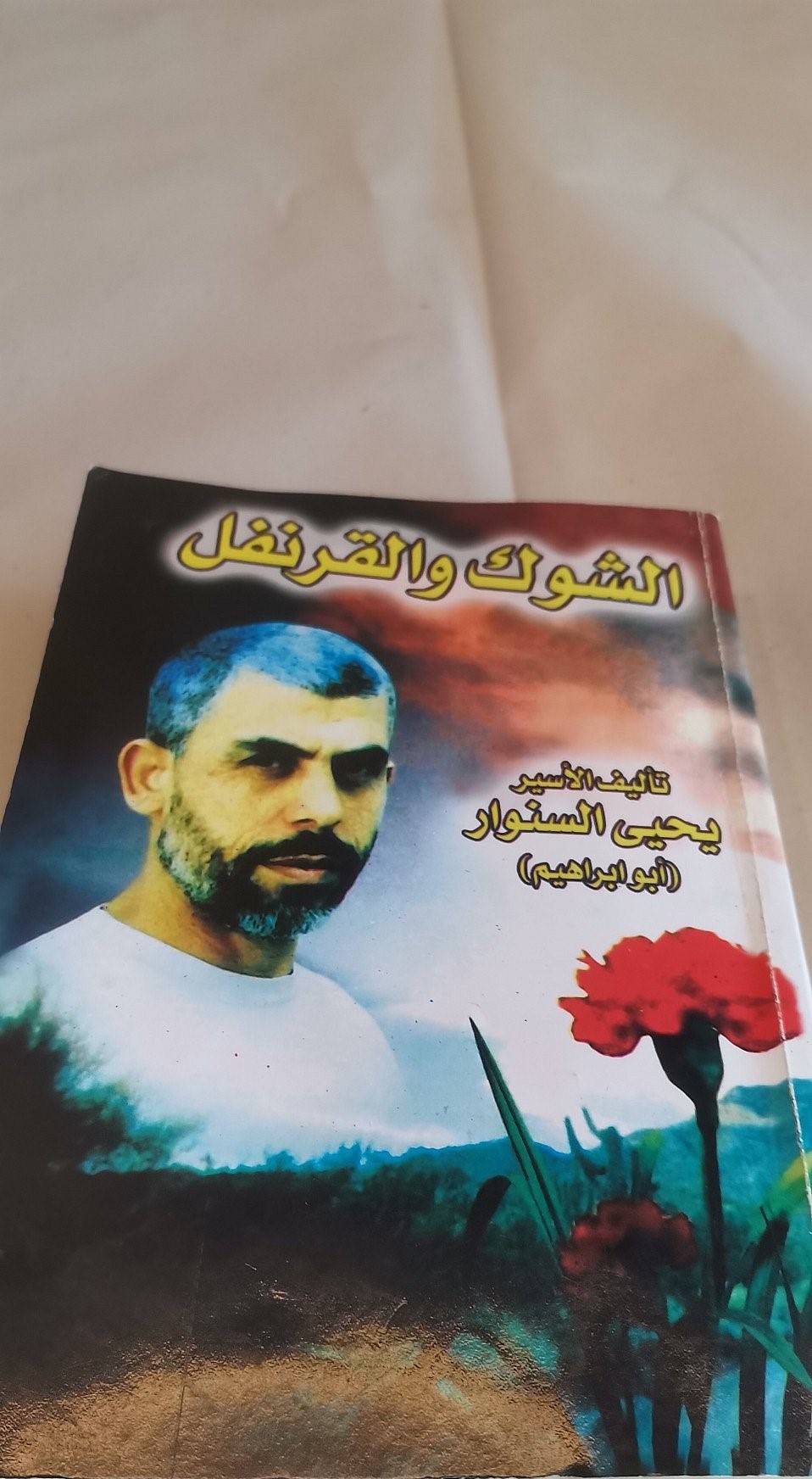
We sat beside it, drawn to its modest elegance. As we waited for our breakfast, we scanned the titles: Surrounded by Idiots, Orwell’s 1984, religious texts, Arabic novels. It was eclectic, sincere. Then my eyes caught a face I knew too well—Yahya Sinwar. His book, Chawk al Qoronfol (Thorns of the Carnation), sat quietly among the others.
The book itself carried Sinwar’s name, alluding to his status as a prisoner. On the back page, a message from him to his mother stunned me. He wrote that his dream was to attack Israelis and slaughter them like sheep, then be martyred. I read the words aloud to my mother. A look of disgust crossed her face. She asked me to put the book aside. I placed it back on the shelf, but the image of his face on the cover seemed to gaze at her. “Put it somewhere far,” she said.
We spoke quietly, disturbed by the barbarity of the metaphor—a dream not just of killing, but of brutal dehumanization. It was chillingly reminiscent of what unfolded on October 7. “But he wrote that while in prison,” my mother exclaimed, “and they let him.” We reflected on the democratic nature of Israel, on the paradox of a prison system that allowed such incitement to be penned and published. I mentioned Ben Gvir’s new policies. But the question lingered: how could such violent rhetoric be born in confinement, with access to ink and paper?
In Essaouira, however, the mood was different—vibrant with Hebrew warmth. Bus after bus of Jews and Israelis arrived last month for the Hiloula and Rosh Hashanah. Since the Abraham Accords, Morocco has seen a noticeable surge in Israeli tourists—drawn not only by heritage but by the warmth of renewed ties. Tents were raised, buffets laid out, and the city glowed in its coexistence. We visited the Mellah, the Jewish quarter where my mother once lived with her family. Her mother worked for Jewish families, and my mother attended their school, ate at the still-functioning Jewish charity, and received portions of US aid to the community in the 1960s.
She led me to that same charity, now restored in the form of a riad. There, we encountered a young Jewish man wearing a kippa and two Israeli women. He invited us to drink from the well—unaware that my mother had drunk from it more than sixty years ago. We parted ways as he made his way toward the nearby synagogue of Rabbi Haim Pinto, where two uniformed policemen stood quietly at the entrance—watchful but unobtrusive, their presence a subtle reminder of the care taken to protect this sacred space.
We spoke of her memories with Daweed, known then as the plumber of Essaouira, and of Smihin al-Tajer, once a great Jewish merchant in the city, whose household employed her mother. She recalled the rhythm of that home—its generosity, its rituals—and of going with Jewish children to the synagogue, even joining them in their prayers. She recited one aloud: Barukh Ata Adonai, her voice steady, the words intact after all those years. I was stunned. I had never heard her speak Hebrew before. These were things I didn’t know—fragments of a life lived in quiet coexistence, now resurfacing like a forgotten melody. And of André Azoulay, adviser to King Mohammed VI and formerly to King Hassan II, who has done a remarkable job preserving Essaouira’s memory for both Muslims and Jews. The city is secure, calm, and welcoming. During the Jewish holidays, security was visibly tightened—especially around the Mellah and the Jewish cemetery. Police forces, canine units, and cynotechnic patrols moved through the streets with quiet precision, maintaining safety without panic.
While the protests are legitimate and deeply understandable, the potential to politicize them is high—especially with a dominant Islamic tendency that risks veering into anti-Israel sentiment. It’s a delicate moment, one that demands clarity, not conflation.
It reminded me that Morocco is not just in political flux—it is in symbolic flux. Was the library curated by ideology or by curiosity? That question lingered. But one thing is certain: if we choose to, we can shape a future of carnations without thorns.
And perhaps that is what this moment demands. Not just reform in hospitals and schools, but reform in how we read, how we reflect, how we discern. The youth are not asking for slogans. They are asking for coherence. For a Morocco where libraries are not rare, and where the books inside them provoke thought, not fear.
Related Topics
Related Posts