Batya – The Courage to Defy Evil
The opening chapters of Shemot present two contrasting narratives. Chapter 1 races through national catastrophe in six terse verses:
“A new king arose over Egypt who did not know Joseph… He said to his people, ‘Behold, the people of the children of Israel are too many and too mighty for us. Come, let us deal shrewdly with them…’” (Shemot 1:8–10)
“They set taskmasters over them… They embittered their lives with hard labour… Pharaoh commanded all his people, saying: ‘Every son that is born you shall cast into the Nile.’” (1:11–22)
Six verses to legislate oppression, slavery, and genocide. Evil is swift, impersonal, systemic.
Then the Torah slows dramatically in the second chapter in contrast. In another six verses it narrows down and describes in quite significant detail an unexpected individual act of defiance:
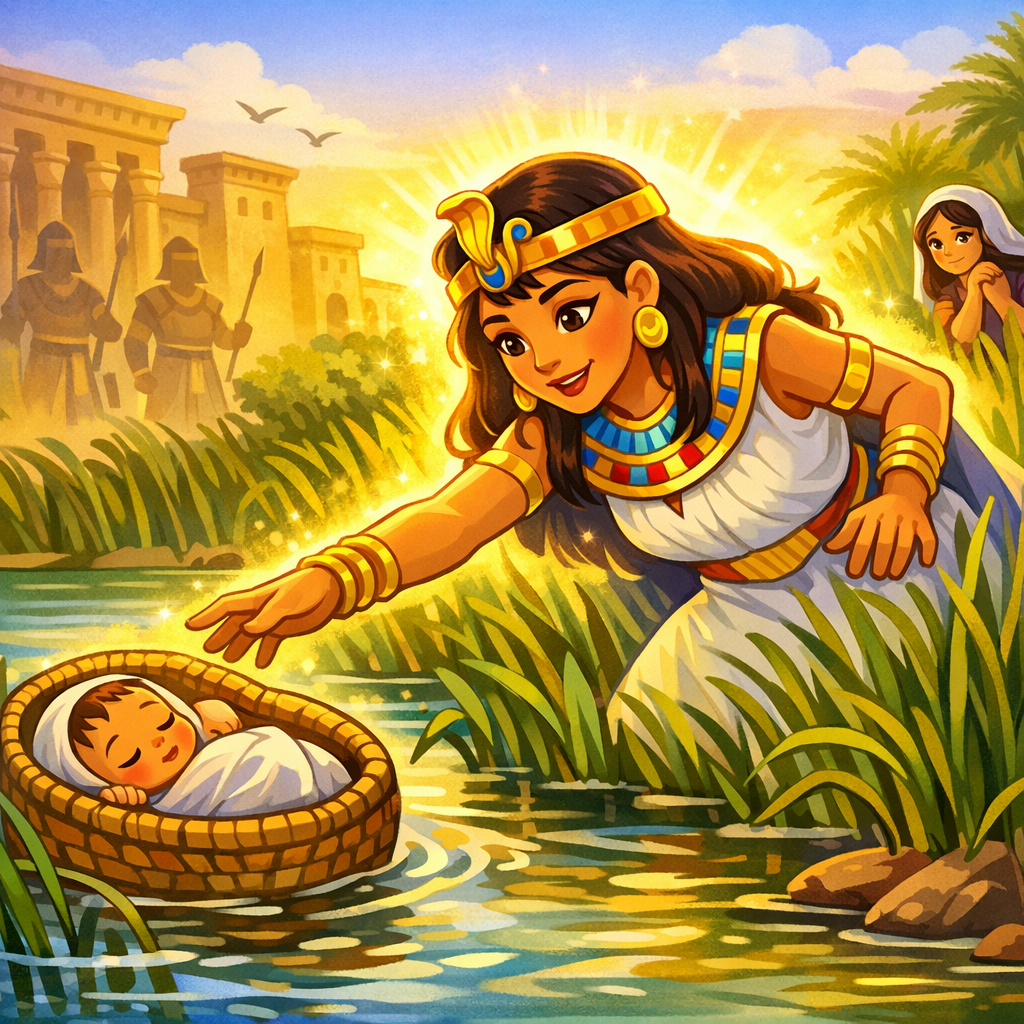
“The daughter of Pharaoh went down to bathe by the Nile, and her maidens walked along the riverbank. She saw the basket among the reeds and sent her maidservant to fetch it. She opened it and saw the child, behold, a boy crying, and she had compassion on him and said: ‘This is one of the Hebrew children.’” (Shemot 2:5–6)
“Then his sister said to Pharaoh’s daughter: ‘Shall I go and call for you a nursing woman from the Hebrews?’ Pharaoh’s daughter said: ‘Go.’ So the girl went and called the child’s mother. Pharaoh’s daughter said to her: ‘Take this child and nurse him for me, and I will give you your wages.’… The child grew, and she brought him to Pharaoh’s daughter, and he became her son. She named him Moshe, saying: ‘For I drew him from the water.’” (2:7–10)
Why this slow down and change of pace and deep dive? Nechama Leibowitz points out that the Torah quickly summarizes the decrees of oppression in just a few verses, while it describes the rescue of Moshe step by step in great detail. This highlights that Israel’s redemption comes not from grand, dramatic events, but from the quiet, courageous actions of ordinary individuals.
Evil can be enacted in sweeping strokes; goodness often emerges in intimate, deliberate moments. The Torah lingers here because Batya’s choice is a turning point: one person defying an empire. We saw it with 9/11 and October 7 – evil can be performed on mass scale and quickly, the opposite is true with rebuilding and fighting evil.
And yet, for all this detail in the six verses around which there is naturally so much commentary of the various ways the interaction took place including the intervention of miracles such as the lengthening of Batya’s arm to reach Moshe, so much remains opaque. Who was she really? Why did she risk everything, her status, perhaps her life, to save a condemned Hebrew child? Did she sense that this crying infant would one day redeem a nation? The Torah does not tell us. It seems deliberate, as if to teach that the deepest moral decisions often defy explanation. When later rescuers during the Holocaust were asked why they endangered themselves to save Jews, many could offer no grand ideology. They simply said, “It was the right thing to do.” Batya’s motivation appears similarly ineffable: a sudden surge of pity (וַתַּחְמֹ֣ל עָלָ֔יו) that overrode fear, custom, and self-preservation.
And notice something remarkable: the survival of the Jewish people at this moment hinges on the courage of three women acting on the micro, tactical level, Yocheved and Miriam (identified by Chazal as Shifra and Puah), and Pharaoh’s daughter. In the face of systemic hatred and overwhelming power, a few individuals, each in her own way, step up. Yocheved hides her child and devises a plan. Miriam watches and intervenes with boldness. Batya defies her father’s decree and claims the child as her own.
Why them? Why so few? The Torah does not explain, and perhaps cannot. Most people remain silent, paralyzed by fear or swept along by the tide of conformity. These women are exceptions. As with the Holocaust, and as we see in our own day post-October 7, it is truly a rare and extraordinary person who risks comfort, safety, and even life to do what is right. The Torah wants us to see this: redemption begins not with armies or politics, but with individuals, often women, who act with courage when others do not.
And then comes the psychological depth: she names him herself, “Moshe, for I drew him from the water” (מִן־הַמַּיִם מְשִׁיתִֽהוּ). Naming is an act of identity and responsibility. Batya does not remain a passive rescuer; she claims him. In a palace built on cruelty, she creates a pocket of compassion and says: This child is mine. That is moral courage at its most radical. Rabbi Jonathan Sacks teaches that true morality transcends what we inherit from our birth or culture; it is defined by the choices we make to follow conscience.
Batya chose conscience over culture, humanity over hatred.
Tradition calls her Bitya, “daughter of Hashem.” In the narrative, she is called “the daughter of Pharaoh” four times (vv. 5, 7, 8, 9), emphasizing her identity as the child of the oppressor. And then the Midrash turns this on its head:
“Moshe was not your son, yet you called him your son; you are not My daughter, yet I will call you My daughter.” (Vayikra Rabbah 1:3)
The Torah’s repetition heightens the irony and the transformation, she who was defined by Pharaoh becomes redefined by God. The daughter of tyranny becomes the daughter of eternity. One source even lists her among those who entered Gan Eden alive. The very child of the tyrant who sought to drown Israel’s future redeemer becomes the instrument of his survival. Hashem orchestrates redemption through the most unexpected vessels.
Batya’s story is not ancient history. It speaks urgently to our world today. Courage begins in small acts. Evil often feels overwhelming, but one person, one moment of compassion, can change history. Identity is chosen, not imposed. Batya rejected Pharaoh’s ideology and chose a moral identity. Post-October 7, when hatred resurfaces globally, we too must choose values over convenience, light over darkness. By saving Moshe, Batya unknowingly partners in redemption. Our acts of kindness, supporting victims, standing against antisemitism, building bridges, align us with divine purpose. Silence is complicity. Batya teaches that moral clarity demands action, even when it costs.
As we read Parshat Shemot, this gives us hope I think. The actions of a few can indeed battle the evil actions of the insane. This is precedent we need. May we be inspired by Batya’s quiet heroism. In a world that can still rush headlong into cruelty, may we too pause at the riverbank, extend our arm further than seems humanly possible, and declare, through action, that some decrees simply cannot stand.