
BBC: One isn’t a jihadist if one just kills Jews
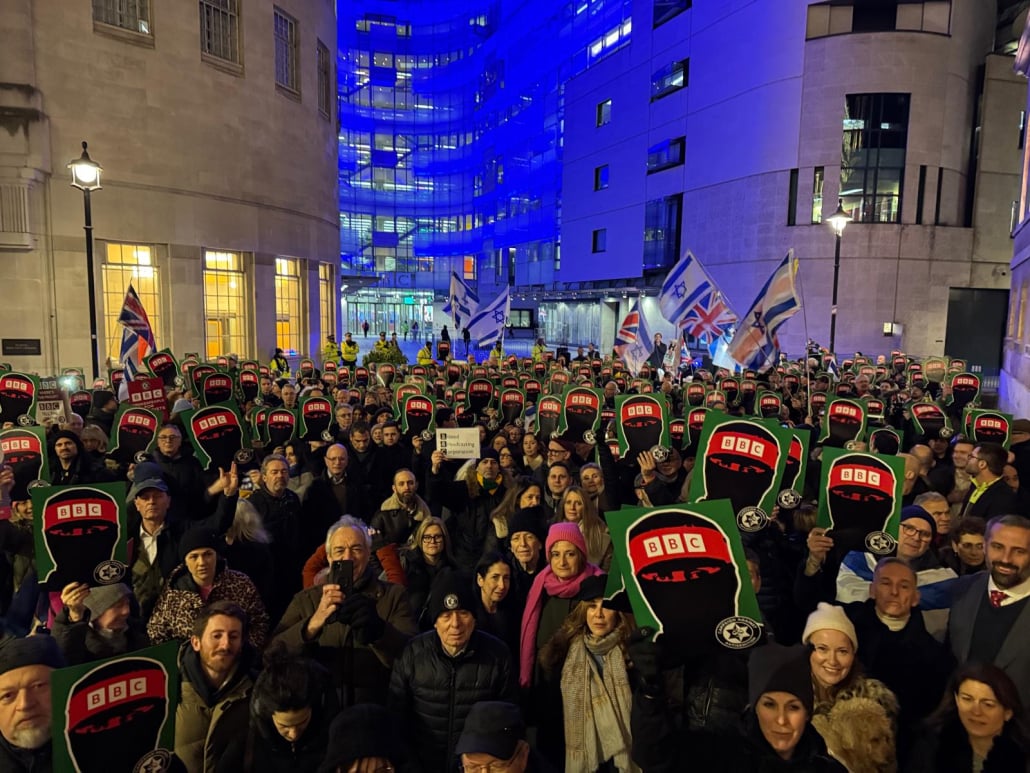
“I am a Jew. Hath not a Jew eyes? Hath not a Jew hands, organs, dimensions, senses, affections, passions; fed with the same food, hurt with the same weapons, subject to the same diseases, healed by the same means, warmed and cooled by the same winter and summer as a Christian is? If you prick us, do we not bleed? If you tickle us, do we not laugh? If you poison us, do we not die? And if you wrong us, shall we not revenge?”
William Shakespeare, The Merchant of Venice
No, the BBC never said ‘One isn’t a jihadist if one just kills Jews’ – though what they did say boils down to it. I wouldn’t normally stoop to dishonest headline tactics – not my style. But the BBC deserves a taste of their own medicine.
As everyone knows, the BBC stubbornly refused to refer to Hamas as ‘terrorists’ – even when they butchered and abducted random civilians. At the time, the Beeb rolled out ‘veteran journalist’ John Simpson, who ponderously explained:
Terrorism is a loaded word . . . It’s simply not the BBC’s job to tell people . . . who are the good guys and who are the bad guys . . . governments have condemned Hamas as a terrorist organisation, but . . . we don’t say it in our voice.
Except they did say “terrorist” in their own voice, when referring to the Manchester Arena bomber and his purported accomplices. That’s of course different because… err… they didn’t kill Jews?
The Beeb never called the 7 October massacre (1,195 killed) a ‘terror attack’. But they did call other incidents: for instance the 2016 attack at Brussels International Airport (32 fatalities) and the 2017 London Bridge attack (8 dead).
I’m bringing all this up, almost two years after that shameful BBC decision, because I recently came across a BBC news item entitled “Jihadists on 200 motorbikes storm Niger army base”.
Why, I wondered, did the BBC call Islamist terrorists storming an army base in Africa “jihadists”, while claiming a much larger attack on civilian communities in Israel was perpetrated by “militants”?
So I put pen to paper and sent a complaint to the BBC.
No journalistic dinosaur with a God complex cared to reply to an ignorant pleb like me; but an Assistant Editor did:
Hamas is not typically classified as a jihadist group, unlike the Islamic State (IS) group . . .
IS promotes a violent transnational Islamist ideology, whereas Hamas and PIJ are localised groups whose focus is . . . the replacement of Israel with an Islamic state in Palestine.
As such, we feel it is clearer to readers to describe Hamas and PIJ as armed groups rather than jihadist, as their fight is against the Israeli state.
So there you are: the Palestinian Islamic Jihad aren’t jihadists – because they only kill Jews. So Saith the BBC.
I briefly wondered whether the Assistant Editor blushed when arguing that? ‘Briefly’, because I once again got on my laptop and responded that the ‘difference’ between “transnational” and “localised” was cut entirely out of new cloth.
Far from being “localised,” Hamas and the PIJ are local branches of transnational movements.
In its Covenant, Hamas describes itself as
one of the wings of Moslem Brotherhood in Palestine . . . a universal organization . . .
But hey – what does Hamas know? It ain’t true unless the BBC Saith it.
Fortunately, the BBC did saith it. In an explanatory article helpfully entitled “What is jihadism?” they describe its two elements:
- An Islamist ideology;
- Willingness to employ violence to promote it.
The BBC did call Hamas “Islamist” in the past. As for violence… post-7 October even the Assistant Editor might find it embarrassing to argue that point.
The BBC explainer also mentioned that jihadists aren’t all the same: they “share the basic aims of advancing Islam, but their priorities can vary”. An example of such priority is:
Establishing sovereignty on a territory perceived as occupied or dominated by non-Muslims. The Pakistan-based Lashkar-e-Taiba (Soldiers of the Pure) is opposed to Indian control of Kashmir…
Lashkar-e-Taiba and Hamas are as similar as terror outfits can ever be. Despite BBC’s euphemism, the former’s programme goes beyond “oppos[ing] Indian control of Kashmir”; they plan to ‘liberate’ all India and ‘reestablish’ Muslim rule over it. Sounds familiar?
I wrote all this to the BBC. The response I got was an exercise in ‘logical’ contortionism and dishonest obfuscation – causing me to escalate to the highest stage of BBC complaints: the mighty Executive Complaints Unit (ECU).
It started with that inimitable BBC arrogance:
We appreciate that it remains your view that Hamas should be called Jihadists. However we remain of the view that [your] reasoning . . . does not amount to compelling evidence for changing our approach.
Why not? Well, he claimed, the BBC explainer did not mention Hamas. It didn’t, of course – nor did it mention most other Islamist terror groups. The article was entitled “What is jihadism?”; not ‘An Exhaustive List of Jihadist Groups’.
The response schooled me in the intricacies of Islamic theology:
the term itself is rooted in the Quran . . . appearing widely in the rhetoric of militant and political movements – including some that are not overtly religious.
I referred ECU to the Hamas Covenant:
Art. 7 . . . ‘the struggle of the Palestinians and Moslem Brotherhood in the 1948 war and the Jihad operations . . .’ Art. 8: ‘Jihad is its path and death for the sake of Allah . . .’ Article 13 [states]: ‘There is no solution for the Palestinian question except through Jihad,’ and goes on to disparage diplomacy as ‘all a waste of time and vain endeavors’
Which part of that, I asked, refers to non-violent jihad? And which part is “not overtly religious”?
Also, he wrote, there were “a number of fundamental differences” between Hamas and “organisations like so-called Islamic State”. The latter “disdain Hamas and . . . have openly labelled them ‘apostates’…”
To further school me in the facts of life, he added links to two articles explaining the differences between Hamas, Islamic State and Al-Qaeda.
But, as I pointed out to the ECU, this was
Another irrelevant ‘argument’: that Hamas, the PIJ, IS & Al-Qaeda are all jihadists needs not imply that they are identical in every respect. The SNP, Alternative für Deutschland, the Catalonian Nationalist Party, Israel’s Jewish Power & the PLO are all nationalist movements – but that doesn’t mean they’re identical or in agreement . . .
One may find articles pointing out the many differences between sharks and mackerel; sharks may even feed on mackerel – but that doesn’t mean they aren’t all fish!
While the IS disdains Hamas, they’re also at odds with Al-Qaeda – yet the BBC does not use this to claim that the latter aren’t ‘jihadists’.
The Assistant Editor had claimed:
we feel it is clearer to readers to describe Hamas and PIJ as armed groups rather than jihadist.
I told ECU that this
is illogical. There are many types of ‘armed groups’ in the world. . . . This is like calling Trotskyism and Leninism ‘political ideologies’: true, but not informative. Surely it’d be much more edifying to call them both – despite their differences/rivalry – ‘communist ideologies’?
But the BBC would have none of it.
ECU’s response came signed by… a former Assistant Editor, who’d gradually risen through the ranks. He wrote:
I am not sure there is much to be gained from continuing a relatively academic argument over which definition most closely fits Hamas as an organisation. . . . The question for . . . the BBC is . . . what is the best means to convey the similarities and differences between the different groups in a way that allows audiences to understand their motives, ideologies and background.
You got that, plebs? Calling Hamas and PIJ “armed groups” rather than “jihadist groups” is more likely to allow “audiences to understand their motives, ideologies and background”!
So Saith the BBC. Or, in ECU’s charming language
This letter represents the final word of the BBC and general complaints of this kind do not usually fall within Ofcom’s remit. But you can contact them if you wish.
Now, it’s not just disgusting arrogance that permeates that letter – but also intellectual dishonesty and ill-faith.
And it’s far from being a one-off . When it comes to Jews, the BBC applies a different ‘logic’, a unique reading of its own Editorial Guidelines and a distinct way of doing things.
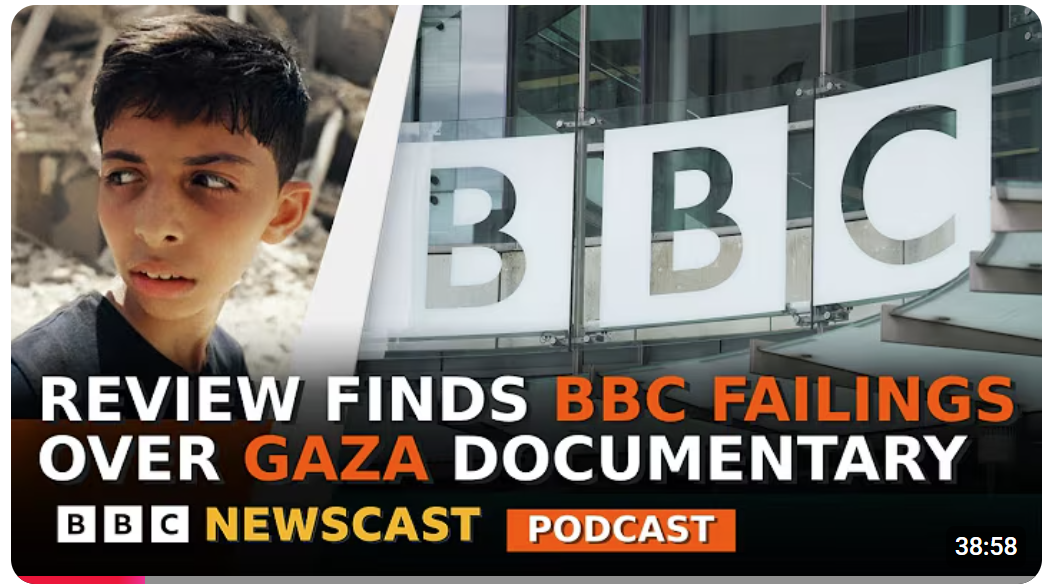
When it comes to Jews, the BBC ‘hears anti-Muslim slurs’ that nobody else does; it pays Hamas families to push Hamas propaganda (as if they wouldn’t do it for free; and as if BBC’s own journalists don’t promote it enough!) When it comes to Jews, the BBC sees only the most evil of intentions – and smuggle in the ruminations of its ‘International Editor’ as facts.
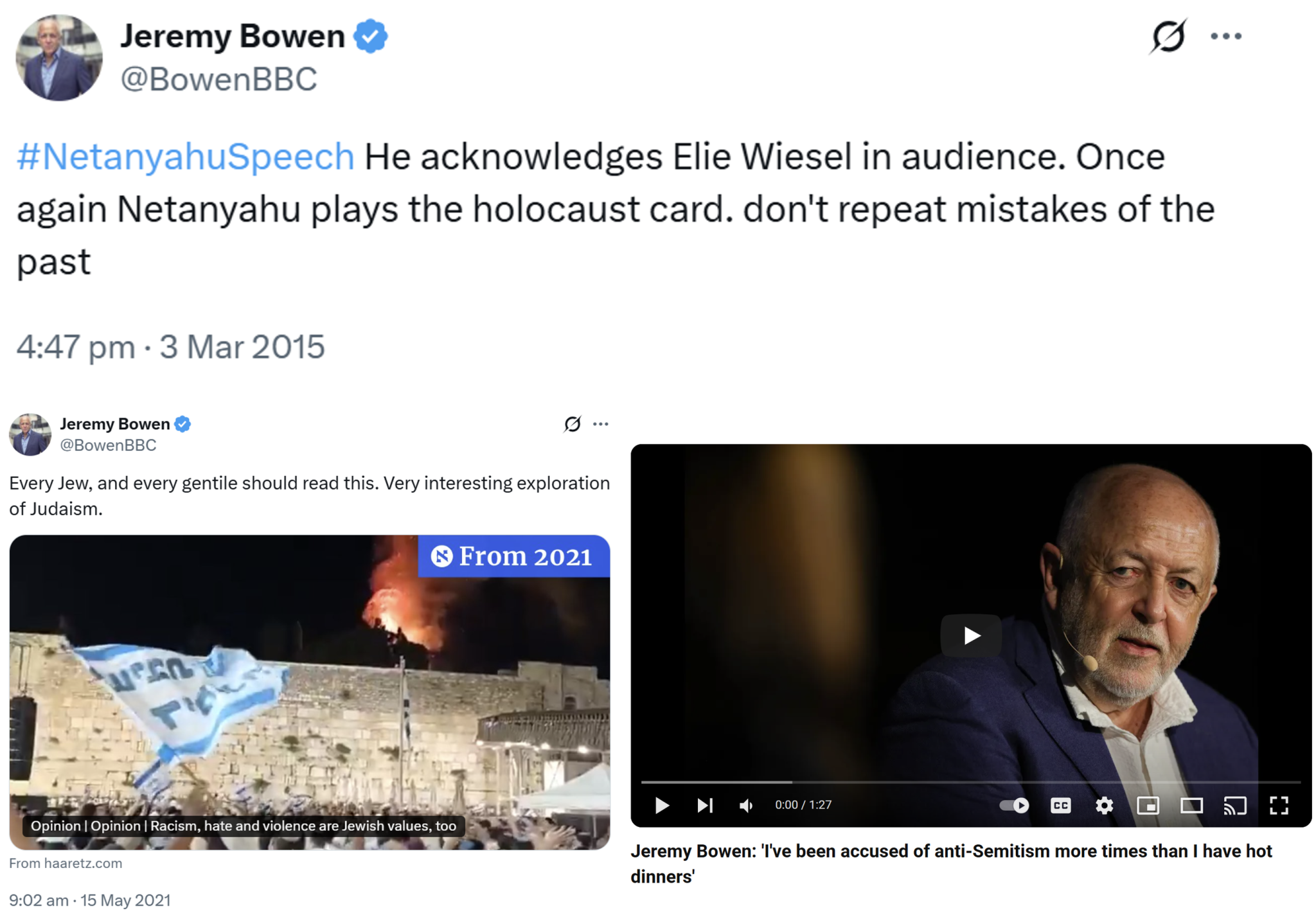
{X and YouTube screenshots}
Sure, the BBC will say they ‘cover the war in Gaza’. But – leaving aside the biased content – which other war did they cover in the same relentless, obsessive way? Ukraine (one million casualties and counting, seven million refugees)? How about Syria (500,000 killed, 12 million displaced)?
The BBC has quoted ad nauseam Hamas’s headcount of deaths “as a result of malnutrition” (circa 200 since 7 October 2023); but when was the last time they reported about Sudan’s refugee camps, where 1 child dies every 2 hours?
The BBC is not the only outlet actively promoting antisemitism; but the others don’t do it on my dime. In the UK, anyone watching a live broadcast has to pay the ‘licence fee’. whether one watches via aerial, satellite dish, internet… and whether on a TV set, computer, smartphone… The licence fee funds the BBC, but no other media outlet (so, if you watch a YouTube broadcast from Burma – you must pay the BBC!) Not paying constitutes a criminal offence; it will result in a hefty fine – if not a prison term; and it goes on your criminal record.
Not that paying gives one any influence over what the BBC says, does, whom they employ, promote, etc. You may believe former BBC International Editor Jeremy Bowen is a talentless piece of dead wood who should at best be working for The Whispering Hedge Weekly (circulation: 15); but you’re still required to fund his c. £260,000 salary!
The BBC’s only raison d’être is being a ‘public broadcaster’. This means that, in return for public funds (while its ‘commercial’ competitors work hard to scrape a living), the BBC is supposed to work in the public interest, according to strict rules ensuring accuracy and impartiality – not to mention integrity.
Except it doesn’t. It’s all a disgusting sham.
The BBC Editorial Guidelines are written by… the BBC, of course. They’re a long and prolix document – the latest version runs to 448 pages. One can read there whatever one wishes. For instance, Paragraph 2.4.7 says
Opinion should be clearly distinguished from fact.
Not a BBC contribution, but a fundamental principle of ethical journalism.
But another Paragraph (2.4.12) states that BBC journalists:
may provide professional judgements, rooted in evidence and professional experience…
In practice, whenever I pointed out that BBC journalists failed to “clearly distinguish [opinion] from fact,” those assessing my complaints claimed that they were expressing not “opinions,” but “professional judgements,” which they “may” do.
I pointed out that, by definition (here, here, here), “judgements” are opinions. And that permitting opinions to be expressed doesn’t remove the obligation to distinguish them from fact.
It didn’t help. The BBC responded:
You say ‘Judgements are opinions’. We would say that judgements are sound conclusions which are rooted in evidence.
That’s it: the BBC makes the rules, interprets the rules, assesses complaints of breaching the rules… and changes the meaning of the English language as it pleases. The national anthem should really be ‘God save the BBC’!
The BBC has turned malignant. And, as usual with such things – Jews are the canary in the coal mine. These days, the BBC is one of the main promoters of antisemitic prejudice. It is only a matter of time before its insidious but incessant propaganda – which is already responsible for additional suffering in the Middle East – will cause bloodshed in this country. UK Government – be warned, or be damned!