

Becoming Human Beings
Recently, I was teaching a young woman in her process of converting to Judaism, who had never learned Hebrew before this year, and we were working on Brachot—the different blessings–when we say them, what they mean, and how to pronounce them.
She was working really hard at the Hebrew—listening carefully, trying to form sounds that were new to her, repeating the words and trying to make them sound right.
But then she stopped, looking genuinely worried, and said to me:
“I learned in a class that every time you make a mistake in a blessing, you create an imperfect angel. So like– I’m making all these imperfect angels!”
I told her that I had never heard that particular teaching before. But mostly, my response was: Of course it’s okay to make mistakes when you’re learning how to say these! That’s how you learn! Make mistakes! You shouldn’t be afraid to say a Bracha because you might not say it perfectly.
The idea of those imperfect angels intrigued me. But it also bothered me a little.
In some ways, Judaism seems to hold up angels as something we aspire to.
On Yom Kippur, we wear white. We don’t eat. We try to transcend our physical selves.
When we say Kedushah, we stand with our feet together, imitating the angels, and repeat their words:
קדוש קדוש קדוש. Holy, holy, holy.
We seem, sometimes, to want to be like angels.
But as we listen to Parashat Bereishit and the story of human creation, we might wonder:
Does God actually want us to be angels?
When God is about to create the first human being, He says:
נעשה אדם בצלמנו כדמותנו
“Let us make the human in our image….”
Let us.
Who is God talking to?
The Midrash in Bereshit Rabbah imagines that God is talking to the angels.
And the angels, it turns out, are not at all convinced that creating us humans is a good idea. They divide into two camps:
Chesed, Loving-kindness, says: Create them, because human beings will do loving-kindness.
Tzedek, righteousness, says: Create them, because human beings will do righteous things.
But Emet, Truth, says: Don’t create them. Human beings will be filled with falsehood.
And Shalom, Peace, says: Don’t create them. Human beings will be filled with conflict.
It is difficult to read this Midrash and not feel that every one of the angels has evidence.
We look at human beings and see cruelty, violence, war, and lies.
And we can imagine Emet and Shalom turning toward God and saying:
This is exactly what we were talking about.
But then we see something else.
We see people bravely stand up for the vulnerable. We see people respond to another’s sadness with tenderness. We see people risk their lives to save others in danger. We see human beings who feed and rescue and comfort and protect.
And we can imagine Chesed and Tzedek turning toward God and saying:
This is what we were talking about.
The Midrash doesn’t tell us which side is right.
Because they’re all right.
Human beings really are capable of falsehood, conflict and cruelty.
And we really are capable of extraordinary chesed and tzedek.
And while the angels are still arguing, God creates Adam.
מה אתם מדיינין? כבר נעשה אדם
Why are you still debating? God says. The human being has already been created.
But the angels’ doubts about humanity don’t end there.
In another Midrash, the Gemara in Sanhedrin imagines the angels asking what human beings will be like.
When God shows them, they answer with the words of Tehillim:
מה אנוש כי תזכרנו ובן אדם כי תפקדנו
“What is man that You are mindful of him?”
Why would You create such a creature?
But God creates humanity anyway. And as the Midrash continues, history unfolds. The generation of the Flood. The Tower of Bavel. Human beings do terrible things.
And the angels essentially say:
See? We told You so.
The text of the Torah itself almost seems to agree.
At the end of Bereishit, God looks at humanity and sees:
וכל יצר מחשבות לבו רק רע כל היום
The inclinations of the human heart are only bad, all day.
After the Flood, God looks at humanity again and says:
כי יצר לב האדם רע מנעוריו
The inclination of the human heart is bad from youth.
But this time, that very recognition becomes part of God’s promise not to destroy the world again.
Human nature hasn’t suddenly changed.
God knows exactly what kind of creature He has made.
And this is exactly the moment this Midrash imagines the angels returning to God to say,
Wasn’t this what we warned You about?
But God answers them with words from Yeshayahu:
אני עשיתי ואני אשא ואני אסבול ואמלט
I made them. I will carry them. I will bear them.
God’s answer isn’t: You were wrong about human beings.
In some ways, the angels were right.
God’s answer is:
I know. And I am not giving up on them.
The question is no longer: Why would God create us if we are capable of failing so badly?
Maybe the question is:
What is there about a human being that makes all of that risk worthwhile?
In the very same Tehillim that the angels quote, I think there’s the beginning of an answer.
מפי עוללים ויונקים יסדת עז
From the mouths of babies, You have established strength.
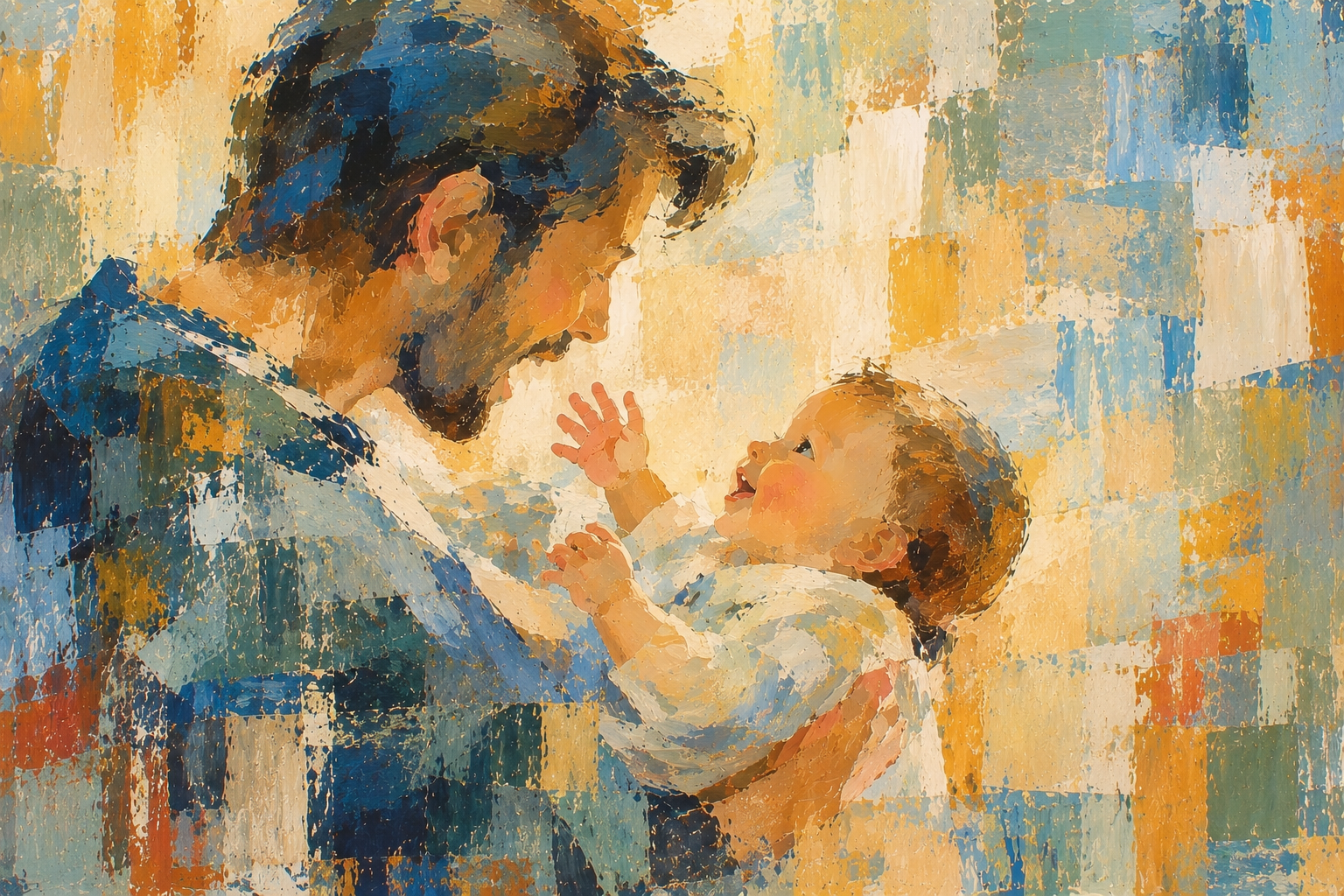
Our baby granddaughter, is beginning to babble. Recently our son was playing with her, making a “ba-ba-ba-ba” sound, moving his hand near his mouth. And she looked admiringly at him—and tried to do it back. Her little hand went up near her mouth and she made her own sounds in response.
And of course, those of us watching thought this was the most brilliant and beautiful conversation that had ever taken place.
She wasn’t saying anything that made sense, and wasn’t even getting the ba-ba-ba right!
And yet she was doing something extraordinary.
She was listening to another human voice.
She was realizing that she could answer.
She was trying to make the sounds.
This is how human beings begin.
An angel arrives already an angel.
But a human being has to learn.
We learn how to talk.
How to walk.
How to care for someone else.
How to apologize.
How to say a blessing.
We begin by babbling.
The glory and strength of being human is not that we arrive perfect and complete.
It is that we are capable of becoming.
There is another Midrash (Shabbat 88b) in which the angels once again question human beings—this time, not whether we should be created, but whether we should be given the Torah.
Moshe has gone up to the heavenly realm to receive it from God, and the angels object:
Why would You give the Torah to him—a human being?
And once again, they quote:
מה אנוש כי תזכרנו
What is a human being that You should pay attention to him?
God tells Moshe to answer them.
So Moshe asks the angels:
What does the Torah say? “I am the Lord your God who brought you out of Egypt.”
Were you slaves in Egypt?
“Remember Shabbat.” Do you work? Do you need to rest?
“Honor your father and your mother.” Do angels have parents?
“Don’t murder.” “Don’t steal.” Do you experience jealousy? Do you have an evil inclination?
Of course the Torah isn’t for angels.
Torah is for beings who get angry.
Who get jealous.
Who get tired.
Who have sensitive and complex relationships.
The things the angels thought disqualified us humans from Torah are precisely the things that make Torah possible.
The angels can do God’s will perfectly. But only human beings can struggle to choose the good.
There are forms of holiness that can only belong to human beings.
An angel can’t feel hurt and still choose not to hurt someone back.
An angel can’t be afraid and still run toward danger to save another person’s life.
An angel can’t sense another person’s feelings and instinctively reach out to them.
An angel cannot realize that it has been going in the wrong direction—and choose to change course.
We can.
At the end of that Midrash, the angels concede:
ה׳ אדונינו מה אדיר שמך בכל הארץ.
“God, our Master, how majestic is Your name throughout all the earth.”
Those words are familiar from the end of Kedushah.
We begin Kedushah by imitating the angels. But here, the angels themselves acknowledge:
מה אדיר שמך בכל הארץ.
How majestic is Your name on earth.
Here, in this messy human world.
And maybe that is something we especially need to hear right now, immediately after the Yamim Noraim.
We spent Yom Kippur confessing, apologizing, making commitments. And presumably, by now, we have already messed some things up.
But the goal of Yom Kippur was never that we would walk out of Neilah as angels.
God already has angels.
The goal was that we would walk out as human beings, who can try, who can grow, who can repair, who can begin again.
And maybe that is why, immediately after the Yamim Noraim, we roll the Torah all the way back to Bereishit.
Back to the moment when God knowingly chooses to create this creature.
נעשה אדם.
Let us make a human being.
And to my student, who was worried about creating imperfect angels, I would say:
The beautiful thing isn’t the perfectly pronounced bracha.
It is a human being trying to learn to make one. Trying again when the words don’t come out right. Wanting to learn how to make a blessing.
And there’s something of that same beauty in the baby trying to answer her father’s voice with imperfect sounds of her own.
Neither one begins with perfect words.
Both are learning how to listen. How to connect. How to answer.
An angel doesn’t have to learn how to say a bracha. We do.
An angel doesn’t have to figure out how to be a blessing, what it can become, what it is here to do. We do.
The angels could debate whether this messy, unfinished, struggling creature really belonged in God’s world.
But God chose to create us.
מה אתם מדיינין Why are you still debating?
כבר נעשה אדם The human being has already been made.
Not because we would become angels.
Because we could become better human beings.