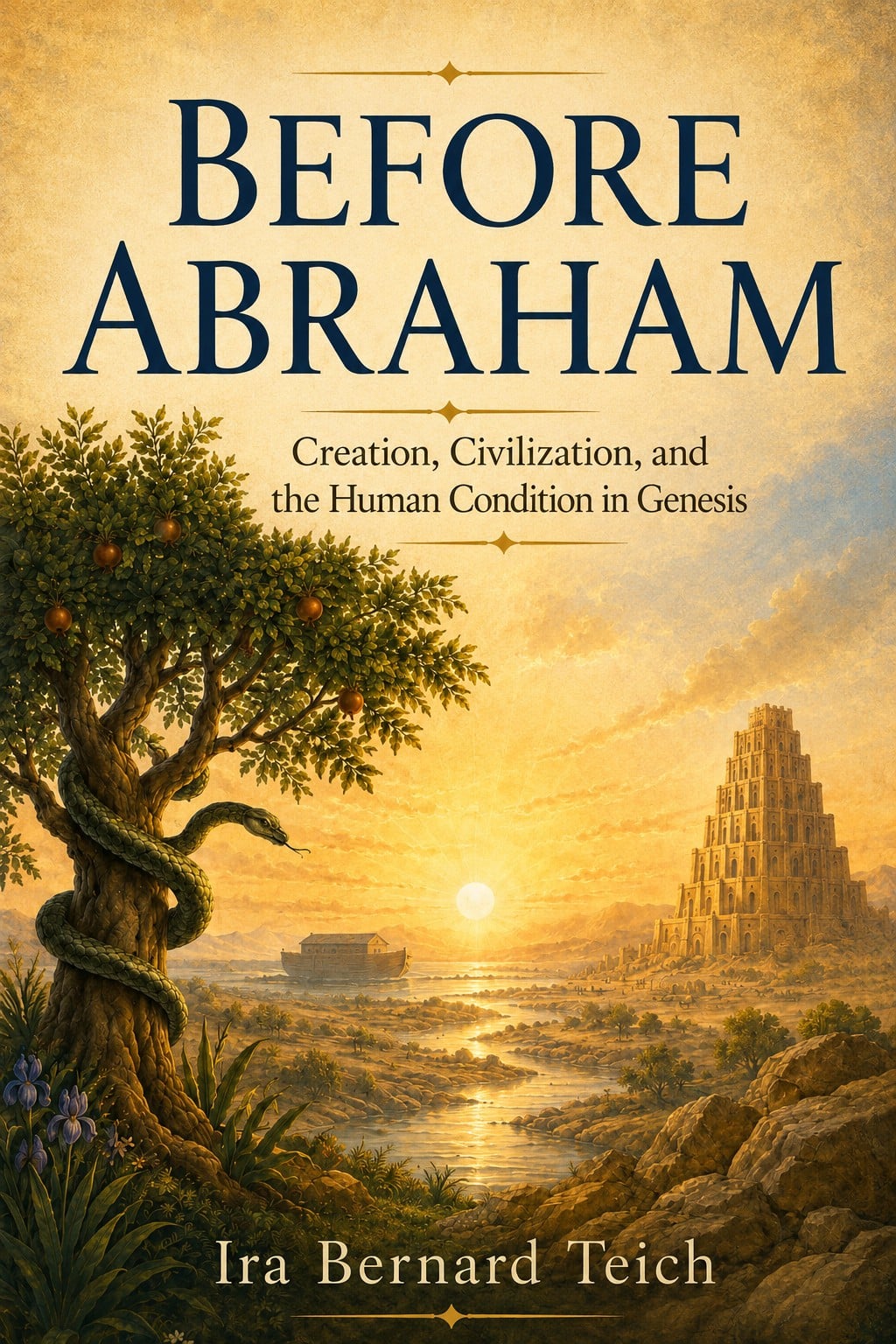
Before Abraham: Why the Torah Begins with Humanity, Not Judaism
The Torah does not begin with Abraham.
It does not begin with the Jewish people, the Land of Israel, the Exodus, or even the first commandment. Instead, it devotes eleven extraordinary chapters to the creation of the universe, the emergence of human consciousness, the first murder, the growth of civilization, the Flood, and the building of Babel.
Only then does Abraham appear.
That structure is so familiar that we rarely stop to consider how remarkable it is. If Genesis is ultimately the story of the birth of the Jewish people, why spend so much time describing a world in which there are no Jews?
The answer, I believe, is that before the Torah can speak to us as Jews, it must first speak to us as human beings.
Genesis (Beresheet) 1–11 addresses the permanent questions of human existence. What does it mean to be created in the image of God? Why are knowledge and moral responsibility inseparable? Why does freedom so quickly become destructive? Why do brothers become rivals? Why does civilization produce both music and murder, technology and tyranny? And why do human beings repeatedly try to build structures powerful enough to replace God?
These chapters are sometimes treated as charming but primitive stories – material to be taught in childhood before moving on to the “serious” biblical narratives. Yet they may be among the most psychologically and politically sophisticated texts ever written.
Consider Adam and Eve.
Their story is often reduced to disobedience and punishment. But the text is wrestling with something much deeper: the birth of moral consciousness. The fruit they eat comes from the Tree of Knowledge of Good and Evil. Their eyes are opened, but enlightenment does not bring peace. It brings shame, fear, blame and alienation.
Knowledge makes humanity more powerful, but not necessarily wiser.
That remains one of the defining dilemmas of modern life. We possess scientific and technological capacities that earlier generations could scarcely imagine, while remaining vulnerable to the same envy, vanity, aggression and self-deception that appear in the earliest chapters of Genesis.
The problem is not knowledge itself. The problem is knowledge unaccompanied by moral maturity.
The story of Cain and Abel takes the warning further. The first death recorded in the Torah is not from disease, old age or accident. It is murder – and the victim is a brother.
Cain’s offering is rejected, or at least not received as he hoped. His response is not introspection but resentment. God warns him that sin is crouching at the door, but that he can still master it. Cain retains freedom. He is not destined to kill.
Yet he does.
The Torah thereby identifies one of the most dangerous patterns in human history: wounded pride transformed into moral entitlement. Cain feels diminished and therefore convinces himself that another person must be eliminated.
His question, “Am I my brother’s keeper?”, echoes through every generation. It is the voice of someone who understands responsibility well enough to deny it.
Then comes civilization.
Cain builds a city. His descendants develop animal husbandry, music and metalworking. Human creativity flourishes. But alongside culture and technology comes Lamech, who boasts to his wives that he has killed a man for wounding him.
The Torah does not present civilization as inherently corrupt. Nor does it romanticize a return to some untouched natural existence. Rather, it warns that material advancement and moral advancement are not the same thing.
A society can become more sophisticated without becoming more humane.
That message culminates in the generation of the Flood, when the earth becomes filled with hamas – violence, lawlessness, and corruption. The destruction is not portrayed as punishment for a single isolated crime. It comes after violence has become systemic, embedded in the very structure of society.
Noah survives, but even the Flood does not remake humanity. Soon afterward Noah becomes drunk and lies exposed in his tent. The survivor of one broken world cannot create a perfect one.
The Torah’s realism is relentless. There are no simple resets. Human beings carry their weaknesses with them.
Finally, humanity gathers to build Babel: a city and a tower reaching toward heaven. The builders want to make a name for themselves and prevent their dispersal across the earth.
At first glance, their unity seems admirable. They speak one language and share one purpose. Yet the Torah views their project with suspicion.
Why?
Perhaps because unity can become another form of tyranny. A society in which everyone speaks the same language, shares the same ambition and participates in the same monumental project may leave no room for individuality, dissent or moral independence.
Babel is not merely a story about human arrogance. It is a warning against enforced uniformity and the worship of collective power.
Only after these repeated failures does God call Abraham.
Abraham is not chosen because humanity no longer matters. He is chosen because humanity matters profoundly. His family is charged with bringing blessing to “all the families of the earth.”
The particular mission of the Jewish people is therefore rooted in a universal moral vision.
This is why I wrote Before Abraham: Creation, Civilization, and the Human Condition in Genesis.
I wanted to look again at these opening chapters – not simply as ancient religious narratives, but as profound reflections on consciousness, freedom, violence, power, civilization and human responsibility. In writing the book, I drew upon classical Jewish interpretation, philosophy, history, psychology and modern thought, while trying to keep the discussion accessible to readers who may not possess a formal background in biblical study.
The questions raised by Genesis 1–11 are not relics of the ancient world.
We still struggle with knowledge without wisdom, technology without restraint, political unity without freedom, grievance without responsibility, and power without moral limits. We still build our towers and make names for ourselves. We still ask whether we are responsible for our brothers and sisters.
And we still await the answer that Abraham’s journey begins to provide.
Before Abraham: Creation, Civilization, and the Human Condition in Genesis is available in paperback and Kindle editions through Amazon.