

A Call to the Moral Debate the World Refuses to Face — A Black Jewish Voice Speaks for Israel and Global Jewry
Before You Build Colonies on Mars, Elon Musk, Come Visit the One in Jerusalem
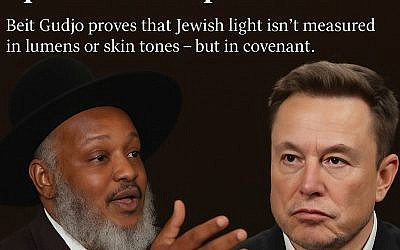
Right: Elon Musk, the owner of X and CEO of Tesla and SpaceX, and Jonathan Greenblatt, head of the ADL. (Alain Jocard/AFP; JP Yim/Getty Images via AFP) Left: Chief Ethiopian Rabbi Reuven Wabashat at Torah Teaching at The Sephardic Yeshiva Jerusalem, Israel., June 9, 2017. (Photo credit and commercial-use permission: Shmuel Legesse)
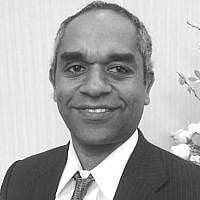
By Dr. Shmuel Legesse: Upcoming Author of Moral Diplomacy for a Broken World: Inspired by the Vision of Rabbi Jonathan Sacks
For 2,500 years, the Jews of Ethiopia Jews/ the Beta Israel community dreamed of Zion. They prayed facing Jerusalem not as a metaphor but as a direction of the soul. When they finally came home, many kissed the soil and wept.
Today, forty years after that historic Aliyah, a new dream is rising in the heart of Jerusalem: to build a living, breathing home for Ethiopian-Jewish heritage, a place where faith, education, and identity can flourish together. Nestled within Jerusalem’s hills stand a remarkable project called Beit Gudjo, a traditional Ethiopian village lovingly re-created and dedicated to the memory of Tedesse Tshoma (z”l), murdered in a terrorist attack at the entrance to Jerusalem in 2022. Around this sacred centerpiece, a new visitor and learning center is emerging, Beit Jerusalem which will become Israel’s first museum to unite authentic cultural heritage with modern technology. Visitors will experience ancient agriculture, traditional crafts, and even don virtual-reality glasses to walk through daily life in an Ethiopian-Jewish village from the humble clay oven to the kesim (spiritual leaders) who kept Torah alive through exile. A memorial room honors those who perished en route through Sudan, who died with the Shema on their lips and Jerusalem in their hearts.
This vision is not one person’s dream; it is a covenant of many. The Yvel Foundation, led by Itzik and Orna Levy, together with the UJA-Federation of New York, Israel’s Ministry of Aliyah and Integration, the Jerusalem Municipality, and the Ministry of Environmental Protection, joined hands to make it possible. As Jerusalem Mayor Moshe Leon said, “We are reconnecting Jerusalem to the ancient story of the Beta Israel community, a story of longing for Jerusalem for thousands of years. The Gudjo House stands as living testimony to the rich heritage of Ethiopian Jewry and its spiritual strength.”
A Living Bridge, Not a Museum
Beit Gudjo is not merely a museum; it is a living bridge. Every week it hosts classes for children, teens, and elders; Hebrew-Amharic storytelling; Torah and tradition workshops; and technology courses preparing Ethiopian-Israeli youth for Israel’s future economy. Alongside Torah scrolls and heritage items, you will find computer labs and robotics kits. Recently, one community leader running a computer class for boys lost access to borrowed school laptops. To continue, he needs just 43 computers, a small act with immeasurable impact. These boys are Jerusalem’s future engineers, rabbis, and soldiers. To give them tools is to give Israel hope.
The Ethiopian Israeli community today numbers over 178,000 citizens. Many have integrated beautifully into Israel’s social fabric, serving in the IDF, academia, and public service. Yet others still face barriers and underrepresentation. Now, as antisemitism and identity crises spread worldwide, the story of Beta Israel is not a side chapter, it is the essence of Jewish resilience. It teaches that Jewish identity is not color or accent; it is covenant. The same faith that kept my ancestors praying toward Jerusalem beneath the Ethiopian sun built the modern State of Israel beneath the desert sky.
In Jerusalem’s Neve Yaakov neighborhood 38 Neve Yaakov Blvd, Jerusalem stands Beit Gudjo, Beit Jerusalem, and Oro Shel Olam, the Oro Shel Olam Organization, founded by Rabbi Moshe Balay and Rabbi Ephraim Tagnia under the spiritual leadership of Rabbi Reuven Wabashat, Shlita, Chief Rabbi of Ethiopian Jewry. Its purpose: to preserve our sacred heritage and raise a new generation of confident, educated community leaders. Through its Yeshiva Gedolah Mishkenotekha Yisrael, the organization offers advanced Torah study to young men of excellence, many once turned away from mainstream yeshivot or forced to set aside their ancestral traditions. Here, they study Torah and Beita Israel heritage side by side honoring both Halacha and history. This yeshiva, the first and only of its kind operated by members of the Ethiopian community, also welcomes students from every background Ethiopian, Ashkenazi, and Sephardi creating unity through shared learning.
Why the World Must Help
These projects Beit Gudjo, Beit Jerusalem, and Oro Shel Olam are more than buildings. They are the continuation of prophecy: “From beyond the rivers of Cush, My worshipers will bring offerings to Me.” (Zephaniah 3:10) But dreams cannot live on prayer alone; they need partners. The global Jewish community and every friend of truth and freedom is invited to come, see, and support. You don’t need to fly to Africa or Red Sea port Elat to meet African Jews; come to the heart of Zion/City of Jerusalem, and witness the miracle. Bring students, rabbis, journalists, and donors. Walk through the Gudjo village, share a Shabbat meal, plant a tree, sponsor a scholarship, donate a laptop, or help fund the Beit Midrash that will train tomorrow’s leaders. Every gesture financial, educational, or spiritual secures this vital chapter of the Jewish story. Supporting these institutions is not charity; it is justice and continuity. Empowering Ethiopian Jews in Jerusalem strengthens Israel’s moral core and fulfills the promise that Zion is not whole until all her children feel at home. Our sages taught: “Jerusalem was destroyed only because her people failed to see one another as brothers.” The reverse is also true: Jerusalem will be redeemed when all her children see one another as family.
To every Jewish federation, synagogue, philanthropist, and educator: come to Beit Gudjo, come to Oro Shel Olam, come to Jerusalem. Please contact the Chief Ethiopian Rabbi Reuven Wabashat at ReuvenW@dat.gov.il Director of the Ethiopian Community Division at Israel Ministry of Religious Service or the program director Rabbi Moshe Balay at moshebalay8@gmail.com Stand where the dream of Ethiopian exiles meets the promise of the modern Jewish state. Meet the youth whose eyes shine with Torah and technology. Meet the mothers singing Amharic lullabies. Meet the elders shaping clay jars as their ancestors did in the days of the Temple. This is living heritage and holy history in motion. If we unite to strengthen this community, we will not only honor those who died on their way to Zion; we will ensure their descendants flourish within it. The light of the Ethiopian Jewish community will continue to illuminate the Jewish world from the alleys of Neve Yaakov to hearts everywhere.
As an educator, diplomatic expert and believer in moral diplomacy, I see in this project a model for humanity: how to heal division by honoring every story, shade, and melody in our shared song. Jerusalem does not belong to one community; it belongs to the family of families called Israel.
Am Yisrael Chai — and let the heart of Zion beat with every color, every prayer, and every soul that longs for Jerusalem.
Permission Note:
The writer grants The Times of Israel and any reputable Jewish, interfaith, or community publication worldwide full permission to publish, reprint, or translate this article in whole or in part for the purpose of education, unity, and support of the Ethiopian-Jewish community in Jerusalem.