
CEO of Time to Stand Up for Israel
Before You Lecture Israel, Look in the Mirror
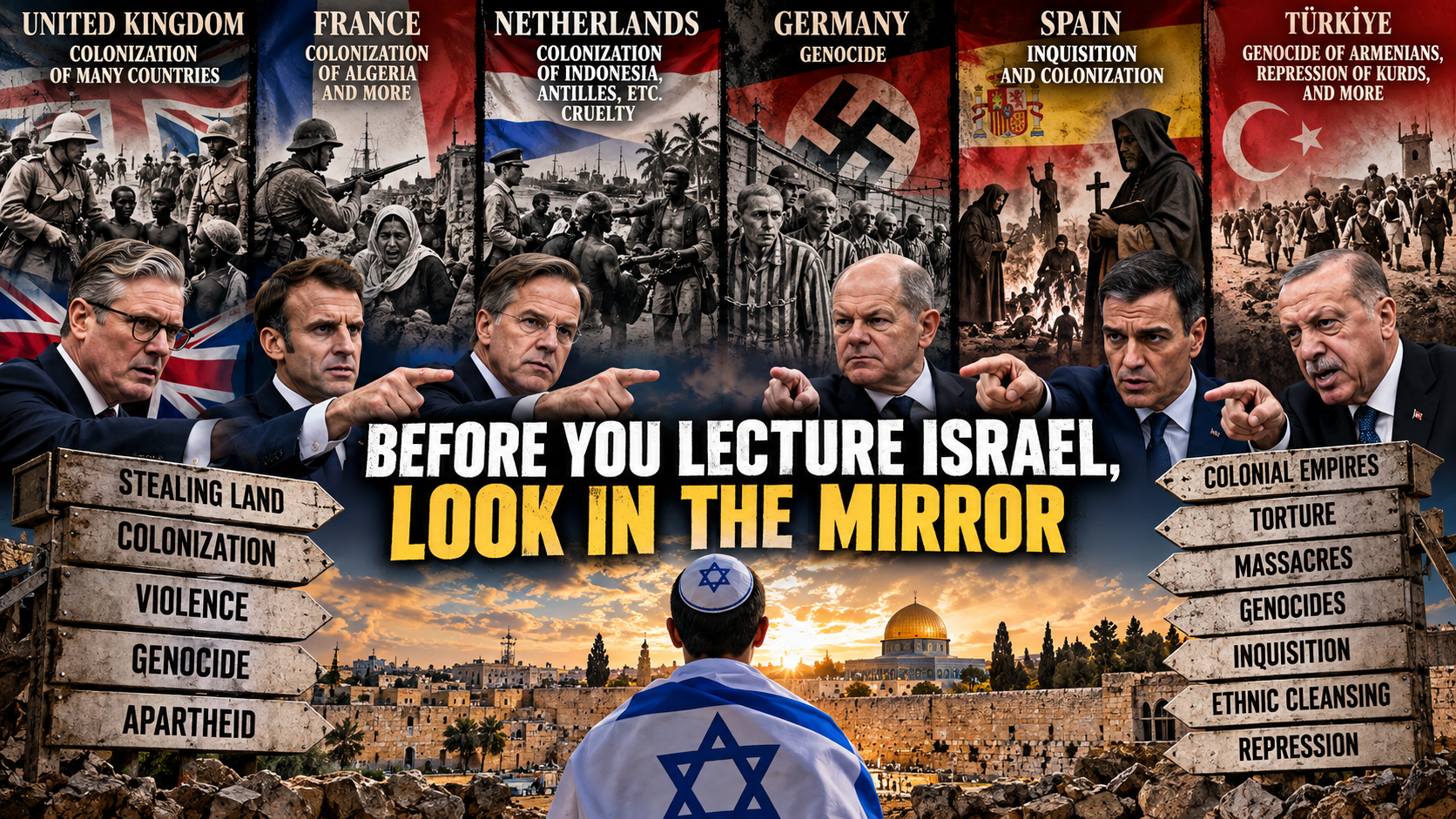
Photo Credits: Sabine Sterk ( AI)
Before You Lecture Israel, Look in the Mirror
There is something increasingly difficult for me to accept when I listen to governments across Europe and beyond lecture Israel about colonialism, stolen land, occupation, violence and even genocide. It is not that countries should remain silent because their own history is stained. No country should receive immunity from criticism simply because others have committed terrible acts in the past, and Israel, like every democracy, should be questioned and held accountable for its decisions. But there is a difference between legitimate criticism and moral grandstanding, particularly when some of the loudest voices come from nations whose own histories contain actual empires, colonies, forced displacement, torture, persecution and genocide. When these countries speak as though history began with Israel, while forgetting what their own flags once represented to millions of people elsewhere in the world, I cannot help asking a very simple question. Before pointing the finger at Israel, have you looked carefully enough in the mirror?
United Kingdom
Britain lecturing Israel about colonialism is perhaps one of history’s strangest ironies. The British Empire controlled territories across Africa, Asia, the Middle East, the Caribbean and elsewhere, governing populations thousands of kilometres away from London. In Kenya, for example, the British government itself has acknowledged that Kenyans suffered torture and other forms of ill treatment at the hands of the colonial administration during the Mau Mau Emergency. In 2013 Britain reached a settlement covering 5,228 Kenyan claimants and publicly expressed regret for those abuses. This does not mean that modern Britain cannot criticize Israel. Of course it can. But when the language is “colonialism,” Britain should understand better than almost any country what colonialism actually meant. Jews did not arrive in the Middle East as representatives of London, Paris or Amsterdam building an overseas empire for a European mother country. Jewish history, religion, language and archaeology connect the Jewish people to the Land of Israel across millennia. Whatever one’s position on the modern Israeli Palestinian conflict, reducing that history to a simple European colonial adventure erases precisely the indigenous Jewish history that such arguments claim to care about.
France
Then there is France, another country from which Israel regularly receives lessons about occupation, violence and human rights. France ruled Algeria for 132 years. In 2012, President François Hollande described the colonial system in Algeria as profoundly unjust and brutal and explicitly acknowledged the suffering it inflicted on Algerians, including massacres, violence and torture. France has subsequently acknowledged individual cases in which French forces tortured and killed people during the Algerian War. President Emmanuel Macron acknowledged that Maurice Audin was tortured and executed or tortured to death within a system that facilitated disappearances and torture, and France later acknowledged that Algerian nationalist Ali Boumendjel was tortured and murdered. Again, none of this removes France’s right to criticize Israeli policies. It should, however, encourage humility. A nation that knows from its own history what genuine colonial domination looked like should be exceptionally careful before casually forcing every aspect of the Israeli Palestinian conflict into the same historical template.
The Netherlands
And yes, I am Dutch, so I am perfectly prepared to look at my own country too. The Netherlands built a colonial empire that included what became Indonesia as well as territories in the Caribbean and elsewhere. We cannot erase that history because it is uncomfortable. A major Dutch research programme by NIOD, KITLV and NIMH concluded that during the Indonesian War of Independence the Dutch armed forces used extreme violence frequently and structurally, including extrajudicial executions, torture and ill treatment, the burning of houses and villages, disproportionate bombardment and mass detention. The researchers concluded that the Dutch government and military leadership tolerated this extreme violence. That history belongs to us. We have to face it. Precisely because I am Dutch, I find the ease with which some people in my country throw around words such as “colonialism” particularly remarkable. Our ancestors sailed thousands of kilometres from Europe to establish and maintain overseas colonial rule. Jews praying toward Jerusalem for generations, maintaining communities in the land and returning to their ancestral homeland represent a fundamentally different historical phenomenon, even though that fact does not by itself resolve competing national claims or every question about territory today.
Germany
Germany requires an entirely different level of historical reflection because here we are not simply discussing colonialism. Nazi Germany carried out the systematic, state sponsored genocide of Europe’s Jews. Six million Jewish men, women and children were murdered, approximately two thirds of Europe’s prewar Jewish population. That history does not mean today’s Germany must agree with every Israeli government or every Israeli military decision. Friendship does not require silence and remembrance does not require abandoning critical thought. But Germany should understand better than almost anyone the enormous historical weight of the word genocide. Genocide is not merely a synonym for a terrible war, large civilian casualties or even alleged violations of international humanitarian law. It is a specific accusation with a specific legal meaning. For Germans in particular, using that word should never become a slogan or a rhetorical weapon detached from evidence, law and historical seriousness.
Spain
Spain should also remember its own history before presenting today’s conflicts as simplistic morality plays. The Spanish Inquisition, established in the late fifteenth century, persecuted suspected heretics, particularly converts from Judaism and Islam accused of secretly practicing their former religions. In 1492 the Catholic monarchs ordered Jews to leave their kingdoms unless they converted, ending centuries of open Jewish life in Spain and contributing to the creation of the Sephardic diaspora. Spain also became the centre of an enormous overseas empire in the Americas and elsewhere. Again, acknowledging that history does not silence modern Spain. It should instead remind us how dangerous it is when powerful societies decide that Jewish belonging can be accepted or rejected according to the political fashion of a particular century.
Turkey
Turkey presents another striking historical contradiction. The Armenian genocide took place in the Ottoman Empire during 1915 and 1916. According to the United States Holocaust Memorial Museum, at least 664,000 and possibly as many as 1.2 million Armenians died through massacres, individual killings, systematic mistreatment, exposure and starvation. Turkey’s history with its Kurdish population also contains serious episodes of repression and human rights violations. Human Rights Watch has documented killings, disappearances and torture involving Kurds in Turkey, while more recent reporting has described arbitrary detention and other abuses affecting Kurdish communities and political figures. Turkey can criticize Israel just as Israel can criticize Turkey, but history makes sweeping moral superiority difficult to sustain.
And that brings me to the point that matters most. This is not an argument that Britain, France, the Netherlands, Germany, Spain or Turkey must remain silent forever because of what previous generations did. That would be intellectually dishonest. Today’s British citizen is not personally responsible for colonial abuses in Kenya, today’s Dutch citizen is not responsible for violence in Indonesia, today’s German is not personally guilty of the Holocaust, and today’s Turk is not individually responsible for what happened to Armenians in the Ottoman Empire. Collective inherited guilt is not the answer.
But collective historical memory matters.
If you accuse another nation of colonialism, know what colonialism means. If you accuse another people of stealing land, understand the history of the land and all peoples connected to it. If you condemn military violence, examine comparable conflicts rather than applying standards to one country that you would never apply elsewhere. And if you use the word genocide, understand what that accusation means before turning one of humanity’s gravest crimes into political vocabulary.
Most importantly, stop treating Jewish history as though it began in Europe in 1945.
The Jewish connection to the Land of Israel did not begin with the Holocaust, the British Mandate or the establishment of the State of Israel in 1948. Jewish civilization developed in that land in antiquity. Jerusalem, Judea, Hebrew, Jewish kingdoms, Jewish religious traditions and the continuous Jewish attachment to Zion existed centuries before most modern states were imaginable. None of that automatically answers every modern border dispute or extinguishes Palestinian history and national aspirations. It does, however, make the fashionable slogan that Jews are simply foreign European colonizers historically inadequate.
Perhaps the world needs fewer pointing fingers and more mirrors.
Criticize Israel when criticism is supported by facts. Debate its governments. Question its policies. Investigate allegations of wrongdoing. Israelis themselves do all of these things constantly. But do not erase Jewish history to make the argument easier, do not redefine complicated history into slogans, and do not apply words such as colonialism and genocide casually because they produce the strongest emotional reaction.
History is not a weapon that belongs exclusively to those accusing Israel.
History is also evidence.
And if nations want to invoke history while judging Israel, then they should be prepared to open the entire history book, including the chapters carrying their own names.
Related Topics
Related Posts