An Aging Jewish Feminist
Beginnings and Endings: Parshat Vayera
There is much posttraumatic stress in Israel today, and thus it is good for my mental health to spend time in Los Angeles with my son in his warm and welcoming congregation. I actually enjoyed the tension over the World Series games—it was a relief to be preoccupied with something as ordinary as baseball rather than with when (and if) all of the hostages’ bodies will finally be returned. Most enjoyable of all is the chance to meet the caring and interesting congregants here, who invite me to partake of meals in their beautiful homes. Their gracious hospitality reminds me, inevitably, of another host—Abraham, our ancestor—whose home and heart were always open.
Abraham’s Home Hospitality
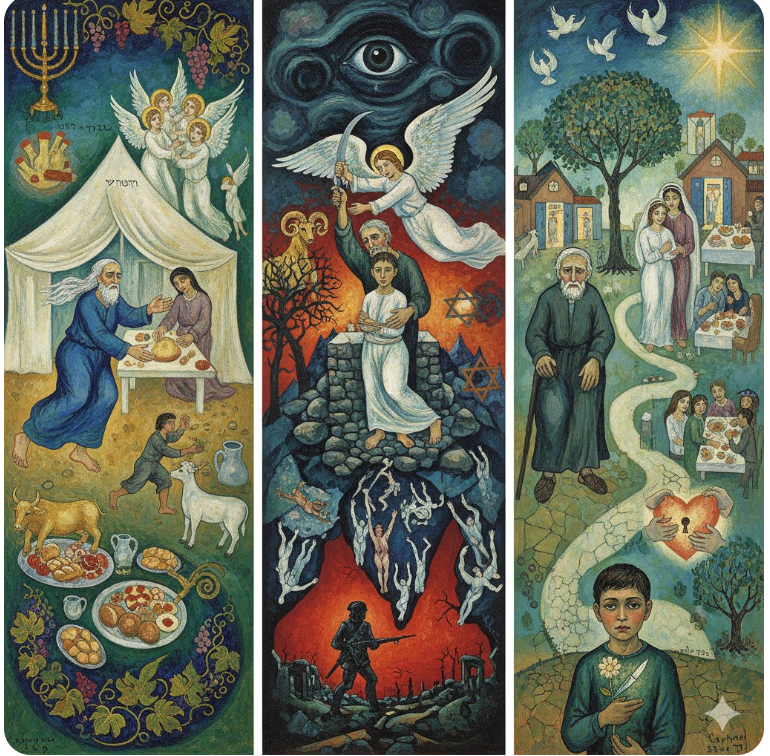
Parshat Vayera begins with Abraham and Sarah’s hospitality to the three messengers of God, when Abraham is still recuperating from his circumcision in the previous parsha (Gen. 17:23–27). Abraham is sitting at the entrance of his tent on a very hot day. Looking up, he sees three figures standing near him. When he sees them, he runs from the entrance of the tent to greet them, bowing to the ground. He insists that they stop and visit with him:
“My lords! If it please you, do not go on past your servant. Let a little water be brought; bathe your feet and recline under the tree. And let me fetch a morsel of bread that you may refresh yourselves; then go on—seeing that you have come your servant’s way.”
They agree, and immediately Abraham runs into the tent to Sarah:
“Quick, three seahs of choice flour! Knead and make cakes!”
Then, full of energy, he hurries out to his herd, chooses a tender calf, and gives it to one of his lads to prepare. When all is ready, Abraham serves the meal—meat, milk, and curds—and waits on his guests while they eat.
Abraham’s hospitality is wholehearted. Seeing these strangers in the desert, he offers them first water, then rest, and finally “a morsel of bread”—an understatement for what becomes a royal feast. He insists on the best ingredients, the finest flour, the choicest meat. Like a model host, he remains present while they eat, alert to their needs, expecting nothing in return.
Fortunately, Abraham has his loyal household—Sarah, his servant boy, and perhaps others—working behind the scenes, ensuring that every detail is tended to and, one hopes, washing the dishes after the guests depart.
Unlike old man Abe, who jumps up, runs to greet his visitors, and dashes between kitchen and field with boundless energy—even while recovering from circumcision—I move slowly, cane in hand, when invited into people’s homes. I can only marvel at Abraham’s superhuman vitality and at the enduring Jewish impulse toward hospitality, even in times of weakness or pain.
The Akedah
The same portion that opens with Abraham’s generous hospitality ends with one of the most harrowing moments in all of Torah—the Akedah, the binding of Isaac. It often coincides with the anniversaries of Kristallnacht (Nov. 9–10, 1938) and the assassination of Yitzhak Rabin (Nov. 4, 1995)—both events that scarred Jewish history and continue to provoke deep reflection. As Tikva Frymer Kensky observed, “In its stark horror and ambiguous statements, the story of the Akedah remains the central text in the formation of our spiritual consciousness.”
In Genesis 22:1, “After these things, God tested Abraham.” Without hesitation, Abraham obeys God’s command to sacrifice his son. This story—described by Kierkegaard as arousing “fear and trembling”—has haunted generations, raising enduring questions about faith, morality, and divine will.
The Hebrew olah (“that which goes up”)—once translated as “holocaust”—took on new meaning after the Shoah. The word nisah (“tested”) suggests not a mere challenge but a trial by fire, one of the many that shaped Abraham’s life and faith.
Rashi, drawing on Sanhedrin 89b, links the Akedah to Satan’s accusation that Abraham’s devotion was incomplete. Like Job, Abraham becomes a test case for divine faith. The question remains: does God test Abraham—or does God Himself struggle with the urge to test humanity’s limits?
In the end, Abraham is spared the act by divine intervention: a ram appears, caught in the thicket. When Abraham lifts his eyes and sees the ram “ahar”—traditionally translated as “behind”—commentators have long debated its meaning. Some render it as “one ram,” others as “afterwards” or “another.” Midrashic tradition even identifies the ram as Yitzchak himself, created at twilight before the first Sabbath, destined for this moment.
The word ahar may suggest not “behind” but “another way.” Abraham looks up and sees—not only the ram, but a divine alternative to human sacrifice. In that instant, he recognizes that faith can mean moral insight rather than blind obedience. The angel becomes the acher—the “other” divine voice—offering Abraham a way out, affirming that not all of God’s commands must be obeyed literally.
Aftermath and Recovery
After the Akedah, God never again speaks directly to Abraham. Yet Abraham grows more humane: he remarries, provides for all his children, and arranges Isaac’s marriage. He becomes a model of recovery—not from physical pain, but from moral and spiritual trauma. His life teaches that faith need not end in silence or paralysis; it can mature into compassion and responsibility.
Modern Echoes
Wilfred Owen, in his poem “The Parable of the Old Man and the Young,” imagines Abraham going through with the sacrifice—a haunting allegory for the senseless obedience of war. Hayim Gouri, writing after the Holocaust, saw it differently in “Heritage”:
“Isaac, as the story goes, was not sacrificed…
But he bequeathed that hour to his descendants.
They are born with a knife in their hearts.”
The challenge that remains—for Abraham’s descendants and for us—is how to live with inherited trauma: to preserve memory yet also heal, to find meaning and faith amid divine silence.
Just as Abraham’s tent opened to strangers in the desert, we too must open our hearts in times of fear and uncertainty. Hospitality, compassion, and the search for moral clarity—these are the beginnings and endings that still shape our story.
Related Topics