Torah for the Age of Awakening
Behar-Bechukotai: Unifying Earthly with Supernal
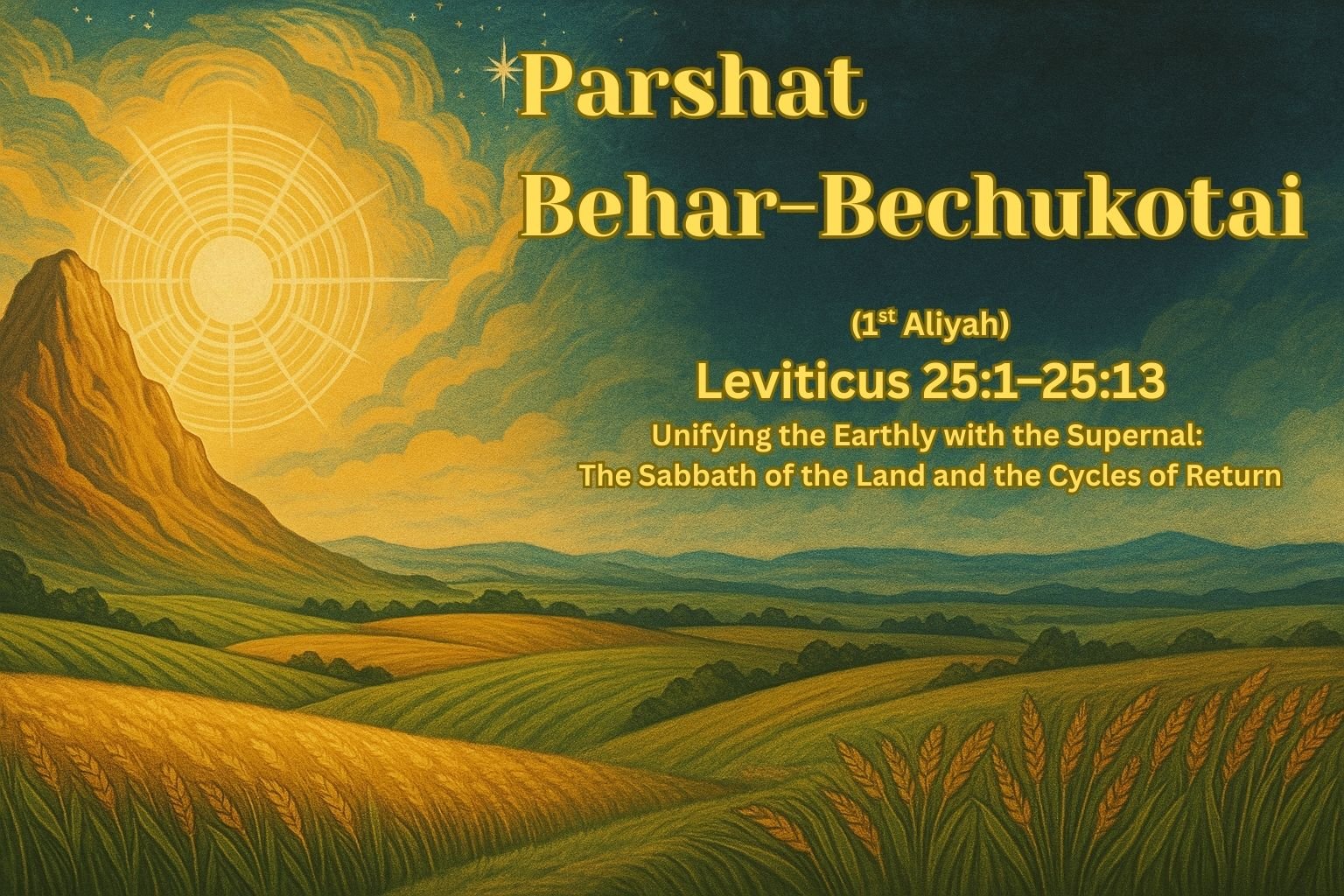
Unifying the earthly with the supernal
Commentary on Parshat Behar-Bechukotai (First Aliyah)
Leviticus 25:1–25:13
Unifying the Earthly with the Supernal: The Sabbath of the Land and the Cycles of Return
“And the LORD spoke to Moses on Mount Sinai, saying…”
At the threshold of this dual parsha, the Torah transports us mystically to Har Sinai—not merely a geographical peak, but a symbol of inner ascension. In Kabbalistic language, Mount Sinai represents the axis between worlds: the sulam mutzav artzah v’rosho magia haShamayma—a ladder planted in the earth, whose head reaches into the heavens. The fact that Behar (meaning “on the mountain”) begins this portion hints to us that we must ascend within to receive the mysteries that follow.
It is no coincidence that the laws of the Shmittah (Sabbatical year) are taught from Sinai. These laws, unlike the moral commandments, pertain to the earth itself. Thus, Sinai becomes the place where heaven and earth embrace, where Torah, a supernal fire, is carved into the elemental clay of human existence. As above, so below.
“When you come into the land which I give you, the land shall rest a Sabbath unto the LORD.”
Here is the seed of metaphysical paradox: The land, inanimate in our material sense, is here instructed to rest. But rest is not inaction—it is return. The land is not a machine but a living vessel of the Divine Breath (Ruach Elohim), and the Shmittah is its inhalation after six years of exhalation.
The Zohar teaches that the number six corresponds to the middot—the emotional attributes of the Tree of Life (Chesed through Yesod), each representing outward flow and creative emanation. The seventh year—Malchut—is the vessel that receives. Just as Shabbat sanctifies the week, the seventh year is a temple in time for the earth itself.
Here we find here the principle of rhythm: the Law of Periodicity. All things move in tides. Expansion (six years of sowing) and contraction (one year of rest) mirror the cosmic breath, the Ein Sof inhaling and exhaling existence. The farmer, then, is not merely one who works the land, but one who must attune himself to its spiritual tides. To violate this rhythm is not only ecological sin, but metaphysical disharmony—a dissonance in the music of the spheres.
“Six years you shall sow your field… but in the seventh year shall be a Sabbath of solemn rest for the land…”
This cycle evokes not only days and years but the greater cosmic epochs: the six thousand years of history, followed by the seventh millennium—the Messianic era, a macrocosmic Shabbat of the world. In this seventh period, the earth will “rest” from duality, and unity (echad) will reign.
On a mystical level, this rest (Hebrew: Shabbat) does not mean idleness but return to source: Teshuvah. The word Shabbat shares roots with lashuv, to return. The land, and by extension humanity, returns to its essential being, unbound by acquisition or labor, unencumbered by the illusion of separateness. In this holy repose, the illusion of ownership dissolves.
“You shall not sow your field, nor prune your vineyard…”
We encounter a deeper paradox: release is commanded. Let go. Do not cling to control. The ego resists this law, for it thrives on mastery, manipulation, and productivity. Yet the Shemitah demands surrender—an unmaking of the illusion that we own anything at all. It is a direct assault on the klippah (shell) of yesh, “I am something,” which conceals the truth of Ayin, “I am nothing but an expression of the One.”
In the Shemitah, we do not create; we allow. The farmer is taught the divine art of non-doing. As it is said in the Sefer Yetzirah: “The end is in the beginning and the beginning is in the end.” To stop sowing is to acknowledge that the true seed is already planted in the soil of Being.
“And the Sabbath produce of the land shall be food for you… for your servant, your maidservant… and for the animals and the beast that are in your land.”
This equal distribution of produce is not mere social justice. It is ontological justice. During the seventh year, the hierarchical illusion collapses. Master and servant, man and beast, all become partakers of one table. This is Da’at Elyon: the higher knowledge that all beings share one root. In this year, the kelim (vessels) of ego shatter, and only the light of unity remains.
We see in this a revelation of the unity principle: All is One, and One is All. The fruits of the earth, which in normal times are divided by social order, are now expressions of the singular source. The spiritual principle is clear: When we relinquish our illusion of control, the abundance of Being flows freely and nourishes all.
“And you shall count seven Sabbaths of years… and you shall hallow the fiftieth year…”
Now we ascend to the mystery of the Jubilee (Yovel), the super-Sabbath. After seven cycles of seven—49 years—comes the 50th, the cosmic aperture. In Kabbalah, the 50th gate (Sha’ar HaNun) is the threshold of pure transcendence, the gate Moshe approached but did not fully enter.
The number 49 represents the full expression of the sephirotic tree within time. Each week of the Omer corresponds to one sefirah within another (Chesed shebeChesed, Gevurah shebeChesed, etc.), refining the soul. But the 50th is beyond structure. It is Keter: the Crown. It cannot be earned or prepared. It is a descent of grace.
In the Jubilee, all debts are forgiven. All lands return to their original owners. The year becomes a mystical rehearsal of Olam HaBa—the World to Come—where each soul returns to its root, unburdened by karma or possession.
“Proclaim liberty throughout the land to all its inhabitants…”
This verse, inscribed on the US Liberty Bell, is not only political—it is metaphysical. The Hebrew dror (liberty) implies the unbinding of the soul from false identification. To proclaim liberty is to speak the ineffable Name into the matrix of form, shattering the illusion of separation.
Liberty is the return of the microcosm to the macrocosm. In Kabbalistic language, it is Shekhinah returning to Kudsha Brikh Hu. In mystical union, the soul that wandered in exile (galut) returns to its palace. The Jubilee is the final tikun—restoration of cosmic order.
Final Thoughts
The first aliyah of Behar-Bechukotai is not merely agricultural instruction—it is a code of cosmic ecology. The cycles of rest, release, and return mirror the deepest truths of Torah metaphysics: that all things emerge from and return to the One. In this portion, Torah speaks not only to Israel but to the soul of the world: teaching us how to live in harmony with the Divine rhythm, how to surrender the illusion of ownership, and how to walk the path where heaven and earth meet—on the mountain of inner Sinai.
As it is written in the Sefer Yetzirah:
“He made them as a balance, weighing one against the other.”
In the balance of rest and labor, giving and receiving, sowing and releasing, we find the Way of the One.
Related Topics
Related Posts