
Being Railroaded in Petach Tikva
My junior high school class day trip from suburban Philadelphia to Washington, DC was a very interesting and enjoyable venture for all of us. We boarded the buses very early in the morning in front of my junior high school, and rode down to Washington for a full day of seeing many of the various sites there. Time constraints dictated that we were only able to view many of the well-known attractions, including the White House, from the street. We did get to see the inside of the Washington Monument, and witnessed the changing of the guard at the Tomb of the Unknown Soldier in Arlington National Cemetery, however.
The teacher who was chaperoning the particular bus I was on had a well-earned reputation for zero tolerance of misconduct; he himself had once been a bus driver, and insisted that we cleaned up the litter before he allowed us to leave the bus upon our return to the junior high school late that night. At least on our particular bus, the trip proceeded without any major complications.
I had previously traveled to Washington with my family on several occasions, and enjoyed each and every trip I had made before (and would make in the future). What I noticed on that particular excursion with my junior high school class was that the Washington DC I had known before was marred by the ongoing construction of what would become the Washington Metro transit system, which would begin operations seven years later. Streets were closed, and piles of dirt from the excavations were to be seen at many locations as tunnels were bored beneath the streets of Washington.
The people of Washington’s affluent Georgetown section used their political clout to prevent the Metro from being constructed in their area; many unabashedly making no efforts to conceal their fears of the prospects of increasing access to their neighborhood of individuals deemed by them to be of lower-class.
Fast-forward a few decades: Many Georgetown residents regret the attenuation of their homes from the advantages of rapid transit availed by the Metro. Proximity to a Metro station has been a factor contributing heavily to the increase in real estate values. Today, many homes near Metro stations have increased in value at rates greater than those in Georgetown (including the one in the Brentwood neighborhood in which my mother-in-law grew up).
* * *
The Transcontinental Railroad in the United States was (mostly) completed on 10 May 1869, with the connection of the tracks of the Central Pacific Railroad to those of the Union Pacific Railroad at Promontory Summit, Utah Territory, effectively linking the rail connection between the eastern and western coasts of the United States. The event culminated with the driving of a ceremonial Golden Spike (which was immediately replaced with an ordinary steel one to forestall its inevitable theft if allowed to remain unguarded). The Union Pacific crews, working westward, were largely Irish immigrants, while the Central Pacific laborers who worked eastward from San Francisco were, for the most part, Chinese immigrants.
In those days before labor laws gave protections to employees, the treatment of the workers was known to have occasions to cross the line from abuse to atrocity. The construction of that railroad is a theme that has found its way into the songs of Irish Americans, and several people having firsthand knowledge have informed me that today it is not unusual amongst sixth- and seventh-generation Chinese Americans to have heard family lore about an ancestor who had worked as a Central Pacific laborer to construct the railroad.
* * *
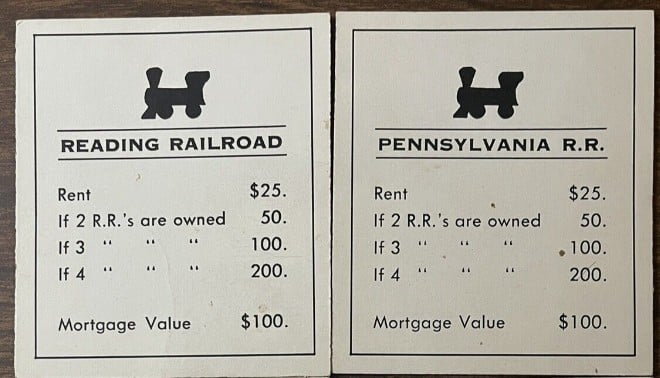
The classic board game of Monopoly® (which, like just about every other pastime game, has gone electronic in this digital age) features four railroad properties, including the Pennsylvania Railroad and the Reading Railroad. These two traction companies, now defunct, were at one time fierce competitors. A relic of that competition can be found in the Southeastern Pennsylvania Transportation Authority (SEPTA) map of its Regional Rail commuter train routes, which shows a Trenton station (formerly of the Pennsylvania RR) and a West Trenton station (formerly of the Reading Railroad). Similarly, the Chestnut Hill section of Philadelphia is served by SEPTA’s Chestnut Hill East (formerly Reading RR) and Chestnut Hill West (formerly PRR) stations.
During the heyday of the railroads, the going between the Pennsylvania and Reading Railroad commuter train stations in center city Philadelphia entailed a walk of nearly 800 meters, with many busy streets to cross. But in 1984, Philadelphia’s Commuter Rail Tunnel was completed, thereby uniting what had been the commuter lines of the two railroads, and giving a great economic and social boost to the Philadelphia area with improved convenience of movement.
But the Commuter Rail Tunnel was disastrous to many people in Philadelphia’s Chinatown neighborhood. During the construction work, the restaurant business, which was (and still is) a significant factor in the neighborhood’s economy, took a hit from the difficulties in finding parking and the discouragement of would-be diners from other areas of Philadelphia and its suburbs from venturing into the area in the first place. The Rail Tunnel construction entailed the destruction of several multifamily residential buildings, driving many residents from their homes.
During the construction of Philadelphia’s Commuter Rail Tunnel, one of the residents of the Chinatown neighborhood, no doubt harkening back to family stories passed down through the generations, put up a sign near the construction site that read, “Our forefathers built the railroad. We never thought that it would come this far!”
* * *
There currently is another controversial subterranean rail project afoot in Petach Tikva; specifically, the Kfar Ganim neighborhood is now boiling with amazement and anger over the construction of the M2 Metro line. A special WhatsApp chat group has been formed; it is no exaggeration to say that more than a thousand posts have been made on it during the past week (and more are sure to be racked up by the time you read this). It seems that the land beneath Ben-Gurion Street is being expropriated for the M2 line, and that the expropriations for the station might possibly include underground spaces beneath the apartment buildings.
The process has taken many of us by surprise; the absence of transparency is perhaps the most infuriating factor. Differing rumors circulate (including suspicions of impropriety by individuals who have political connections), and good information is at a premium.
A few weeks ago, my wife and I moved out from the Kfar Ganim neighborhood we have come to love in order to be up North near our grandchildren; if not for that, we would have remained, tolerated the inconveniences of the construction and street closures, and awaited the opening of the commuter station near our building while holding realistic expectations of increase in our residence’s value. While Philadelphia’s Chinatown is situated at a location that is continually prone to commercial development that inconveniences if not displaces its residents – the Commuter Rail Tunnel was not the last one – Kfar Ganim is not located at such a transportation crossroads and has far more open spaces and parks.
After weighing all the pros and cons, we have traded the coming inconveniences of the M2 Metro construction in Petach Tikva for the more uncertain and potentially lethal dangers of being closer to the Lebanon border. We hope, for the sake of our friends and (now former) neighbors in Petach Tikva that their situation proves to be more like the one in Washington’s Brentwood neighborhood than the one in Philadelphia’s Chinatown.