Beings in Yetzirah: Ontological Politics in the 2028 Election
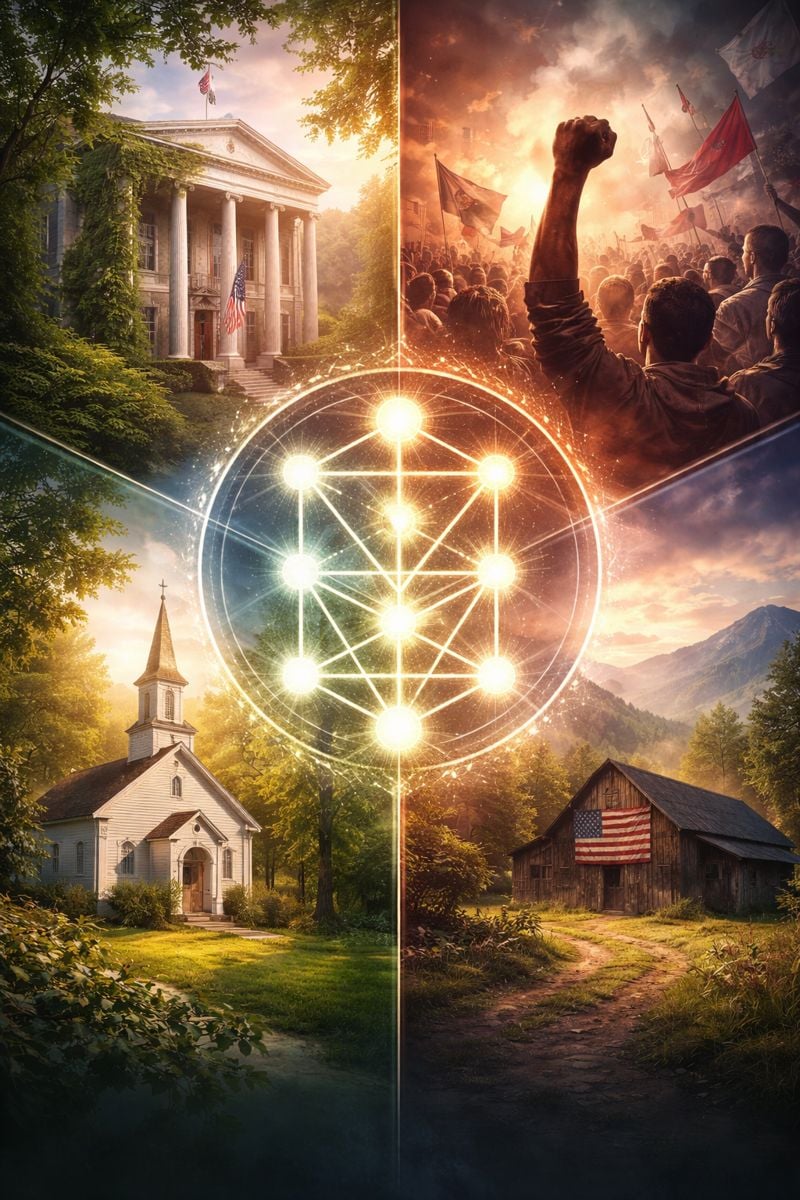
Rather than treating the 2028 presidential field as a contest of policies or ideologies, I read it as a contest of political beings — different forms of authority through which legitimacy becomes intelligible to the public.
To make that legible, I draw on a distinction from Kabbalistic metaphysics between Assiyah, the world of action, and Yetzirah, the world of formation. Assiyah names what political actors do: campaigns, policies, votes, and institutional maneuvering. Yetzirah names something deeper: the forms through which political authority itself becomes recognizable — the emotional, symbolic, and moral grammars by which power coheres and persuades.
Using Yetzirah, we can ask not merely what candidates support, but how they exist politically: what grammar of authority they embody, and how power gathers around them before it ever expresses itself as policy.
The Four Political Beings
The 2028 field coheres around four distinct Yetzirah forms — grammars of legitimacy through which authority becomes believable.
Yankeedom: Authority through procedure, institutional continuity, legitimacy via law, process, and inherited political grammar.
Western Marxism: Authority through structural critique, systemic moral diagnosis, and antagonistic framing of power and inequality.
Quakerdom: Authority through moral coherence, ethical witness, relational trust, and personal credibility, independent of systems.
Greater Appalachia: Authority through identity, narrative, cultural embodiment, and civilizational symbolism, rather than governance competence or moral philosophy.
Most candidates are hybrids — a reflection of a system in ontological fracture.
What follows is not a speculative typology detached from political reality, but an ontological reading of the actual 2028 field as it exists today. The ordering and relative weight of each figure reflects their current standing in the RealClearPolling polling average, using empirical reality to anchor symbolic form.
The Democratic Field: Political Beings in Yetzirah
Gavin Newsom (23.6) — Yankeedom / Western Marxist
Newsom embodies the late-liberal governing form: procedural legitimacy fused with moralized systems language. His authority arises from presenting institutions as workable but in need of ethical recalibration, rather than replacement or moral witness.
Kamala Harris (21.4) — Western Marxist / Yankeedom
Harris draws her authority first from structural moral claims — representation, justice, and symbolic redress — and second from procedural competence. She operates as a figure whose legitimacy is anchored more in what she stands for than in how she administers.
Pete Buttigieg (11.0) — Yankeedom / Quakerdom
Buttigieg is a morally serious institutionalist: he speaks in ethical and civic language while remaining deeply loyal to procedural legitimacy. His authority comes not from structural antagonism, but from presenting civic virtue as the precondition for institutional survival.
Alexandria Ocasio-Cortez (7.7) — Western Marxist
Ocasio-Cortez’s authority flows entirely from systemic critique rather than institutional loyalty or moral stewardship. She acts symbolically by naming power, inequality, and structural injustice, positioning legitimacy as something seized through exposure rather than earned through procedure.
J.B. Pritzker (4.8) — Yankeedom / Western Marxist
Pritzker operates as a technocratic reformer with moral vocabulary: legitimacy through delivery, stabilized by equity-oriented rhetoric. He does not dramatize injustice nor embody moral witness, but instead presents governance itself as the moral act.
Josh Shapiro (4.6) — Quakerdom
Shapiro’s authority arises not from systems critique or procedural mastery, but from relational trust and perceived ethical coherence. He leads as a moral steward, deriving legitimacy from being seen as personally credible rather than ideologically correct or structurally oppositional.
Andy Beshear (3.4) — Quakerdom
Beshear embodies political authority as moral presence rather than political performance. His legitimacy flows from local trust, emotional steadiness, and a style of leadership that presents public office as ethical caretaking rather than ideological struggle.
Tim Walz (3.2) — Western Marxist / Yankeedom
Walz fuses class-inflected structural rhetoric with institutional executive experience. He draws authority from naming systemic economic tensions while remaining firmly committed to operating through established procedural channels.
Mark Kelly (3.0) — Quakerdom
Kelly’s political authority rests in personal credibility and seriousness rather than ideological clarity or narrative performance. As a senator, he derives legitimacy from restraint, biography, and perceived adult supervision rather than from moral dramatization or systemic critique.
Cory Booker (3.0) — Yankeedom / Western Marxist
Booker operates as a procedural liberal animated by structural moral language. His authority arises from combining institutional fluency with a persistent emphasis on systemic injustice, inequality, and reform, positioning governance itself as a vehicle for moral redress rather than moral formation.
Taken together, the Democratic field remains oriented toward restoring legitimacy through procedure, structure, and moralized governance.
The Republican field, by contrast, contests legitimacy on entirely different terrain.
The Republican Field: Political Beings in Yetzirah
J.D. Vance (48.8) — Greater Appalachia / Insider
Vance embodies political authority through civilizational narrative rather than procedural legitimacy or moral philosophy. His power arises from presenting himself as the voice and embodiment of a particular America, rather than as a steward of institutions or a reformer of systems.
Donald Trump Jr. (11.0) — Greater Appalachia / Insider
Trump Jr. extends the same ontological form, functioning less as a policy actor than as a symbolic inheritor of a civilizational identity. His authority flows from lineage and narrative continuity rather than institutional credibility.
Marco Rubio (9.3) — Yankeedom / Greater Appalachia
Rubio represents a transitional political being: procedural conservatism attempting to survive within an identity-centered political field. His legitimacy is split between institutional fluency and narrative appeal.
Ron DeSantis (9.0) — Yankeedom / Greater Appalachia
DeSantis fuses executive proceduralism with civilizational signaling, governing through institutions while framing authority in cultural conflict and identity assertion.
RFK Jr. (4.3), Tulsi Gabbard (3.0), Vivek Ramaswamy (2.5) —
Greater Appalachia / Outsider
These figures operate primarily as challengers to established authority rather than as institutional or moral stewards, deriving political force from questioning the coherence of prevailing narratives and sources of legitimacy rather than embodying them.
Ted Cruz (3.3), Glenn Youngkin (2.0) — Yankeedom
Residual procedural conservatives attempting to operate in a political environment no longer organized around procedure.
The Ontological Fault Line
What this analysis ultimately reveals is not a disagreement over policy, nor even ideology, but a conflict over the very forms through which political authority becomes legible in contemporary America.
On the Democratic side, power remains distributed across competing grammars of legitimacy. Yankeedom and Western Marxism stand in near parity, reflecting a party torn between restoring institutional authority and morally reinterpreting it through systemic critique. Quakerdom persists as a meaningful but structurally secondary form, reminding us that moral formation and relational trust remain electorally viable, even if they are no longer how the party primarily understands power.
In other words, Democrats are still arguing about how legitimacy should be repaired.
The Republican field, by contrast, is no longer organized primarily around legitimacy at all. Its center of gravity has shifted decisively toward civilizational identity, here named more precisely as Greater Appalachia. Authority now flows less from law, institutions, or moral philosophy than from cultural embodiment, narrative inheritance, and symbolic belonging. Yankeedom survives, but only as a minority grammar, subordinated to identity as the primary source of political power.
Republicans are no longer arguing about how America should be governed.
They are arguing about who gets to be America.
That is the true fault line of our political moment.
This is why so many policy debates feel hollow, repetitive, or unresolvable: they are downstream of a much deeper ontological rupture. We are not merely disagreeing about what to do. We are disagreeing about what kind of beings are entitled to rule, to speak, and to represent the nation.
Until that conflict is understood and addressed, politics will continue to feel simultaneously overheated and empty — full of noise, yet strangely detached from resolution.
America is not in a policy crisis.
It is in a crisis of political being.
And until we learn to speak at that level, every attempt at reform will remain a surface treatment for a much deeper fracture we are only beginning to name.