

Palestinian Peacebuilder Bridging Communities Across Conflict Lines
Believers for Peace in the Heart of Qusra’s Siege
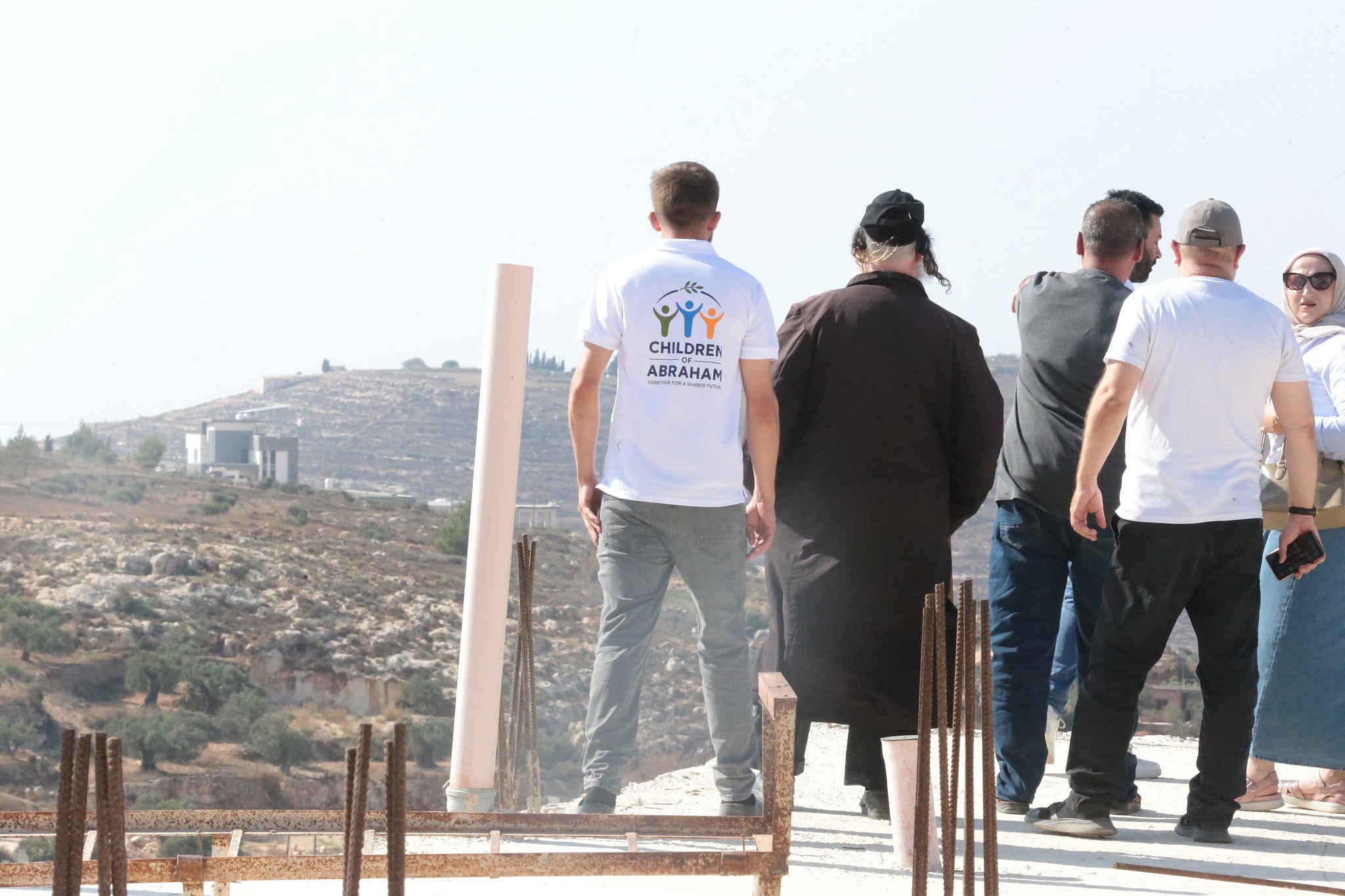
Palestinian and Israeli participants with the Children of Abraham Project during the Protective Presence initiative in Qusra, September 2, 2026.
Peace of the Believers in the Heart of Qusra
For years, I have worked through the Children of Abraham Project to bring Palestinians and Israelis together, especially when the political reality around us tells us that doing so is impossible.
We have gathered around tables and inside tents. We have brought together rabbis and sheikhs, Palestinians from the West Bank and Gaza together with Israeli Jews, Muslims, Jews and Christians, religious and secular people, children and grandparents.
We have done this because we believe that peace cannot begin only in political negotiations. It must also begin between human beings — in the difficult work of seeing, hearing and recognizing one another.
And over the past few years, we have tried to turn that belief into something real.
In March 2025, more than 900 Jews and Muslims came together for our Iftar Meal of Reconciliation in the midst of war. We sat at one table while children were dying in Gaza and Israeli hostages remained in captivity. We did not pretend that the suffering around us did not exist. We gathered precisely because it did. Our message was that humanity is indivisible, and that suffering does not become less sacred because the person suffering belongs to the other people.
A few months later, around 200 Palestinians and Israeli Jews — children, parents and grandparents — spent a day and night together in 100 Tents for Justice, Humanity and Equality. We ate together, held dialogue circles, shared our experiences and watched children from different communities simply play together.
Then came one of the most difficult and meaningful initiatives we have organized: 100 Stories, One Voice for Peace.
We brought together 100 Palestinian and Israeli voices from Gaza, the West Bank and Israel — people who did not know war as an argument on television, but through their own bodies, homes and families.
Among them were Maoz and Mayan Inon, who lost their parents on October 7. Abdulrahman came from Gaza carrying the loss of more than nine members of his family during the war. Others had lost loved ones, suffered injuries, experienced displacement, or watched the world they knew collapse around them.
Some of the stories were almost unbearable to hear.
But we did not bring these people together to compare their suffering.
There was no competition over whose dead mattered more, whose tears were more legitimate, or whose trauma deserved greater recognition.
We came to listen.
And what moved me most was not only the enormous loss these people carried. It was the choice many of them had made despite that loss.
They understood that revenge would not bring their families back. Another dead child would not resurrect their own child. Another grieving mother would not heal their own mother. Another destroyed home would not rebuild the home they had lost.
Their pain was real.
But they refused to make revenge their future.
Instead, these Palestinian and Israeli voices spoke about justice, equality, reconciliation and the possibility of building something together.
One hundred stories of trauma, grief and survival became one voice saying: we must break this cycle rather than pass it on to our children.
This past Ramadan, we went even further. Despite war and enormous logistical challenges, our interfaith Iftar connected more than 1,500 Palestinians and Israelis across the West Bank and Gaza, with parallel gatherings and participants joining from elsewhere.
I do not mention these events to present a list of achievements.
I mention them because Qusra was the moment when the meaning of all those years of work was put to the test.
It is one thing for Palestinians and Israelis to sit together when food is on the table, children are playing and people are giving speeches about peace.
It is another thing to stand together when there is fear, violence and blood.
If peacebuilding means anything, it has to mean something precisely then.
And so we went to Qusra
When news reached us about the violence facing Palestinian villagers in Qusra, south of Nablus, Jerry Katz, president of the Children of Abraham Project, and I spoke.
Jerry is Jewish.
I am Palestinian.
We do not carry the same history. We do not experience this conflict in the same way. We do not have to agree about everything.
But after years of working together, there is one principle on which we have come to agree deeply:
The holiness of a human life cannot depend on whether that human being is Palestinian or Israeli, Muslim, Jewish or Christian.
If that principle was real, then we could not simply talk about what was happening in Qusra.
We had to go.
And less than 200 meters before we reached the village, our own day began with violence.
On the main road, cars carrying members of our group were attacked with stones by settlers.
Inside those cars were Palestinians and Israelis. Muslims and Jews. Religious leaders and peacebuilders.
We kept going.
In a strange way, that moment made the purpose of our journey even clearer.
There are people on this land trying to convince Palestinians and Jews that our only possible relationship is one of fear — that the other side is permanently our enemy, that every wound must produce another wound, and that the future can only be built by defeating or removing the other.
We reject that future.
A different Jewish voice in a Palestinian village
Our day began at the Qusra municipality, where local representatives briefed us on the violence and insecurity facing their community.
We listened to accounts of attacks, damaged property and infrastructure, and families living in particularly vulnerable and isolated areas. Local representatives told us that 11 residents of Qusra had been killed since October 7.
But statistics can never explain what loss actually means to a family.
Inside the hall was Mahmoud Odeh, a resident of Qusra and a member of the Children of Abraham Project.
Mahmoud’s brother, Muath, was killed during a settler attack in the first year of the war.
His photograph hung on the wall among photographs of other people from Qusra who had been killed.
I have worked in peacebuilding for many years, but there is something profoundly different about hearing a call for reconciliation from someone who has buried his own brother.
Mahmoud could have allowed that loss to become hatred.
Instead, he has continued to meet Jews.
He has continued to speak about dialogue.
He has continued to reject the idea that the people responsible for his brother’s death should be allowed to define an entire people.
That day, Muslim and Jewish religious leaders stood together in the same hall.
Mukhtar Abdel Hakim Salim, Eliyahu McLean and other religious figures spoke against extremist settler violence and expressed solidarity with the people of Qusra.
As a Palestinian, seeing Jews — including religious Jews — come into a Palestinian village under these circumstances mattered deeply to me.
They were not there to defend what other Jews had done.
They were not there to explain Palestinian suffering away.
They came to say, through their presence: there is another Jewish voice.
A voice that refuses hatred.
A voice that sees holiness in Palestinian life.
A voice willing to stand beside Palestinians when Palestinians are afraid.
That is what I mean by the peace of the believers.
Not a peace in which Muslims and Jews abandon their faith.
A peace in which our faith makes us more responsible for the dignity of the other, not less.
Dialogue had to leave the room
After the meeting, we divided into two groups and moved through Qusra, some on foot and others by car, going from home to home.
We distributed humanitarian packages and school supplies provided by the Children of Abraham Project to families in the village.
The bags themselves were simple.
But the message behind them was not.
We wanted families to know that they had not been forgotten — and that among the people who came to stand beside them were Jews.
After completing the distribution, we headed toward the Ras al-Ain area, where three Palestinian families live in isolated homes.
We tried to reach them but were prevented from going farther. Eventually, we stopped around 300 meters away.
Standing there, unable to reach those families, made the idea of “protective presence” very concrete to me.
Sometimes solidarity means providing humanitarian assistance.
Sometimes it means listening.
Sometimes it means putting your body in a place where your words have been for years.
Dialogue had to leave the meeting room. Peace had to become presence.
But Qusra also challenged me
There is another part of this story that I believe is just as important.
When I watched Jews stand in Qusra and publicly reject violence committed against Palestinians by members of their own community, I could not only ask what this moment demanded from them.
I had to ask what it demanded from me.
I am Palestinian.
I know Palestinian pain.
I know what occupation, checkpoints, settler violence, displacement, fear and loss have done to Palestinian families.
I will never ask my people to forget that suffering in the name of peace.
Justice matters.
Palestinian freedom and dignity matter.
But if I ask my Jewish friends to stand against violence committed against Palestinians by Jews, then I must be willing to apply the same moral principle to myself.
If innocent Jews are attacked by Palestinians, I must stand against it.
If I ask Jews not to judge millions of Palestinians by Hamas or by those who commit violence in our name, then I cannot judge millions of Jews by violent settlers.
If I ask an Israeli mother to recognize the humanity of a Palestinian child in Gaza or Qusra, I must recognize the humanity of her child as well.
That does not make our histories identical.
It does not erase injustice.
It does not require Palestinians or Israelis to surrender their national identity, their history or their rights.
It simply means that no injustice committed against us gives us permission to stop seeing the humanity of someone else.
This, to me, is one of the hardest tests of peacebuilding.
It is easy to condemn the violence of the other side.
Moral courage becomes much more difficult when the person committing the violence comes from your own community.
If Jewish religious leaders can enter Qusra and say, in effect, “Not in our name,” then Palestinian leaders, Muslims and peacebuilders must have the courage to say the same when innocent Jews are attacked.
Otherwise, coexistence becomes something we demand from the other side rather than something we practice ourselves.
What does God ask of believers?
For me, this is ultimately also a question of faith.
Too often in this conflict, religion is used to deepen the walls between us.
God is invoked to explain why the land belongs only to one people.
Sacred texts are used to justify hatred.
Our own suffering becomes holy while the suffering of the other becomes invisible.
But that cannot be the only religious vision available to us.
The Children of Abraham Project was built around another possibility: that Jews and Muslims can draw from their faith not to deny one another, but to rediscover the holiness of the other.
This idea has been at the heart of our work: beneath the identities, narratives and fears that separate us is a human holiness that we are constantly in danger of forgetting.
If we believe that human beings are created by God, then the value of a human life cannot change at a checkpoint or a border.
A Palestinian child is sacred.
A Jewish child is sacred.
A Muslim mother mourning her son is sacred.
A Jewish mother mourning her daughter is sacred.
Recognizing one does not require denying the other.
And justice for one people should not require the destruction of the other.
Perhaps that is what I saw in Qusra.
I did not see peace in the political sense.
We did not end occupation.
We did not end settler violence.
We did not end Palestinian and Israeli fear.
We certainly did not resolve more than a century of conflict in one afternoon.
What I saw was something smaller.
But perhaps it was also something fundamental.
I saw believers choosing not to use God to widen the distance between us, but to cross it.
I saw Muslims and Jews standing together in a Palestinian village and rejecting the idea that hatred committed in our names must represent us.
For years, we have gathered around tables, told stories, slept in tents, listened to grief and spoken about another future for this land.
In Qusra, those words had to become action.
Because peace is not proven only by whom we are willing to sit beside when everything is calm.
Peace is proven by whom we are willing to stand beside when they are afraid.
On that day in Qusra, Palestinians and Israelis, Muslims and Jews, chose to stand together.
And perhaps, in a Holy Land exhausted by people telling us why we must hate one another, that choice is where another future begins.
About the Author
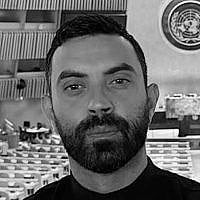
Mohamad Jamous is a Palestinian peacebuilder and community leader based in Ramallah. For more than a decade, he has worked in Palestinian-Israeli dialogue, interfaith peacebuilding, youth engagement, and grassroots humanitarian initiatives across the West Bank and the region. He currently leads the Children of Abraham Project’s work in Israel and Palestine and is the founder of Peace Pioneers Palestine. He holds a Master’s degree in Political Science, International Law and Diplomacy. His work focuses on building relationships across conflict lines and advancing dignity, justice, security, and a shared future for Palestinians and Israelis.
Related Topics
Related Posts
Mohamad Jamous