


CEO of Jewish Federation of British Columbia
Beneath the Surface: Discovering Jewish BC
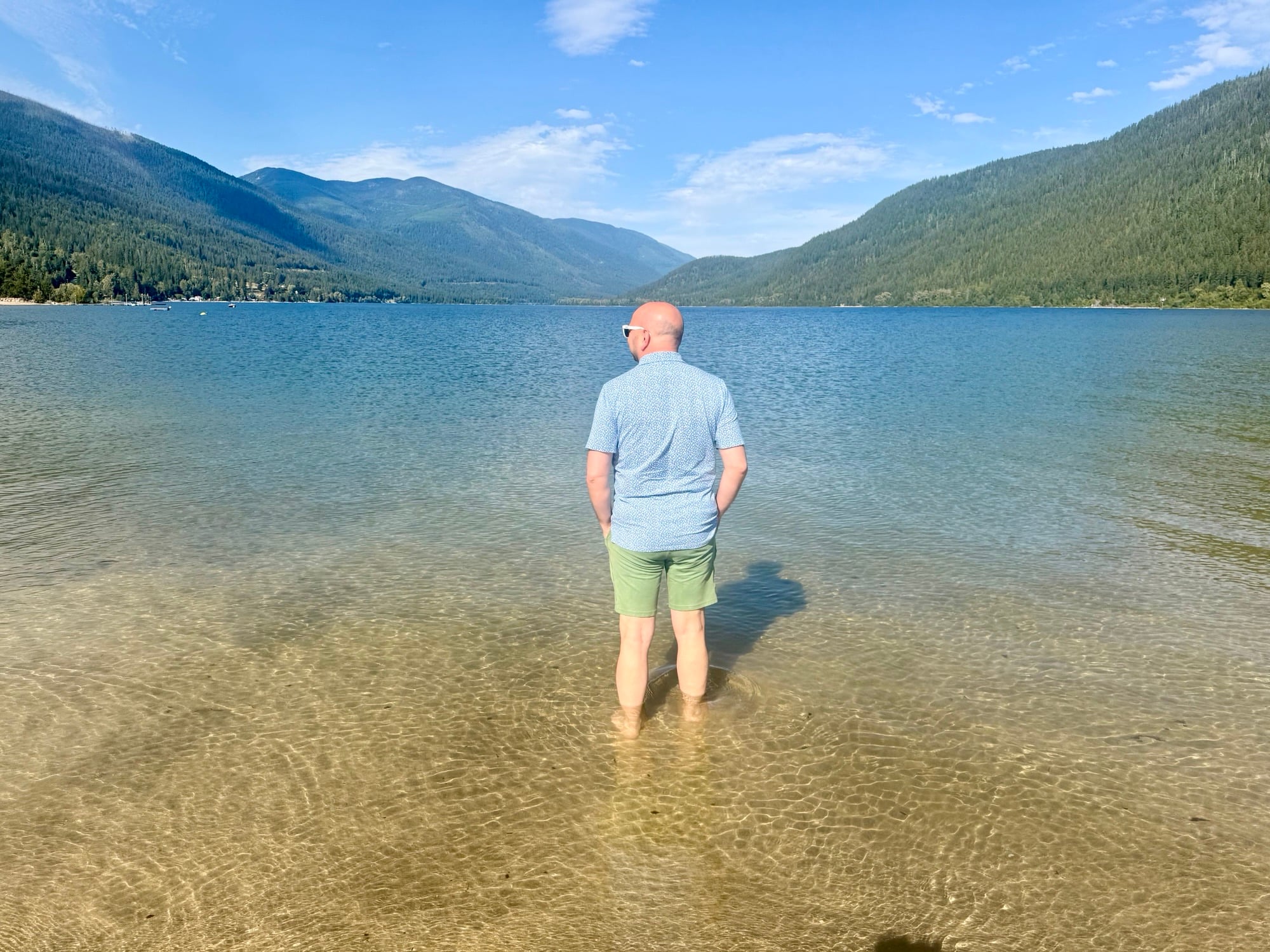
An eight-day journey through the Okanagan, the Kootenays, and Revelstoke revealed a simple truth: the challenge facing smaller Jewish communities is not a lack of desire for Jewish life. It is access to it. And when people find one another, remarkable things happen.
Earlier this year, we officially launched Jewish Federation of British Columbia. The change was more than a new name. It reflected a belief that Jewish life in this province extends far beyond any one city, institution, or region. It recognized that our responsibility is to support and strengthen Jewish communities wherever they exist.
I understood that in principle. Over the past eight days, I had the opportunity to experience it firsthand.
While our children were away at camp, Rachel and I packed up The Beast, our family’s well-travelled ten-year-old Yukon Denali, and set out across British Columbia. Two nights in Naramata and Penticton. Four nights in Nelson. Two nights in Revelstoke. Then home.
At first glance, it looked like a vacation. And it was. We walked lakeshores, explored wineries, read books, and slowed down. But somewhere along the way, work found us. Not the kind of work that happens in boardrooms or spreadsheets, but the kind that begins with a conversation, an invitation, a story, and a connection.
This journey became my first opportunity to experience Jewish British Columbia through the lens of our new identity as Jewish Federation of British Columbia. What I discovered was a reminder that Jewish life is not defined by buildings or institutions alone. It is defined by people choosing to gather, to create, and to care for one another.
One evening overlooking Okanagan Lake, we spent time with people who had chosen to build new Jewish lives in the Interior. Their stories reflected themes that would surface throughout the journey: belonging, reinvention, community, and the determination to create meaningful Jewish lives wherever they call home.
That same spirit was present in Nelson. A casual invitation led us up a winding mountain road overlooking Kootenay Lake to a Shabbat gathering unlike any I had experienced before. There were guitars, First Nations drums, newborn babies, expectant parents, elders, and children weaving between generations. The full arc of Jewish life was gathered together on a mountainside.
At one point, someone said to me, “We don’t have a synagogue. We just have this.” Without hesitation, I replied, “This is a synagogue.”
Because it was.
The meal that followed reflected the community itself: local fish from BC waters, homemade dishes prepared by neighbours and friends, and six small challot baked during a visit from family members who had travelled from Israel to Nelson, then frozen and saved for a special occasion. This was that occasion.
Sharing the challah was about more than food. It was about family, memory, and community gathered around one table. The Power of Together was on full display, not as a slogan, but as a lived experience. People choosing to gather. People choosing to build. People choosing one another.
What struck me most was that this community was not simply preserving Jewish life. It was creating it. One participant shared her plans to establish a local Hadassah chapter. Nobody had assigned her the task. Nobody was waiting for permission. She saw an opportunity and decided to bring it to her community.
That is what organic Jewish growth looks like. One person starts something. Others join. Over time, individual acts become community.
Another conversation from Nelson has stayed with me. Community members spoke about their efforts to establish a dedicated Jewish section within the municipal cemetery. While that work continues, families have begun purchasing plots near one another, creating a Jewish section of their own.
What I heard was not a conversation about land. It was a conversation about belonging, roots, and permanence.
Earlier in the evening, newborn children rested in their parents’ arms while elders shared stories nearby. Later, people spoke about their hopes to remain connected for generations to come. Birth, community, memory, and legacy were all present in that one evening.
The final stop of our journey brought us to Revelstoke, where I encountered another expression of the same story. People arrived in town knowing no one. Families were seeking a different pace of life and a smaller community. Then, through schools, sports, work, and chance encounters, they found one another.
One story especially stayed with me. A child introduced himself at an activity and mentioned he was Jewish. Another child immediately responded, “Wait a second, I’m Jewish too.” What followed was friendship, sleepovers, family connections, introductions, and community.
This is so often how Jewish life begins. Not with buildings, but with people. One relationship at a time.
Several community members reflected on how October 7 changed their relationship with Jewish life. Rather than retreating, many moved toward one another. Participation increased. Connections deepened. Community became more important, not less.
Today, dozens gather for Passover and Chanukah celebrations. Families travel from neighbouring communities to participate. Children sing Chanukah songs at school. Community members advocate together and support one another.
One person shared a dream that has stayed with me. Someday, they hope to place a Star of David atop a building in the centre of town so that everyone passing by knows a simple truth: we are here.
That aspiration brought to mind recent analysis of smaller Jewish communities across North America. The findings challenge some common assumptions. Jews in smaller communities often demonstrate a strong desire for deeper Jewish connection, even when access to programs, institutions, and infrastructure is limited.
The challenge is not desire. The challenge is access: geography, opportunity, infrastructure, and leadership capacity.
After driving hundreds of kilometres between communities, those realities were impossible to ignore. After travelling through the province, those findings became personal.
I met the people behind the statistics: families creating Jewish homes, volunteers building community, elders and young parents carrying Jewish life forward, and people who believe deeply that Jewish life belongs wherever Jews choose to live.
Federation’s role is not to create Jewish life. Jewish life is already here. Our role is to strengthen the connections, resources, and infrastructure that allow it to flourish.
That is why our network of Community Connectors working across British Columbia matters. Together, they help create opportunities for connection, support local leadership, and transform Jewish desire into Jewish community. Behind every number are real people: relationships, invitations, and moments of belonging.
As Rachel and I made the long drive west toward home, the car was filled with memories: a Shabbat gathering on a mountainside, a child discovering another Jewish child, families preserving memories through challah, neighbours creating a Jewish cemetery section of their own, volunteers building community one relationship at a time, and a dream of a Star of David overlooking a small mountain town.
These were not isolated stories. They were expressions of the same truth.
Jewish life is thriving across British Columbia. Sometimes it is highly visible. Sometimes it exists just beneath the surface.
And finally, standing in the streets of Revelstoke, listening to a Haitian band from Montreal beneath the summer sky, surrounded by members of the local Jewish community and moving to the rhythm of the music, I realized I could not imagine a more fitting way to conclude the journey.
Eight days earlier, we set out to explore British Columbia. I returned with a deeper appreciation for Jewish British Columbia and a deeper understanding of one simple truth: the challenge is not desire. The desire is everywhere. The challenge is access.
And when people find one another, remarkable things happen.