


Geopolitical Analyst: Bridging Somaliland & Israel to the world
Berbers: From Fortress Bases to Distributed Maritime Power Center
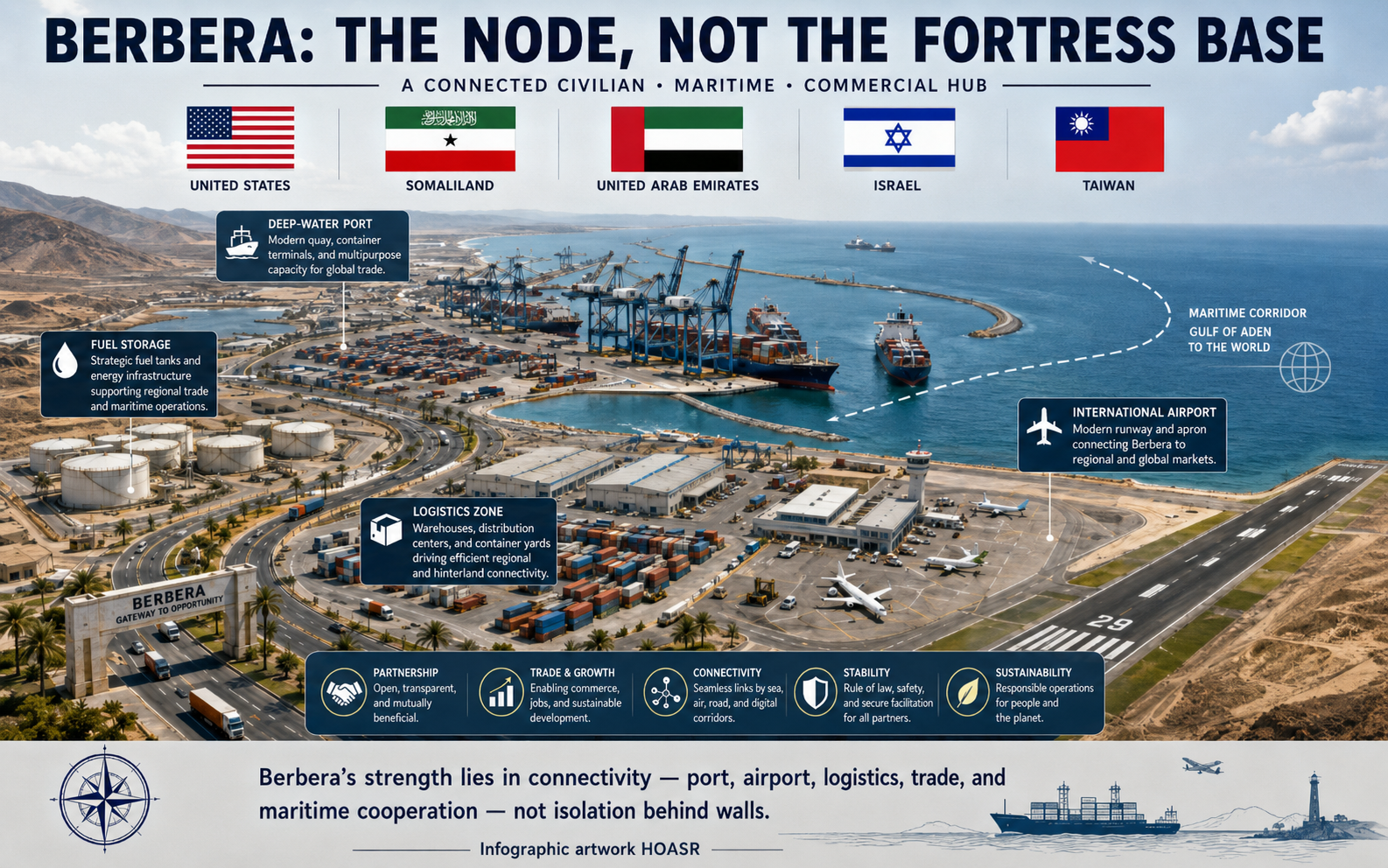
The concept emphasizes phased access, maritime security, trade, emergency response and shared infrastructure before any larger permanent military presence is considered. Infographic artwork: HOASR
Why Berbera fits America’s changing Red Sea posture
Missile threats and disrupted shipping are pushing the United States to spread its operations across several sites. Somaliland can become one reliable part of that network—if Hargeisa puts the right security, legal and commercial foundations in place.
The main question about Berbera is not whether it can host another large foreign base. It is whether the port and airfield can work as part of a wider network that keeps running when a runway comes under threat, a chokepoint becomes dangerous or a host government limits access.
This is very important because relying on one large base for every regional crisis is becoming more dangerous. Recent missile and drone attacks in the Gulf have made an existing debate in U.S. military planning more urgent. Forces are more likely to survive if they are spread out, mobile, supplied in advance and able to move between several locations.
Berbera should be judged in this way. It should not be sold as a replacement for Djibouti or as a launch site for an undefined war across the Red Sea. Its most realistic value is as a backup for maritime surveillance, logistics, refuelling, search and rescue, emergency access and the protection of commercial infrastructure on the African side of Bab el-Mandeb.
The fortress model meets the precision-strike era
Large bases still have an important role. They offer command centres, maintenance, stockpiles, medical care and secure communications that smaller sites cannot easily match. But their size and fixed location also make them attractive targets. A large hub can be defended, but it cannot be hidden.
The U.S. Air Force created its Agile Combat Employment concept to deal with this problem. It calls for forces sized for a specific mission to move between different locations, with supplies placed there in advance and agreements with host countries. The Marine Corps follows a similar approach through Expeditionary Advanced Base Operations. It uses small, mobile forces that are harder to detect and can operate from temporary or basic sites to support sea control and keep units supplied.
These ideas were mainly designed for the Indo-Pacific, but they also fit the Red Sea and Gulf of Aden. The risks are similar: too few known bases, exposed supply lines and heavy dependence on politically sensitive chokepoints. A distributed network does not replace the main base. It makes sure the whole system does not fail if that base is hit or closed.
“Berbera’s strongest case is not that it can replace Djibouti. It is that a strong maritime network should not depend on only one hub on the African coast.”
Why Berbera belongs in the network
Berbera’s location is its starting point, but location alone is not enough. The port sits on the Gulf of Aden, close to Bab el-Mandeb and the shipping lanes linking the Indian Ocean, Red Sea and Suez Canal. Its infrastructure adds to that value. DP World reports a 400-metre quay, a 17-metre draft, three ship-to-shore cranes and capacity for 500,000 containers a year. A planned second phase would raise capacity to two million. The nearby Berbera Economic Zone is also being built along the trade corridor to Ethiopia.
Berbera also combines a port and an airfield. Any distributed site must be able to move people and supplies by sea, air and land. It also needs fuel, storage, power, communications and protection. Berbera has the basic shape of such a site, but it has not yet publicly shown that it can support long military operations. Closing that gap is the real work ahead. Hargeisa should not claim that Berbera is already fully ready.
U.S. officials have shown serious interest but have not announced a basing decision. In June and November 2025, senior U.S. Africa Command delegations visited Somaliland and toured Berbera’s port and airfield. They assessed the site’s operational capacity and security. These visits show that Washington is studying Berbera. They do not prove a secret deal or make a U.S. deployment certain. Somaliland’s case will be stronger if it keeps that distinction clear.
Complement Djibouti—do not pretend to replace it
The Congressional Research Service describes Camp Lemonnier as the only long-term U.S. military base in Africa. Djibouti has command, aviation, intelligence, logistics and partner networks built over more than twenty years. Berbera cannot recreate that system quickly, and Somaliland should not claim that it can.
The stronger case is that Berbera can support Djibouti. Djibouti’s importance has brought American, Chinese, French, Japanese and other foreign facilities into a small area. China’s base is also close to Camp Lemonnier. This creates several risks. The area is crowded, foreign powers can watch each other closely, the host government has leverage, and many missions depend on access to one country.
An access agreement for Berbera could spread out selected tasks without building another huge permanent base. Djibouti would remain the main base. Berbera could serve as a backup for diverted aircraft, fuel, logistics, maritime awareness, humanitarian response and occasional exercises. In a crisis, the second site is useful because legal access, tested procedures and compatible communications are already in place. That is far better than trying to arrange access after the main base is restricted.
Commercial resilience is now part of maritime security
The Red Sea crisis is not only about missiles and damaged ships. It is also changing routes, insurance prices and business decisions. Reuters reported on 12 August 2026 that tankers carrying Saudi crude from Yanbu were increasingly switching off their tracking signals. Average daily traffic through Bab el-Mandeb had fallen to about 32 ships, down from about 50 before the Houthi blockade. The numbers varied because more ships were becoming difficult to track.
The insurance market is also reacting. The Financial Times reported on 24 August that Saudi Arabia was considering state-backed war-risk insurance after commercial cover became more costly or unavailable for some ships. This is important because insecurity can change shipping decisions even when the strait remains open.
Berbera cannot stop the Houthis, and it is not a cure for the region’s wars. But it can support the practical work that makes shipping safer and more reliable: combining radar and vessel data, watching ships that switch off tracking, search and rescue, emergency diversion, port security, cable protection, pollution response and trusted reports for commercial operators. A port gains strategic value when it reduces uncertainty.
Build an access ladder, not plant a flag
Somaliland should seek a phased access partnership. Each stage should deliver something useful, even if the next stage takes years. This approach would avoid the political shock of a sudden basing announcement, allow results to be measured and stop infrastructure promises from moving faster than the law and public consent.
PHASE ONE: A joint technical audit
Start with a detailed inspection of the runway and apron, access to the berth, fuel quality and storage, power and water supplies, communications, firefighting, medical support and site security. These are not minor details. The International Civil Aviation Organization’s Annex 14 on Aerodromes establishes standards covering airport physical infrastructure, runways, taxiways, aprons, technical services and rescue and firefighting capability. NATO host-nation-support guidance similarly stresses advance planning for infrastructure, transportation, civilian resources and logistical support.
The U.S.–Poland Enhanced Defense Cooperation Agreement provides a useful practical example of what such an assessment can involve. Its infrastructure provisions cover electricity, water, sanitation, fuel distribution and storage, telecommunications, fire and emergency response, medical services, installation security, aircraft aprons and maintenance facilities.
The public should see findings about civilian infrastructure wherever security allows. A proper audit turns political excitement into a clear engineering plan.
Sources: ICAO — Annex 14, Aerodromes; NATO Logistics Handbook — Host Nation Support; U.S.–Poland Enhanced Defense Cooperation Agreement.
PHASE TWO: Maritime awareness and coast-guard capacity
Set up a fusion centre that combines coastal radar, Automatic Identification System (AIS) data, port reports and intelligence from partners. The International Maritime Organization explains that AIS automatically provides ship identity, position and other navigational information to other ships and coastal authorities, making it one of the basic tools of maritime-domain awareness.
Train Somaliland staff in search and rescue, pollution response, fisheries law enforcement, cable protection and investigations of suspicious ships or vessels that switch off tracking. There are established international frameworks for all of these functions. The IMO International Convention on Maritime Search and Rescue calls for coastal search-and-rescue services, rescue coordination centres, communications, trained personnel and cooperation with neighbouring states. The IMO’s Oil Pollution Preparedness, Response and Co-operation Convention calls for national response systems, equipment, exercises and international cooperation in dealing with marine pollution.
For fisheries enforcement, the UN Food and Agriculture Organization’s Agreement on Port State Measures provides an international framework for detecting, deterring and investigating illegal, unreported and unregulated fishing. FAO also operates an information-exchange system through which port, flag and coastal authorities can share vessel information.
Cable protection is increasingly part of maritime security as well. The International Telecommunication Union’s 2026 report on submarine-cable resilience recommends better risk identification, monitoring, information sharing, legal frameworks, maritime training and cooperation between governments and the cable industry.
Somaliland should build on Taiwan’s newly launched Red Sea Fusion Centre project and develop it into a fully operational maritime-security hub, ideally based in Berbera. The centre should combine coastal radar, AIS data, port reports and intelligence shared by trusted international partners to create a common picture of activity along Somaliland’s coast and the Gulf of Aden.
Taiwan announced in August 2026 that it had funded the Red Sea Fusion Centre project to safeguard freedom of navigation in the Red Sea. Reporting on the launch says the project is intended to strengthen maritime-domain awareness, information and intelligence exchange and cooperation in the Red Sea and Gulf of Aden.
Somaliland personnel should be trained in search and rescue, pollution response, fisheries law enforcement, protection of undersea cables and the investigation of suspicious vessels, including ships that switch off their tracking systems or engage in unusual movements. Taiwan’s initiative provides a practical starting point for exactly this kind of maritime-domain awareness and information-sharing capability.
Strengthening these civilian and coast-guard functions would deliver immediate public and commercial benefits while building Somaliland’s maritime-security capacity before any larger foreign military presence is considered.
Sources: IMO — Automatic Identification Systems (AIS); IMO — International Convention on Maritime Search and Rescue; IMO — Oil Pollution Preparedness, Response and Co-operation Convention; FAO — Agreement on Port State Measures; ITU — 2026 Submarine Cable Resilience Report; Horn Diplomat — Taiwan Funds Red Sea Maritime Security Centre in Somaliland; Haatuf Online — Taiwan-Funded Red Sea Fusion Centre Launched in Somaliland.
PHASE THREE: Rotational exercises and contingency access
Test the site with short deployments for refuelling, medical evacuation, humanitarian relief, maritime patrol support and non-combatant evacuation drills. Regular use will expose problems and build working procedures without requiring a permanent garrison.
There is established precedent for this approach. The U.S.–Poland Enhanced Defense Cooperation Agreement authorizes the use of agreed facilities for training and exercises, logistical support, contingency operations and humanitarian and disaster-relief activities. Its supporting infrastructure also includes aviation fuel, medical facilities, communications, emergency services and contingency accommodation.
The U.S. Joint Chiefs of Staff also maintains dedicated doctrine for Noncombatant Evacuation Operations, covering the planning and conduct of evacuations during crises, while its humanitarian-assistance doctrine covers transportation, medical assistance, food and water, temporary shelter and other forms of disaster response.
For Somaliland, this means access could initially be tested through exercises and temporary deployments rather than immediately moving to a large permanent foreign base.
Sources: U.S.–Poland Enhanced Defense Cooperation Agreement; U.S. Joint Chiefs of Staff — JP 3-68, Noncombatant Evacuation Operations; U.S. Joint Chiefs of Staff — JP 3-29, Foreign Humanitarian Assistance.
PHASE FOUR: Maintenance and limited pre-positioning
If the earlier stages work, store a limited supply of spare parts, emergency equipment and fuel under clear inventory rules. Pre-positioning equipment and supplies before a crisis is an established military-logistics practice intended to make forces and facilities usable quickly when they are needed.
The U.S.–Poland Enhanced Defense Cooperation Agreement, for example, specifically authorizes the transport, pre-positioning and storage of equipment, supplies and other materiel at agreed facilities. Importantly, it also requires advance notification concerning the types, quantities and delivery schedules of pre-positioned materiel.
The same agreement provides for storage and maintenance services, fuel storage and distribution, emergency services and other logistical support, demonstrating that pre-positioning is not simply about storing weapons but about sustaining operations.
At first, Somaliland’s focus should therefore be on keeping operations running and responding to emergencies and disasters, not on creating a hidden stockpile of offensive weapons. A smaller site is easier to protect, explain and maintain.
Sources: U.S.–Poland Enhanced Defense Cooperation Agreement — Article 6, Prepositioned Materiel; NATO Logistics Handbook — Logistics Principles and Policies.
PHASE FIVE: A durable legal and political framework
Any long-term agreement needs the host country’s consent and clear rules on legal status and jurisdiction, customs and taxes, environmental responsibilities, protection of sensitive information, human-rights safeguards and the chain of command.
This is standard practice in international defence arrangements. The NATO Status of Forces Agreement establishes detailed rules governing the respective jurisdiction of the sending and receiving states, taxation, customs, entry and departure, local procurement, facilities and the obligation of foreign forces to respect the law of the host country.
Modern bilateral agreements go further. The U.S.–Poland Enhanced Defense Cooperation Agreement contains separate provisions on security, environmental and health protection, healthcare, telecommunications, logistics, contracting and local employment. It also recognizes the host country’s overall responsibility for security within its own territory.
Somaliland should also demand local purchasing, employment and skills training. The Poland agreement offers a useful precedent: U.S. forces are required, where feasible, to publicize procurement opportunities locally and use Polish individuals and companies as suppliers of goods and services.
If American security assistance or training became part of a future arrangement, human-rights safeguards would also matter. Under the U.S. Leahy Law, foreign security-force units proposed for U.S. assistance are vetted, and assistance can be withheld where credible information indicates gross violations of human rights.
Somaliland should additionally insist on safeguards that keep normal commercial port operations separate from unnecessary military restrictions. Clear rules strengthen sovereignty; secrecy weakens it.
Sources: NATO — Agreement Regarding the Status of Forces (NATO SOFA); U.S.–Poland Enhanced Defense Cooperation Agreement; U.S. Department of State — Leahy Law Fact Sheet.
The recognition question cannot be avoided
Congress has already told the executive branch to examine a separate relationship with Somaliland. Section 1275 of the Fiscal Year 2023 National Defense Authorization Act called for reports on U.S. assistance to Somaliland and the possibility of a security partnership, as summarised by the Senate Foreign Relations Committee. The law did not recognise Somaliland or require a base. It did show that U.S. law and policy allow Somaliland to be assessed separately.
Practical cooperation and diplomatic recognition are connected, but they are not the same decision. Washington could support coast-guard training, disaster response or port-security reviews without first deciding Somaliland’s status. But a lasting defence agreement cannot depend forever on deliberate uncertainty. Treaty powers, jurisdiction, liability, diplomatic protection and long-term investment all need a clear legal basis.
Israel’s recognition of Somaliland on 26 December 2025 changed the diplomatic setting, but other governments still have to make their own decisions. Reuters described Berbera’s strategic importance after the decision and also reported Somaliland’s statement that recognition had not automatically given Israel a military base. The point is simple: recognition can create an opening, but access still needs negotiation, law and strong safeguards.
Hargeisa should avoid two mistakes. It should not refuse every practical partnership unless recognition comes first. It also should not accept years of security cooperation as a permanent replacement for a political decision. A phased agreement should include formal reviews of capability, legal status and the future of the relationship.
Risks Hargeisa should not minimise
A greater security role would bring risks as well as influence. Facilities linked to the United States or Israel could attract Houthi threats, terrorist plots, cyberattacks or sabotage. Protection must be part of the agreement from the start. Public claims that Berbera will support offensive strikes could increase the danger before Somaliland has the defences to respond.
Regional politics will also be difficult. Somalia will oppose any agreement that it sees as recognition by another route. Turkey, Egypt, China and the Gulf states will each judge Berbera through their own regional competition. Ethiopia will see the port through its unresolved need for reliable sea access. Somaliland should avoid making conflicting promises to rival countries. A partnership with one country should not close important economic links with others.
Support at home matters most. A secret or unfair agreement that benefits only a small elite would damage the stability that makes Berbera attractive. Parliament, local authorities, port users and affected communities need clear roles. Revenue, land use, environmental duties and the boundary between civilian and military work must be open and clear.
Berbera’s value is that it is one node
Berbera’s case becomes stronger when Somaliland makes a narrower and more realistic claim. It does not need to say that one port can protect Bab el-Mandeb, replace Camp Lemonnier or change U.S. strategy on its own. It needs to prove that Berbera can carry out a limited set of missions reliably, under clear law and as part of a regional network.
The strategic test is simple: can the United States and its partners continue to watch, supply, rescue and respond when a route is disrupted, a base is threatened or political access is reduced? If Berbera gives them another tested option, it has real value. If it is offered only as a political symbol, it does not.
Somaliland’s opportunity is not a return to the fortress-base era. It is a chance to join a distributed maritime system where reliable access, commercial strength and political trust matter as much as physical infrastructure. Berbera suits that future, but Hargeisa must build the capabilities and rules that turn geography into practical power.