Ethiopian Jewish wisdom: A sukkah creates community
There is something remarkable about the sequence of the Jewish holidays in the month of Tishrei. Rosh Hashanah, the Jewish New Year, and Yom Kippur, the Day of Atonement, invite us to return. Teshuvah, usually translated as repentance, means, at its deepest level, returning — to God, to ourselves, to our families, and to our identity. Yet immediately afterward comes Sukkot, the Festival of Booths, which commands us to do something seemingly opposite: leave home.
If the 10 days from Rosh Hashanah through Yom Kippur are a journey home, why must we leave as soon as we arrive? The tradition of Bete Israel, Ethiopia’s Jewish community, offers a way to understand this paradox, particularly through its approach to hospitality — a value also deeply rooted in the Ethiopian Christian and Muslim cultures, as well as in Ethiopian Jewish culture.
In Geʿez, the sacred language of Ethiopian Judaism, the Torah is called the Orit, a name probably derived from the Aramaic Orayta. It commands: “You shall dwell in booths for seven days … so that your generations may know that I made the Israelites dwell in booths when I brought them out of the land of Egypt” (Leviticus 23:42–43).
Rabbinic tradition developed an extensive body of Jewish law around this commandment: what makes a sukkah, the temporary shelter used during the holiday, valid; which plant materials may be used for its roof, the s’chach; its dimensions; how one eats and sleeps in it; and when to recite the blessing for dwelling in it. An entire tractate of the Talmud addresses these questions.
Bete Israel tradition developed along another path, without the Mishnah and Talmud, drawing instead on its own biblical, interpretive, and inherited traditions. Sukkot offers a revealing example of the difference.
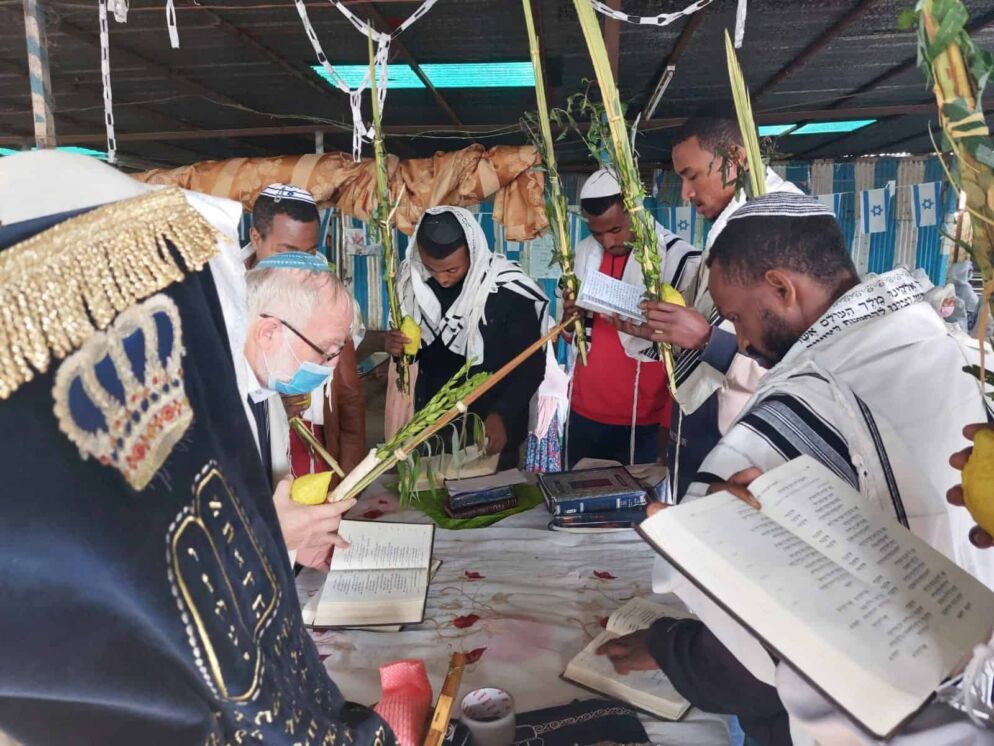
In Ethiopia, the holiday was called Be’ale Metselet. Kes Mentosnot, an Ethiopian Jewish religious leader, shared two explanations of the name with me: “the Festival of Shade” and another interpretation connecting it with prayer. Unlike the familiar rabbinic practice, each family did not build its own sukkah. Volunteers from the village built one large sukkah in the synagogue courtyard for the entire community.
Here, I believe, lies a key to the holiday: not “my sukkah,” but “our sukkah.”
Kes Mentosnot explained that hospitality stood at the heart of the celebration. The sukkah was not primarily a private space where individuals fulfilled their religious obligations. It was where villagers gathered to pray, eat, welcome others, and enjoy one another’s hospitality. The sukkah created community.
The emphasis was on strengthening a shared sense of belonging. Bete Israel’s spiritual tradition placed particular weight on intention: what mattered was not simply the number or scale of our actions, but the depth of the intention behind them. The focus therefore fell less on the sukkah’s precise dimensions or whether the biblical “fruit of a beautiful tree” meant a citron rather than an orange, and more on faith in God and the experience of living beneath God’s shelter.
The plants associated with the festival were used to decorate the sukkah, rather than treated as a separate commandment to take the “four species”—the citron, palm, myrtle, and willow specified by rabbinic tradition. Nor were the plants necessarily identical to those species. The festival’s religious meaning was expressed through its communal purpose: beneath God’s shade, everyone belonged. Israeli society has much to gain from this understanding of Sukkot.
Hospitality, however, raises a deeper question: Who is hosting whom?
We usually assume that the homeowner is permanent and the guest temporary: I am in my place, and you enter it. Sukkot unsettles that distinction. We leave our permanent homes and enter temporary shelters. Precisely when we seek to welcome guests, we become guests ourselves.
The tradition of ushpizin — symbolically welcoming the biblical ancestors into the sukkah — casts us as hosts. In Ethiopian tradition, the ancestral mothers are included as well. We also speak of the Shekhinah, the Divine Presence, dwelling there. But perhaps the question should be reversed: Is God our guest, or are we God’s guests? Is this really “my sukkah”?Or does it remind me that I have always been a guest in God’s world?
Once I recognize that I, too, am a guest, hospitality changes. The other person is no longer merely someone to whom I offer space. Their presence may reveal that my home is larger than I imagined. Sometimes a guest opens a door the homeowner never knew existed.
Dr. David Biton proposes understanding Jewish traditionalism through three interconnected elements: Mediterranean culture, attachment to tradition, and hospitality. In his account, hospitality is more than an obligation toward another person; it expresses a religious understanding of identity. Someone rooted in tradition knows who they are and can therefore open their home and world to others. Welcoming another person does not require erasing one’s boundaries, just as preserving one’s identity does not require rejecting a guest.
I hear an echo of Ethiopian Jewish tradition in this approach. Hospitality assumes a home with an identity and a memory — but also a door. Confidence in who we are allows us to make room for others without fearing that we will lose ourselves.
Hospitality crosses the many divisions within the Jewish people: Sephardi and Ashkenazi, secular and religious, Israeli and Diaspora. Its biblical roots also extend beyond the Jewish community. Micha Feldmann, who worked closely with Ethiopian Jews and played a central role in helping them immigrate to Israel, shared an example from Ethiopian Orthodox Christianity: the idea of receiving someone as “a guest of our father Abraham.” When a guest arrives, the host seeks to act as Abraham did — to open the gate, offer a welcome, wash the traveler’s feet, provide food, and make the visitor feel at home.
Abraham becomes more than a biblical figure whose story we tell. He becomes a model for conduct. The question is not only who stands at the door, but who I become by opening it. The guest gives me an opportunity, for a moment, to be Abraham.
I recognize this spirit in my own life. When I was a child in an Ethiopian village, two white Jews from Jerusalem came to visit. We were thrilled and wanted to draw close to them, even to touch their clothes. Despite two thousand years of separation and enormous differences in appearance, language, and culture, we did not see strangers. We saw brothers.
Years later, in Sudan, I encountered the same spirit from the other side. Mossad operatives and members of Shayetet 13, Israel’s naval commando unit, risked their lives to help us reach Israel. They did not see strangers from Africa. They saw brothers and sisters who needed to be brought home.
When I arrived in Israel without my parents and lived at the Oman–Emunah boarding school in Afula, I received food, clothing, shoes, and everything else I needed. Only later did I understand that Jews around the world who did not know me had donated money for children they had never met.
I experienced that same generosity in the United States. During my postdoctoral work at Brandeis University, while living in Newton, Massachusetts, I once sat with a Jewish man named Dan Goldish. I told him I had been born in an Ethiopian village; he told me he had grown up in Oklahoma. Suddenly, he began to cry. “I never thought I would meet a Jew from Ethiopia,” he said. “I feel as though we are brothers.” Throughout my time in Newton, people who had never known me opened their homes and welcomed me as family.
It was a non-Jewish taxi driver in New York who put into words what I had witnessed for years. When he learned that I was Jewish, he said, “That’s what I envy about Jews. Wherever you are in the world, if you’re Jewish, another Jew will open the door for you.”
Hospitality and solidarity, I realized, are more than acts of generosity. They express a deeper recognition: the person who appears to be a stranger may turn out to be a brother or sister.
I once heard an Ethiopian sage express an idea that has stayed with me: In Ethiopia, we did not speak of building bridges between people; we lived alongside rivers.
Ever since, I have thought about the difference between seeing a bridge and seeing a river. A bridge asks how I, standing on my bank, can reach you on yours. That is an important question, but it begins with separation: I am here, and you are there. The river begins elsewhere: we both drink from the same source. We may be different and stand on opposite banks, but our lives are bound together. I do not have to erase my identity to see you, and you do not have to become like me to be my brother or sister.
This also captures something of the religious world of Bete Israel as I knew it and as my grandfather and the community’s elders described it. There were Keisim and community members, elders and young people, women and men, with different responsibilities and degrees of authority. But those differences were not meant to establish different levels of human worth before God. Even a Kes, for all his authority, belonged to the covenant and was bound by it. For someone praying, fasting, or bowing in worship, the primary point of reference was God, not the person standing nearby. The question was not whether I stood above or below someone else, but where my heart was directed.
This brings us back to the sukkah: beneath the same roof, we are all guests. Bete Israel’s communal sukkah offers an image of a society in which different people enter a shared space without having to become alike in order to belong.
Here Sukkot connects with what I call a consciousness of redemption. A consciousness shaped by destruction tends to think in hierarchies: who is above and who is below, who belongs and who is excluded. It fears that making room for someone else will diminish one’s own place. A consciousness of redemption preserves boundaries and identities while refusing to turn them into walls. It allows the home to grow without losing its character.
The Torah itself connects the sukkah to the Exodus: “I made the Israelites dwell in booths when I brought them out of the land of Egypt.” Biblical Egypt represents a rigid hierarchy of master and slave, Egyptian and Hebrew. Leaving Egypt means more than escaping physical bondage. It challenges a world in which one person’s power depends on another’s subjugation.
The sukkah carries that challenge forward. Those freed from slavery are not invited to become absolute masters themselves. They leave their permanent homes and remember that they, too, are guests. Freedom means being released not only from someone else’s control, but also from the need to control others.
Bete Israel knew destruction, exile, and distance from Jerusalem. The community fasted and mourned, but destruction did not become the center of its identity. Its face remained turned toward Jerusalem. It could acknowledge brokenness without making brokenness the foundation of belonging.
In this sense, the sukkah is a small Jerusalem: a temporary place in which we can experience something of the home we long for. Redemption begins along the way, whenever we create a space of faith, responsibility, and fellowship within an imperfect world.
The cycle of the holidays of the Hebrew month of Tishrei now comes full circle. On Rosh Hashanah, we stand before our Creator. On Yom Kippur, we seek to return. Then Sukkot tells us: Now that you have come home, step outside so that you can understand home anew.
Perhaps this is also the deeper meaning of teshuvah: returning as someone who has passed through brokenness and learned from it — and who can now open the door.
A consciousness of redemption asks more than who is to blame, who won, or who lost. It adds a harder question: What is my responsibility? What can I repair so that our shared home becomes a better place?
We may never agree on exactly what redemption looks like. But we can propose one test: Does my redemption require someone else’s destruction? If belonging depends on leaving someone outside, and if standing tall requires keeping someone else below me, then we have not yet come home.
Perhaps this is the secret of Sukkot. After a journey of return, we leave home to discover that it was never ours alone. We are all guests in God’s world. We all drink from the same river. And we are all invited to gather beneath the same shade.