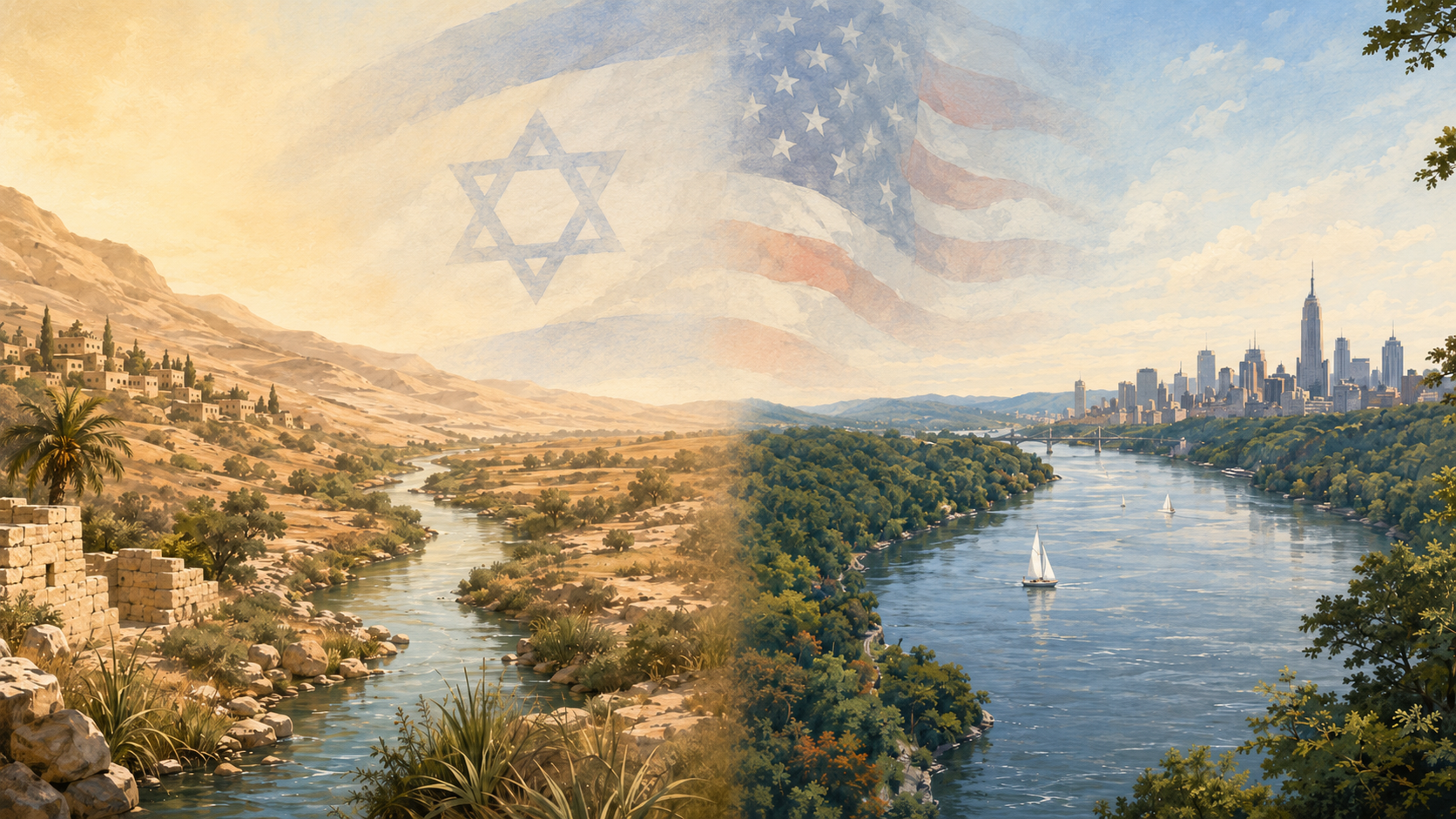
Between Hudson and Jordan: The Abyss We Ignore
We arrived in the United States after a full year of studying, reading, discussing, and trying to understand North American Jewry up close—its history, its complexity, and the broad spectrum of identities, denominations, communities, and views that shape it.
But after all the books, lectures, and articles, one truth became clearer than anything else: there is no substitute for meeting people face to face.
No article can replace conversation.
No lecture can replace sitting across from another Jew and hearing the fears, hopes, frustrations, and questions that shape his or her world.
That is precisely why the Ruderman Program matters so deeply.
For the past 13 years, the Ruderman Family Foundation has been sending Israeli opinion leaders to encounter North American Jewry in a serious, direct, and personal way. Not through slogans. Not through headlines. Not through social-media arguments. But through people, communities, and real conversations.
After this journey, I understand more than ever why that mission is essential.
Because the encounter was important.
At times, it was even jarring.
As the conversations continued, one difficult feeling became increasingly clear: a significant part of American Jewry simply does not understand what it means to be Israeli.
Not really.
It does not understand what it means to grow up in a country where an exploding bus is not a history lesson, but a childhood memory.
It does not understand what it means to be a mother accompanying her child to the IDF induction center, knowing that from that moment on, her heart no longer fully belongs to her.
It does not understand what it means to wear a uniform, stand at a checkpoint, enter Gaza, serve on the northern border, or live in a country where every generation is called upon, again and again, to defend with its own body the very existence of the Jewish people.
It does not understand what it means to be Jewish not merely as a cultural idea, a communal ritual, or a comfortable moral position on a college campus, but as a living, bleeding, demanding national reality that requires decisions.
And that is where the rupture lies.
The gap between Israel and parts of American Jewry is not merely political. It is not only a debate over one government or another, over settlements, Netanyahu, Trump, Biden, or the two-state solution.
The gap is much deeper.
It is a gap of identity.
Not only the identity of the State of Israel, but our identity as a people.
In Israel, Judaism is not only synagogue, community, charity, tikkun olam, and a weekly class. It is also a border. It is an army. It is a military funeral. It is a siren in the middle of the night. It is a 19-year-old with a rifle on his shoulder. It is a mother waiting for a message. It is a family sitting shiva.
It is also a people that returned to history and refuses to remain an eternal victim.
By contrast, parts of American Jewry have fused Judaism with American liberalism, progressive language, and moral frameworks shaped in a world where there is no immediate existential price to pay.
From that place, it becomes difficult to understand the Israeli Jew.
The Jew who does not only pray, but also fights.
The Jew who does not only demand rights, but also exercises power.
The Jew who does not only speak about morality, but is forced to make impossible choices between bad and worse.
The Jew who knows that in order for children to sleep safely in Sderot, Kiryat Shmona, Kfar Aza, Jerusalem, or Tel Aviv, someone else must stand guard at night in a vest and helmet, carrying a weapon.
And that is precisely what parts of the American Jewish world struggle to digest.
They want Israel as a moral project. As a symbol. As an inspiration. As a beautiful country on a postcard. As a smart, creative, moving, and tragic people with whom it is comfortable to identify.
But they struggle to accept Israel as a sovereign state.
A state that fights.
A state that sometimes makes mistakes, but must also act.
A state that cannot afford the luxury of sterile morality from afar.
A state where the question is not only, “What is the right thing to say?” but, “How do we survive the next summer?”
And perhaps this is the hardest thing to say out loud: not all criticism of Israel comes from antisemitism. Of course not.
But some of that criticism comes from a profound lack of understanding of Israeli reality—and, at times, from a lack of willingness to understand it.
Because to understand Israelis, one must listen not only to conference speakers, but also to mothers of soldiers.
One must speak not only with rabbis and heads of organizations, but also with bereaved families.
One must understand not only the fear of a Jewish student on campus, but also the fear of an Israeli child running to a bomb shelter.
One must see not only the rise of antisemitism in the United States, but also the price Israel has paid for decades for the simple fact of its existence.
During this trip, I realized that the crisis between Israel and Diaspora Jewry is not merely a crisis of public diplomacy.
It will not be solved by another polished video, another delegation, another panel, or another slogan about “building bridges between communities.”
It is a much deeper crisis.
A crisis of language.
A crisis of consciousness.
A crisis of Jewish identity that has developed in two entirely different worlds.
In one world, the Jew learned to be a successful citizen within a liberal democracy: to build community, integrate, influence, contribute, be cautious about power, and sometimes even suspicious of it.
In the other, the Jew learned that without power, there will be no community, no democracy, and no children to send to school in the morning.
These two worlds do not always speak the same language.
Sometimes, it must be said honestly, they do not even recognize one another.
The meetings with Jewish organizations, rabbis, public figures, social activists, community leaders, and students were deeply important. They revealed real pain, real concern, real fear, and a sincere desire to maintain a connection with Israel.
But they also revealed just how deep the gap is.
How much parts of American Jewry want Israel to be something it simply cannot be: a Jewish state without a Jewish price. A sovereign state without the use of force. A country surrounded by enemies that behaves as if it were Switzerland. A people that returned to its land, but is still expected to act as though it were merely a persecuted minority asking the world for permission.
That will not happen.
Israel cannot be only an object of identification. It is, first and foremost, a home.
And a home must be defended.
Even when it does not photograph well.
Even when it does not play well on campus.
Even when it does not fit the progressive language of parts of the American Jewish community.
Amid all of this, the words shared by Rabbi Meir Goldwicht of Yeshiva University remained with me in a special way. He reminded us that we must learn to see first with the heart, and only afterward with the eyes:
“וְלֹא תָתוּרוּ אַחֲרֵי לְבַבְכֶם וְאַחֲרֵי עֵינֵיכֶם אֲשֶׁר אַתֶּם זֹנִים אַחֲרֵיהֶם.”
(במדבר ט״ו, ל״ט)
But seeing with the heart does not mean blurring the truth.
It does not mean pretending that everything is fine.
It does not mean smiling politely while, beneath the surface, a historic rupture is forming between two parts of the same people.
Seeing with the heart means daring to tell the truth: there is a gap. It is deep. It is dangerous. And it will not be closed with slogans.
If American Jewry wants to understand Israel, it must stop seeing it only as a moral case study and begin seeing it as a family fighting for its life.
And if we in Israel want to preserve this relationship, we must understand that there, too, there is fear, pain, confusion, and a sense of abandonment.
But the starting point must be clear: Israel is not an abstract idea.
Israel is a living reality, difficult, beautiful, wounded, strong, and at times impossible to fully understand for those who have never been required to pay the price of Jewish sovereignty.
I end this journey more worried than when I began.
But also more clear-eyed.
Because to build a real bridge, we must first stop lying to ourselves about the size of the abyss.
For that reason, I am deeply grateful to the Ruderman Foundation and University of Haifa.
For 13 years, the Ruderman Foundation has understood something too many of us forget: the relationship between Israel and North American Jewry cannot be built from a distance. It cannot be sustained through statements, campaigns, or polished talking points alone.
It requires Israelis to come, listen, ask, argue, be challenged, and encounter the complexity of American Jewish life face to face.
This journey did not give me easy answers.
It gave me something more important: a deeper understanding of the questions.
It reminded me that people cannot truly understand one another through headlines. Israelis cannot understand American Jewry only through news about campuses, protests, donations, or political arguments. And American Jews cannot understand Israel only through op-eds, viral videos, or moral debates from afar.
There is no substitute for people.
There is no substitute for sitting together.
There is no substitute for looking someone in the eye and realizing that behind every position there is a story, behind every criticism there is often fear, and behind every disagreement there may still be a shared destiny.
And it begins, as it always has, with people.