As a teacher of Hebrew as a second language and Israeli culture, my passion lies in building bridges between diverse worlds. Every year, as Memorial Day approaches, this mission feels particularly poignant. Just this past Friday, leaving my Pilates studio, the receptionist wished me a “Happy Memorial Day weekend.” This time, it struck me with the same jolt it did 16 years ago when I first moved to America. The phrase “Happy Memorial Day” was, quite frankly, a cultural shock.
I remember my American husband encouraging me to go shopping, explaining it was a weekend of sales and barbecues. I couldn’t bring myself to do it. Instead, I took my children to the local military cemetery, feeling a profound need to instill respect for the fallen. For years, I struggled to reconcile the noun “Memorial Day” with the adjective “Happy.” It took me a long time to grasp that here, Memorial Day is a completely different “creature.” Eventually, I even found myself saying “Happy Memorial Day” in English, though in Hebrew, that combination would never cross my lips.
Walking to my car, I wondered why it bothered me so much this year. And then, alone for a split second in the car, I broke down. Tears flowed for the Israeli soldiers, so many of them. I sat for long minutes, remembering them all – both the Israelis and the Americans.
Since I began teaching Hebrew and Israeli culture in the U.S., it has become incredibly important for me to teach the differences between “here” and “there.” My adult students, especially those who serve in the American military, were quite shocked after lessons where I showed them videos from Israel, explaining how everything comes to a halt on Yom HaZikaron. They solemnly informed me that from then on, they would view Memorial Day from a different perspective. My younger students connected less, and of course, when in America, behaved like an American; I didn’t expose them to the full weight of the sorrow and grief. However, during my time as the project manager for “The Partnership” between Tel Aviv and Los Angeles, under the auspices of the Jewish Federation of Los Angeles, I had the incredible opportunity to take a delegation of 6th-grade students to Israel. Parents also joined this delegation, and I was so glad they too would have the chance to grasp this profound cultural difference. We intentionally chose to travel during the week of Yom HaZikaron, immediately followed by Independence Day. This timing was no coincidence; it was designed to immerse the students and their families in what I believe is the peak expression of cultural difference between our two nations.
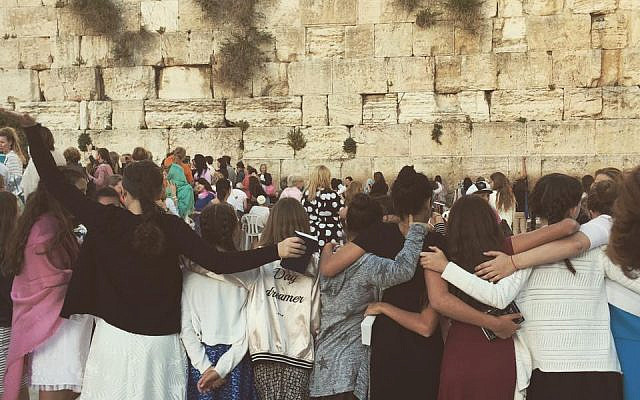
Pressman Academy middle school students from Los Angeles embrace at Jerusalem’s Western Wall during a transformative cultural immersion experience. This moment captures the profound connection formed between young learners and Israeli culture through The Partnership delegation program between Tel Aviv and Los Angeles, coordinated by the Jewish Federation of Los Angeles. (Photo credit: Orly Lavi Travish, 972 Education Inc.)
I distinctly remember the feedback sessions we had after the Yom HaZikaron ceremonies. The parents were consistently amazed, even shocked, by how young children in Israel knew to stand solemnly during the siren, and how they participated in such a profoundly sad ceremony. They often asked, “Why expose such young children to so much sorrow?” Our explanation was simple: “This is part of our lives.” We believe it’s perhaps due to this direct engagement with remembrance and loss that Israelis possess such remarkable resilience. In America, it’s possible to shield oneself from this grief, but in Israel, almost every person knows someone – a relative, a friend, a friend of a friend – who has been killed in one of the wars. This shared understanding of sacrifice is woven into the fabric of daily life.
Sadly, after 20 years, the Jewish Federation ceased funding “The Partnership” project in its original format. To my disappointment, it no longer takes 6th-grade students to Israel, and the project has taken a different turn in its nature. Especially since October 7th, I deeply wish for this program to return to its original format. It proved itself immensely valuable: to this day, I have students who remained in contact with their host families, even visiting each other after the program officially ended. Some even made Aliyah to serve in the IDF, and during their military service, they reconnected with the very friends who hosted them as 6th graders. This kind of deep connection and cultural exchange is truly invaluable, allowing American and Israeli families to connect and learn about each other’s cultures in their natural environments – a true form of place-based learning.
This shared human experience of remembrance, expressed so differently across cultures, is at the heart of what I want to explore today. While both Israel and the United States dedicate a day to honoring those who made the ultimate sacrifice, the ways in which these days are observed, and the feelings they evoke, reveal fascinating and often profound cultural distinctions. Let’s delve into these differences, not to judge, but to better understand and connect.
Timing and Transition: From Sorrow to Celebration
One of the most striking differences between Israel’s Yom HaZikaron and the U.S. Memorial Day lies in their placement on the national calendar and the immediate transition that follows. In Israel, Yom HaZikaron (Memorial Day for the Fallen Soldiers of Israel and Israel’s Victims of Terrorism) is observed directly before Independence Day. This creates a powerful, almost jarring, shift from profound mourning to national celebration. The solemnity of remembering those lost in defense of the state flows immediately into the joy of celebrating the very existence of that state. It’s a stark, sharp transition that underscores the direct connection between sacrifice and sovereignty.
In contrast, the United States observes Memorial Day on the last Monday in May. While it is a federal holiday dedicated to honoring fallen service members, it often marks the unofficial start of the summer season. For many Americans, this day is associated with a long weekend, travel, barbecues, and the opening of swimming pools. The atmosphere, while acknowledging remembrance through official ceremonies, is generally more relaxed and celebratory, often described as “the world goes on with greater intensity”. The very idea of wishing someone a “Happy Memorial Day” in Hebrew feels incongruous, reflecting the deeply divergent cultural approaches to these days. This sequential timing highlights the continuous narrative of loss and resilience that defines the Israeli experience, a narrative less explicitly woven into the fabric of the American observance.
Public Atmosphere and Daily Life: A Nation Stands Still vs. A Nation Carries On
Beyond the calendar’s timing, the very air in Israel and the United States feels distinctly different on their respective memorial days. In Israel, Yom HaZikaron is a day of profound national mourning, where the entire country seems to hold its breath. Flags are flown at half-mast, and a solemn quiet descends as most restaurants and stores are closed. Many Israelis spend the evening at home, listening to somber music or watching official broadcasts dedicated to remembrance. The feeling is best described as the world “standing still” – a deeply felt national mourning that impacts daily routine everywhere.
In stark contrast, U.S. Memorial Day, while honoring the fallen, is observed as a national holiday often used for travel, shopping, and leisure activities. Businesses often remain open, and many even offer sales, marking the unofficial start of the summer season. The atmosphere, despite official ceremonies and parades, is less universally characterized by public mourning. As I experienced, “the world goes on with greater intensity”, and the combination of “happy” and “memorial” in a single greeting, so common here, remains incongruous in the Israeli context. I recall attending an Israeli Memorial Day ceremony here in Los Angeles, organized by the Israeli Consulate to remember all fallen soldiers, including those whose bereaved families reside in our city. The Mayor of Los Angeles was invited to speak, expressing support for the Jewish Israeli community. He began his address by saying, “Happy Memorial Day.” I could feel a collective shiver ripple through every Israeli present, and more than anything, my heart ached for the bereaved families in the audience. It was a regrettable incident, in my opinion, that no one from the Consulate had prepared the then-Mayor for an encounter so deeply identified with Israeli culture. This difference highlights a fundamental cultural divergence: in Israel, the collective grief is outwardly expressed and woven into the public fabric of life, whereas in the U.S., while individual remembrance is profound, the public sphere largely continues its usual rhythm.
National Observances: The Siren’s Call vs. Silent Reflection
Perhaps the most indelible image of Yom HaZikaron in Israel is the nationwide siren. Sounded twice – once at 8 PM on the eve of the day and again at 11 AM on the day itself – this siren brings the entire country to a standstill. During these moments, people stop whatever they are doing, whether driving on a highway or walking down a busy street, step out of their cars, and stand in silent tribute to honor the fallen. Cars halt on roads, pedestrians pause their movements, and the air fills with a profound, unified silence. This public, collective halt is a defining and deeply moving feature of the day, a visceral manifestation of national mourning.
In the United States, while official ceremonies, parades, and respectful observances take place, there is no mandatory nationwide siren or enforced public stop comparable to Israel’s practice. Memorial Day ceremonies might include moments of silence, but they are typically observed within specific events rather than universally by the entire populace at a designated time. This difference profoundly shapes the experience of remembrance: in Israel, it is a shared, unavoidable moment that interrupts daily life and forces a collective pause, embedding the memory of sacrifice into the very rhythm of the day. In the U.S., while equally heartfelt, the observance of silence is more often a personal or communal choice within a larger, continuing public sphere.
Who We Remember: Defenders of the Land vs. Guardians of Freedom
The scope of remembrance also differs notably between the two nations. In Israel, Yom HaZikaron is dedicated to those who have fallen in Israel’s wars and the victims of terror attacks. The commemoration is intrinsically linked to the ongoing effort to defend the existence and security of the state. The fallen are primarily individuals who died directly defending the country or specific places within it. This focus emphasizes a direct connection between their sacrifice and the nation’s survival.
In the United States, Memorial Day honors members of the armed forces who died while serving. Historically, the day first honored Union soldiers who died in the Civil War, and after World War I, it expanded to include all American soldiers who died in combat. This includes those who may have fallen “thousands of miles away, defending ‘freedom’ or ‘America’s strategic interests'”. This broader scope reflects a different geopolitical context and a remembrance that extends to military personnel lost in conflicts globally, not solely those directly defending the homeland. The distinction highlights the deeply localized and existential nature of remembrance in Israel versus a more globally focused military commemoration in the U.S.
Symbols of Remembrance: The Blood of the Maccabees vs. The Red Poppy
Visual symbols also play a distinct role in remembrance in both nations. In Israel, the official symbol for Yom HaZikaron is the “Blood of the Maccabees” flower (Helichrysum sanguineum). Its origin is linked to a local legend about the flower growing where the blood of the Maccabees was shed, and it was later adopted by Zionist leaders, connecting ancient bravery to modern defense. This flower became an official symbol of the day in 1955. Due to the flower being protected, stickers or pins bearing its image are commonly worn across the country. This widespread use creates a visual solidarity and immediate recognition of the day’s solemnity.
In the United States, the red poppy (Papaver rhoeas) is a common symbol of remembrance, particularly influenced by the British tradition which started after World War I, inspired by the poppies that grew on the battlefields of Flanders. While worn, its use might not be as universally adopted or intensely promoted as the “Blood of the Maccabees” symbol in Israel. This difference in the prevalence and official endorsement of a symbolic flower further underscores the distinct ways each nation collectively remembers its fallen.
The differences between Israel’s Yom HaZikaron and the U.S. Memorial Day are profound, reflecting the unique histories, geopolitical realities, and cultural fabrics of each nation. From the stark, immediate transition from sorrow to celebration in Israel to America’s more relaxed entry into summer, and from the unifying national siren to differing symbolic flowers, these days serve as powerful lenses through which to understand each country’s soul. While the specific expressions of remembrance diverge significantly, the underlying human impulse to honor those who made the ultimate sacrifice is universal.
As an educator bridging Israeli and American cultures, I believe understanding these distinctions is not about judging one as “better” than the other, but about fostering deeper empathy and connection. Each nation honors its fallen in a way that resonates most deeply with its collective experience. For my students and for myself, truly grasping the weight and meaning of Yom HaZikaron, with its raw immediacy and nationwide halt, has undeniably deepened our appreciation for Israel’s resilience and the profound cost of its existence. May we continue to remember, to learn, and to build bridges of understanding, so that the sacrifices of the past may inspire a more connected and compassionate future. May the memory of all the fallen be a blessing.
About the Author
Educational Entrepreneur. Hebrew language and Israeli culture specialist Orly Lavi Travish is the founder and owner of 972 Education Inc. With over 30 years of experience and degrees in Hebrew and Arabic language and literature, she trains students and educators worldwide in innovative teaching methods that integrate AI. Her additional certification in teaching diverse learners informs her pioneering work, which includes the creation of multiple educational initiatives, including IVRITECH conferences, "Language on the Sofa," (״שפה על "הספה, Language on the Sofa) the first international teacher’s forum of its kind for language teachers in general, and Hebrew language teachers in particular, "In One Language on a Second Language" (״בשפה אחת על שפה שניה״) the first Hebrew podcast on teaching a second language, education, and culture, and “Zikaron BaMuzeon” (״זיכרון במוזיאון״ "Remembrance in the Museum" ) a FREE educational virtual tour with the Holocaust Museum LA for students around the world.



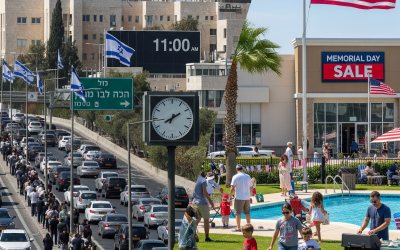 (Gemini Generated Image- Photo credit: Orly Lavi Travish, 972 Education Inc.)