


Executive Director, World Jewish Relief USA
Beyond Batumi Boulevard
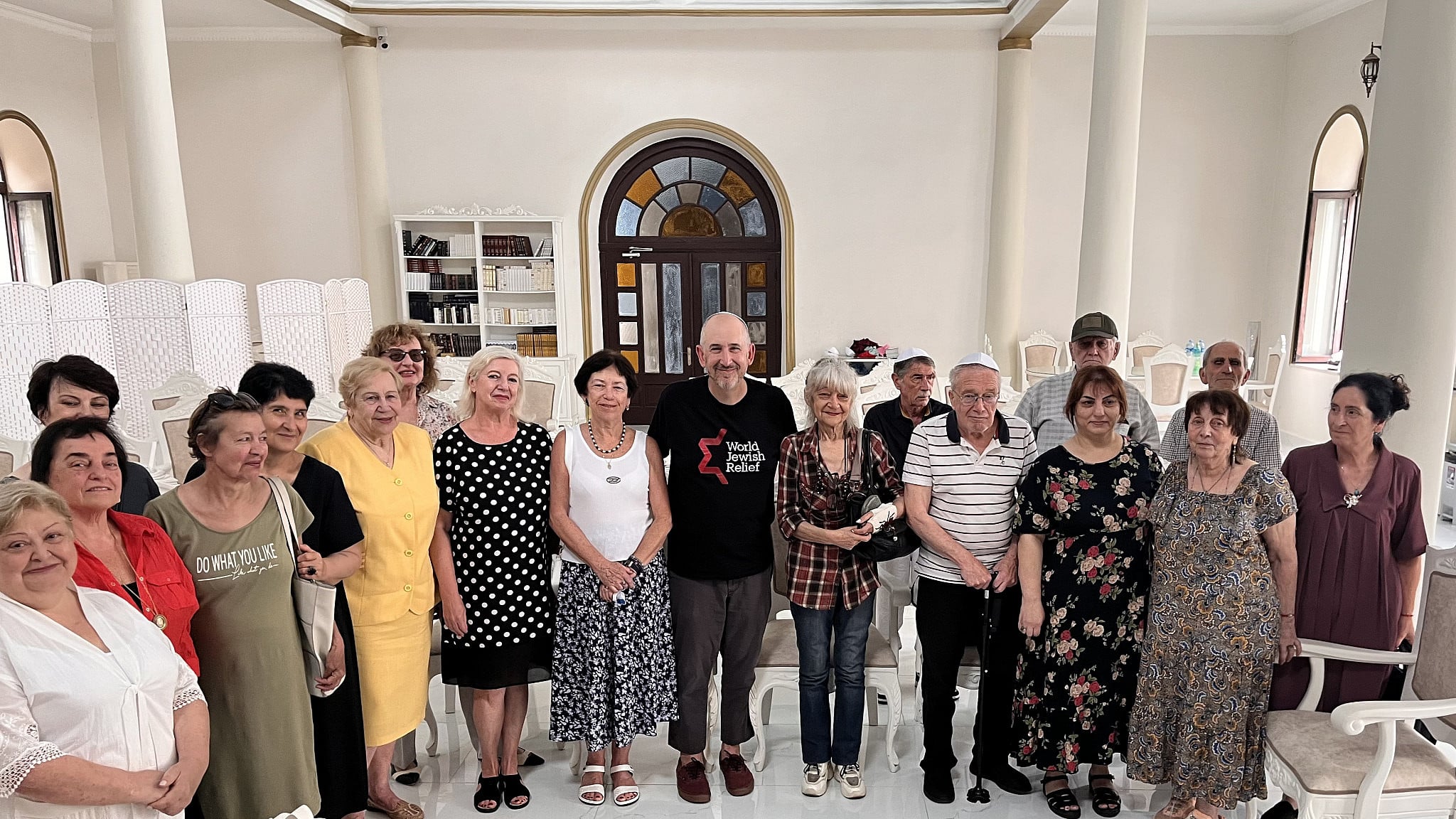
David Weisberg, Executive Director of World Jewish Relief USA, meets with members of the Jewish community of Batumi, Georgia.
On the surface, the city of Batumi, situated on the beautiful Black Sea coast in the country of Georgia, can feel curated and manicured, like a vacation getaway for people from throughout the region. Fancy hotels and casinos line the promenade, with sleek architecture, playful fountains, and horticulture from throughout the world. Walking down Batumi Boulevard, I found myself fascinated not only by the Ferris wheel attached to the side of a hotel many stories above the ground (no, I would never ride it) but also by the international duck pond, featuring species ranging from Asia to South America.
But while Batumi has experienced remarkable growth in population, wealth, and visibility over the past two decades, some trajectories beneath the surface have moved in the other direction.
At its peak, in the 1920s, there were over 3,500 Jews in Batumi. A synagogue was built there in 1904 (for which there is an absolutely fascinating legend about the Jewish community agreeing to pray that Tsar Nicholas II and Empress Alexandra would be blessed with a son in exchange for the right to build the synagogue. Their son, Alexei Nikolaevich, would be born that same year.) The Jewish community was a small, but meaningful, part of Batumi, representing over 5% of the overall population.
By 1970, the Jewish community of Batumi numbered just over 1,300.
Today, the best estimate is that only about 150 remain, most of them older adults.
In fact, during my visit with the local Hesed, one of a network of Jewish welfare and community centers serving Jewish communities across the Former Soviet Union, yesterday, I came to think of our 25-year-old translator, Veronika, as, with apologies to Paul Simon, the only young Jew in Batumi.
When we were picked up yesterday to visit with some of the 149 Batumi Jews older than Veronika, I expected that we would be traveling to another part of town. Instead, I was surprised to find our first visit was just a block from our hotel, just steps from the fancy fountains and restaurants.
But this Soviet-era apartment building had no bank of spacious elevators with embedded video screens. Instead, it was five flights of dark, concrete stairs that led to Natalia’s apartment.
Natalia, herself, likely doesn’t use those stairs often. At 71, a widow with a serious oncological illness, she is largely homebound. She proudly showed us photos of her children, grandchildren, and even great-grandchildren. But they no longer live in Batumi, having, like many young people, moved to Tbilisi…or to Israel. They visit on holidays, but they are unable to help with her daily living needs.
Her monthly government pension, approximately $250, barely covers her food and some of her utilities.
It’s the Batumi Hesed, she says, that keeps her alive and keeps her from feeling alone. With the support of World Jewish Relief, the Hesed pays for her monthly medicine, covers the costs of her utilities during the winter, and, remarkably, provides a daily helper for several hours of home care. Natalia said she could not live without this support.
When I asked Natalia whether there’s something else that she needs that we could provide, she responded, “Nothing.” It was unclear whether that was an entirely candid response or instead reflected a combination of pride and gratitude.
And, while she set out a lovely table of homemade khachapuri and cakes for us, we were clearly the rare social visitor. Instead, Natalia finds community through a special mobile phone provided to her by the Hesed, which provides access to programs that Natalia, a former professor of Russian, not only finds intellectually stimulating, but that are also her greatest source of connection, providing her ongoing friendships and a feeling of community.
In contrast to Natalia, Svetlana, with whom we also visited, is not a native of Batumi. Born and raised in Russia, she would move to Sukhumi, her husband’s hometown, in northwestern Georgia, in 1986. But their peaceful life would be interrupted by the 1992-1993 war in the breakaway region of Abkhazia, which claimed thousands of lives and forced hundreds of thousands of ethnic Georgians, like her husband, from their homes.
They relocated to Batumi, where her husband tragically died at the age of 47. They had no children. She was left alone. An internally displaced person with no family or community of support.
Like Natalia, Svetlana credited World Jewish Relief, through its partnership with the Hesed, with not only providing the practical support she needs, facing both heart issues and diabetes, but also with the community that gives her a quality of life.
She exuded strength, warmth, and pride, and even shared with us how she’s taken in a local dog (despite the misgivings of some of her neighbors).
That synagogue that was built in the early 1900s, when Batumi’s Jewish community numbered in the thousands, is where the Hesed is located and where its in-person programs take place. (It’s also where Veronika told us she had gone to Hebrew school, as part of a class of five that she described as having her and four of her cousins.)
It was moving to understand that the twenty or so older adults that came to meet with us there yesterday represented a significant percentage of what is now the total Jewish population of Batumi.
I asked what program I had been invited to join them for, and I was surprised to learn that I was, in fact, the program. We talked about their lives, their journeys, how they had seen Batumi change over the decades, and how it made them feel.
When I asked them what they enjoyed about the Hesed’s programs, their answers were manifold. The holiday celebrations. The connections beyond Georgia to other Former Soviet Union populations and even to Israel. The opportunities to learn and to exercise and to sing together.
When I asked what message they would like me to convey to our World Jewish Relief community that helps to enable these programs and services, the answer was uniform. “Please don’t let us be forgotten.”
In a community that now lies just below the surface behind Batumi’s beachside resort playgrounds, that has seen its younger population, its own families, move away for greater opportunity, the sense of both gratitude and fear was real and understandable.
All I could say was, “We won’t forget you.”
I won’t.
And, with World Jewish Relief’s community of supporters, we won’t.