
Writer covering Israel–Africa, Jewish affairs, and Israel worldwide
Beyond Bibi: The Lesson Israel Must Learn from October 7
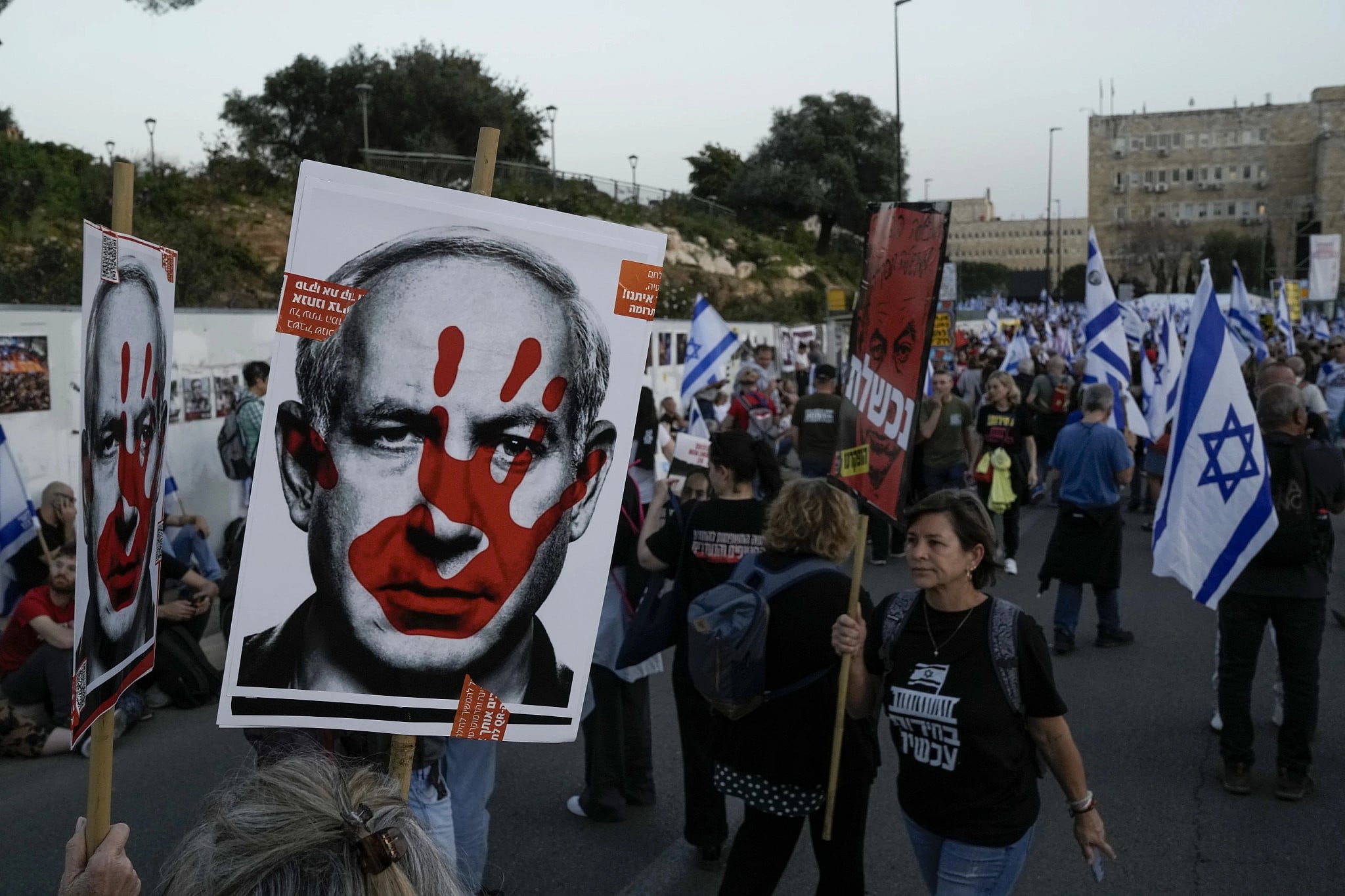
People take part in a protest against Israeli Prime Minister Benjamin Netanyahu’s government and call for the release of hostages held in the Gaza Strip by the Hamas militant group outside of the Knesset, Israel’s parliament, in Jerusalem, Sunday, March 31, 2024. (AP Photo/Leo Correa)
There is a perfectly legitimate case for holding Bibi responsible for Israel’s catastrophic failure on October 7. But there is a dangerous leap from blaming him for failing to stop Hamas to treating his leadership as the explanation for Hamas’s attack. Israel must not confuse the two.
As Israelis prepare to vote, the question of Netanyahu’s future is inseparable from the trauma of October 7. Three years have passed, but the dead are not less dead, the hostages and their families are not less deserving of answers, and the disgrace of that morning has not diminished with the passage of time. Israelis are entitled to demand accountability. They should demand it. The government, the military, the intelligence services, and the political leadership must answer for the failures that permitted the massacre to happen.
I have been troubled by the way October 7 is increasingly discussed in Israel, particularly as the country approaches another election. I understand the anger directed at Benjamin Netanyahu. I understand the demand for accountability. But I worry that, in the understandable desire to hold Bibi accountable, the distinction between his failures and Hamas’s own intentions is sometimes being lost, as though the problem might have been avoided simply by having a different man in the Prime Minister’s Office.
Netanyahu may have failed to heed warnings, or presided over a security establishment that catastrophically underestimated the threat. These are serious questions, and Israelis are entitled to demand answers. But none of them explains why Hamas wanted to attack Israel in the first place. Hamas was not waiting for Bibi to leave office before deciding whether Israel should exist. Its hostility did not begin with Netanyahu, and it will definitely not end with his departure.
Israel has made this mistake before: believing that a change in policy, a territorial concession, or an economic incentive might finally persuade its enemies to abandon their hostility. In 2005, it withdrew from Gaza, removing every Israeli and military presence from the territory. Two years later, the withdrawal did not produce the peaceful neighbour many hoped for. Instead, Israel faced years of rocket fire, escalating attacks and, eventually, October 7.
As Israelis head to the polls, they face a genuine choice about their leadership. The election matters. The record of Netanyahu’s government matters. Accountability matters. The families who lost loved ones on October 7 deserve answers, and the country deserves a political leadership capable of learning from catastrophe.
Bibi’s political opponents have understandably made the October 7 disaster central to their case against him. Gadi Eisenkot’s camp has even used a video game, Sleepy Bibi, in which players help the prime minister avoid responsibility by dodging warnings and making it safely to bed. The joke is obvious. The political objective is equally obvious: persuade Israelis that a different leadership would have prevented the catastrophe.
But a campaign slogan is not a security doctrine, and a video game is not an inquiry.
The question is not whether Netanyahu failed. The question is what precisely he failed to do, which failures were his, which belonged to the security establishment, and which deeper assumptions left Israel vulnerable to an enemy preparing for a massacre. The ballot box is not an Iron Dome. It cannot intercept a missile, dismantle a terrorist network, or erase an ideology. It can elect a government. It cannot guarantee that the government’s enemies will suddenly become reasonable.
This is where the debate over Bibi risks becoming dangerously misleading. Netanyahu’s failures deserve scrutiny. But accountability is not the same as causation. To say that Bibi failed to protect Israel is not to say that a different prime minister might have prevented it, even if he might have made different decisions, strengthened defences or responded differently to intelligence.
If the political lesson drawn from the massacre is simply that Bibi was the wrong man, Israel may change its leadership while retaining the assumptions that left it vulnerable. It may once again mistake a temporary lull for a strategic transformation, or a policy failure for the entire explanation of an enemy’s actions.
That would be a terrible way to honour the victims of October 7. Israel must investigate its failures, hold those responsible accountable and learn everything it can about how the massacre became possible. But it must also confront the reality that Hamas chose to carry it out, for reasons that cannot be reduced to the identity of the Israeli prime minister.
Israel can elect a new prime minister, reorganize its intelligence services and rebuild its defences. It must do these things where necessary. But it cannot vote Hamas’s ideology out of existence. It cannot make October 7 impossible simply by removing Bibi from office. The danger is that, in its understandable anger at its own leadership, Israel will once again convince itself that the problem lies chiefly in the wrong Israeli policy, the wrong Israeli government or the wrong Israeli man. There will always be another Israeli to blame. There will not always be another chance to protect the people who depend on the country getting this right. If Israel changes its leaders but refuses to confront the assumptions that blinded it, it will have changed the government without learning the lesson.
Bibi failed to protect Israel. That is an argument for accountability. Hamas chose to attack Israel. That is an argument for confronting the enemy. Israel must be capable of holding both truths at once. The price of confusing the two may be paid, once again, by those who have no say in the argument.
Related Topics
Related Posts