Beyond Haredim: The Secular Draft Issue No One is Talking About
As Israel approaches another election cycle, the national debate over military service is once again becoming a central political issue. For years, however, the conversation has been framed almost entirely around one subject: Haredi exemptions. Yet the data shows this narrative is incomplete.
Israel is not facing a single-sector draft crisis. The enlistment challenge now cuts across multiple parts of society, including growing numbers of secular Israelis who do not enlist, rising psychiatric exemptions, high dropout rates, and longstanding non-participation among large parts of the Arab population.
The question voters should now ask is not simply which politicians promise to “solve” the Haredi issue, but whether any party is willing to address the deeper structural challenges affecting military and national service across Israeli society as a whole.
It is important to recognize that the IDF’s enlistment challenges have been evident for some time. By 2020, the scale of non-service among Israelis, secular and religious, had already reached striking levels. Around 32.9% of men did not enlist in the IDF, while 44.3% of women also did not enlist. An additional 15% of men who did enlist failed to complete their service. Nearly half of Israeli men were therefore not completing full mandatory military service. That is not a fringe phenomenon. That is a national issue.
Even more striking is the composition of exemptions themselves. Among those receiving exemptions, 46.6% were secular Israelis, compared with 44.7% who were Haredi. In other words, secular Israelis represented a slightly larger share of exemption recipients than the ultra-Orthodox in this dataset. That fact alone fundamentally complicates the way the issue is commonly discussed in Israeli public life.
Historically, figures already showed an upward trend of IDF exemptions in secular-majority cities. For instance, in 2013, secular-majority cities such as Tel Aviv–Yafo recorded enlistment rates of around 68%, compared with more than 90% in cities such as Modi’in. However, this trend of exemptions has steadily increased in secular cities over the years. By 2023, Tel Aviv no longer appeared in the top 10 cities for enlistment, while Modi’in, for instance, continued to lead at roughly 90%.
Tel Aviv also failed to appear in the top 10 cities for combat-unit enlistment. Jerusalem, Beit Shemesh, and Modi’in led those rankings instead. Most recently, Israel Hayom reported in 2026 that Tel Aviv ranked only 48th nationally in enlistment rates.
At the same time, psychiatric exemptions have surged dramatically. Reporting based on IDF data shows exemptions on mental health grounds rising from roughly 2,000 in 2020 to around 9,000 in 2023, an increase of approximately 350% in just three years.
Military officials have acknowledged that many exemptions can be fraudulently obtained through various legal and medical channels by otherwise healthy individuals, however these are currently difficult to independently verify. These pathways are not unique to one group. They exist across Israeli society.
One of the most revealing datasets came through a Freedom of Information request submitted to the IDF by The Movement for Freedom of Information in Israel. The information, released following legal pressure and a court petition, covered the years 2018–2024, with partial 2025 data included. The figures showed between 9,000 and 15,000 mental health exemptions annually, with 2023 marking the peak year.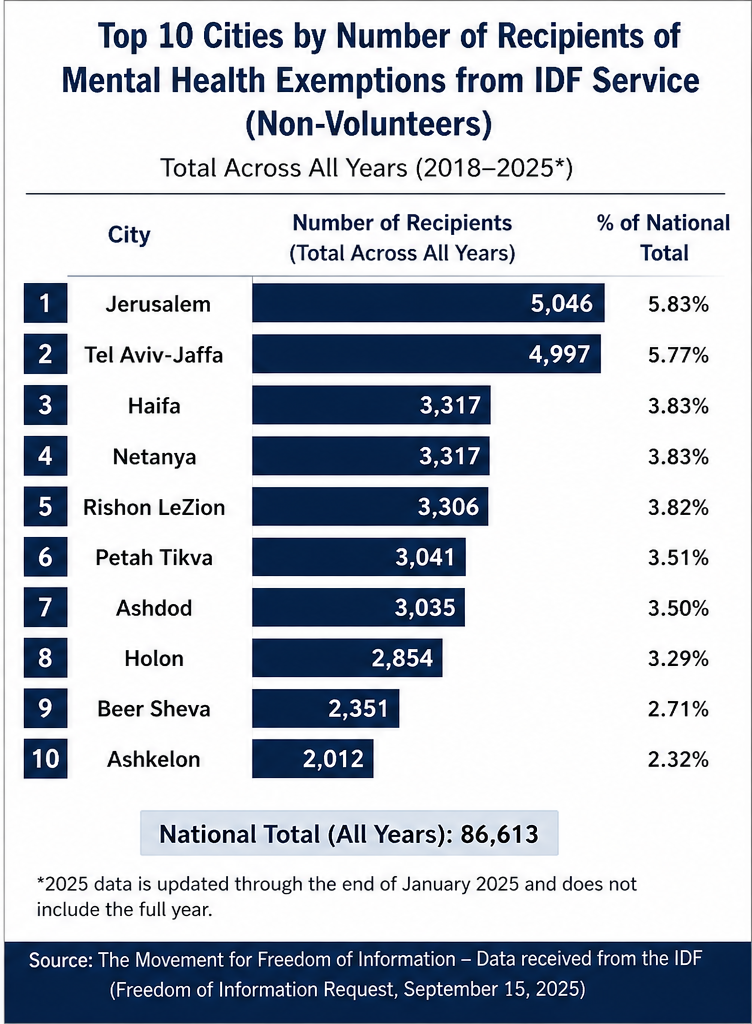
The concentration of these exemptions for individuals is especially notable. The top 10 cities accounted for roughly 38.5% of all mental health exemptions nationwide. Jerusalem and Tel Aviv stood far above the rest, each recording around 5,000 cases.
Most strikingly, Tel Aviv recorded almost the same number of mental health exemptions as Jerusalem: 4,997 compared with Jerusalem’s 5,046, a difference of just 49 cases across the entire dataset. Meanwhile, many secular-majority coastal cities saw dramatic increases between 2018 and 2023: Ashkelon rose by 102%, Holon by 99.6%, Be’er Sheva by 97.3%, Ashdod by 83.4%, and Netanya by 83.1%.
At the same time, another major reality is often overlooked entirely: Arab citizens of Israel, who make up roughly a fifth of the population, are generally exempt entirely from compulsory military service under IDF policy guidelines. Outside specific communities such as the Druze and some Bedouin populations, enlistment rates remain low, although Arab Christian enlistment has reportedly increased in recent years.
Taken together, the picture that emerges is clear: non-service in Israel is not concentrated in one community. It cuts across secular Israelis, Haredim, and Arab citizens alike, each for different structural, cultural, and legal reasons.
But public debate rarely reflects that reality.
Instead, the national conversation has narrowed into a political and moral confrontation focused almost entirely on the Haredim, while broader enlistment trends elsewhere in Israeli society receive far less scrutiny.
This does not mean the Haredi draft issue is unimportant. It is important. But reducing Israel’s enlistment crisis to one community is increasingly detached from the actual numbers.
If Israel genuinely wants to expand participation among all these populations, then the response cannot focus only on punishment and enforcement. It must also create practical frameworks that people can realistically enter and sustain.
For the Haredi community, that means expanding service tracks that accommodate religious lifestyles, including stricter gender separation, regular prayer schedules, and higher standards of kosher supervision.
More broadly, for all communities – Haredi, secular or Arab alike, Israel should begin moving toward a universal civic service model in which anyone who does not serve in the IDF contributes through national or civil service instead. That could include emergency medical services such as Magen David Adom and United Hatzalah, rescue organizations such as ZAKA, hospitals, education, elder care, municipal support, and civil emergency response. Such a system would not eliminate differences in military participation. But it would ensure that non-service does not become non-contribution.
Israel’s enlistment crisis has been reduced to a debate about one community. But the data shows something much larger: a national system under strain across multiple sectors of society. Yet, if Israel wants to maintain both its security and its social cohesion, it cannot continue relying on selective blame or politically convenient narratives.
The question is no longer simply who serves in the army. The real question is whether Israel is willing to rethink the system. The goal should be to build a fair and sustainable framework where contributing to the country, whether through military, national, or civil service, becomes a shared responsibility for all communities.