


Beyond Tech Export: What Israel Can Learn and Gain from Gulf Climate Leadership
Nearly a decade ago, in 2017, research conducted at the Association for Environmental Justice in Israel (AEJI) challenged a prevailing setup in Israeli policy circles. At the time, the dominant mindset framed climate change in a regional prism primarily as a commercial opportunity: Israel, with its technological prowess in drip irrigation and desalination, would export proprietary solutions to its water-scarce neighbors for short-term financial gain.
We argued then that a purely transactional, asymmetric approach was misguided. Real stability requires long-term, equitable, and strategic environmental partnerships.
Today, as our region navigates unprecedented geopolitical instability and the looming threat of renewed conflict, it is time to flip the question entirely: In a regional economic peace, what can the Gulf states offer Israel in climate and environmental resilience?
Breaking the Paradigm of Asymmetry
For too long, the Israeli discourse on regional environmental cooperation has suffered from a subtle patronizing bias—assuming technology flows strictly from West to East or North to South. Yet over the past decade, the Gulf Cooperation Council (GCC) nations, particularly the United Arab Emirates and Saudi Arabia, have evolved from capital investors into global powerhouses of climate strategy, renewable energy scaling, and arid-zone innovation.
The Gulf states face environmental baseline conditions far more severe than Israel’s: extreme heat indices, hyper-arid soils, and acute marine salinity in the Persian Gulf. In response, they have invested billions not merely in buying foreign tech, but in building holistic, large-scale systems for climate adaptation.
If Israel wishes to secure its own climate future—and ensure that the benefits reach its most vulnerable populations—it must move past the “tech exporter” trope and embrace a reciprocal learning and investment model.
Three Strategic Pillars of Reciprocal Climate Peace
Recent research in the frame of the new Mediterranean Climate Justice Think-Tank indicates three Strategic Pillars of Reciprocal Climate Peace, a truly strategic hydro-climate partnership between Israel and the Gulf states that should focus on three transformative domains:
- Arid Agri-PV and Microgrid Infrastructure for Marginalized Desert Communities
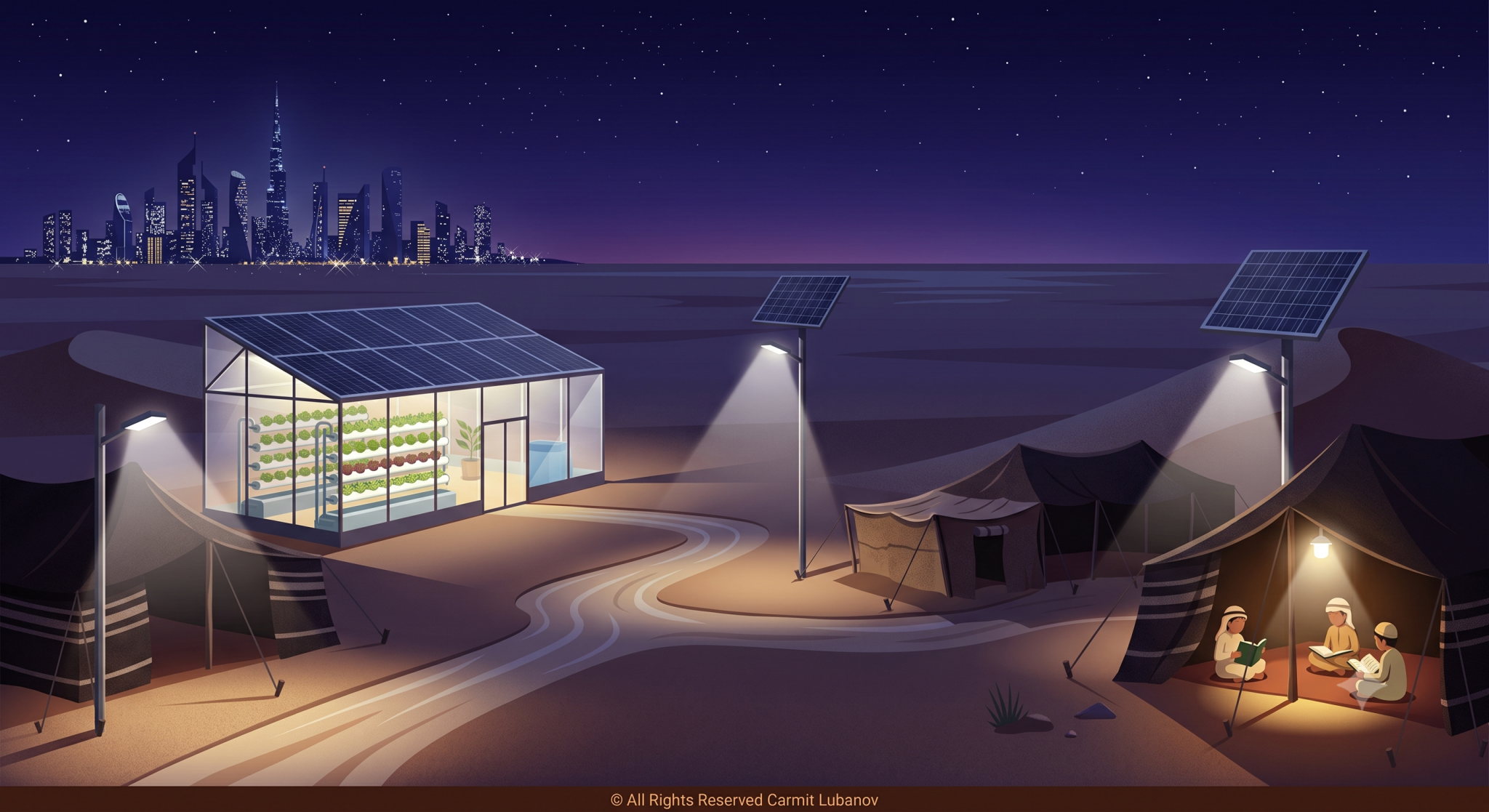
One of the most pressing environmental justice issues in Israel is the socio-economic and climate vulnerability of Bedouin communities in the Negev desert. The Gulf states have pioneered large-scale utility and community-level Agri-Photovoltaic (Agri-PV) systems designed for harsh desert environments, combining solar generation with shading that reduces water evaporation for crops.
Joint Gulf-Israeli investments in decentralized solar-plus-storage microgrids tailored for unrecognised or underserved desert villages could deliver clean energy, water security, and agricultural livelihoods. Learning from GCC models of community-centered desert agriculture would directly improve the lived reality of Israel’s desert minorities, moving environmental justice from academic theory to ground-level reality.
- Advanced Extreme-Heat Adaptation and Arid Urbanism
As climate models predict Mediterranean heatwaves exceeding 45°C, Israeli cities will face catastrophic heat island effects. Gulf nations are currently the world’s living laboratories for extreme heat adaptation. From smart district cooling systems and heat-resilient passive architecture to biosaline agriculture utilizing halophytes (salt-tolerant plants), the Gulf offers field-tested solutions that Israel urgently needs.
Collaborative research centers focusing on extreme heat physiology, urban cooling, and saline agriculture could safeguard public health across Southern Europe and the Middle East alike.
- Regional Food Security and Biosaline Crop Resilience
Global supply chain disruptions and climate volatility pose severe risks to regional food security. Both Israel and the Gulf import significant portions of their staple foods. A strategic alliance centered on breeding drought-resistant crops, scaling vertical farming with low-carbon energy, and developing alternative protein ecosystems can insulate the entire region from global shocks. This is not about selling drip emitters; it is about building a shared regional food reserve and knowledge bank.
From Short-Term Profit to Geo-Strategic Stability
In times of war and political fragility, cynics often dismiss environmental cooperation as a luxury. In reality, climate resilience is the bedrock of regional security.
An economic peace that merely serves corporate tech sales will fail to build lasting bonds between societies. Conversely, an equitable climate partnership that tackles heat resilience, energy access for desert populations, and regional food security creates tangible human value on both sides of the border.
It is time for Israeli policymakers and researchers to step back from the podium of technological superiority and sit at a round table of mutual strategic survival. The Gulf states have much to teach us—and together, we can build a regional climate alliance that serves all its inhabitants, from the dunes of the Negev to the shores of the Arabian Gulf.