London based entrepreneur, cybersecurity analyst doing a PhD in AI
Beyond the Laws of Thought.
Beyond the Laws of Thought
Aristotle formalised valid inference. Boole expressed logical relations algebraically. Shannon showed that Boolean algebra could govern switching circuits, helping make digital computation possible. Their shared question is structural: if A and B are given, what follows?
The Qur’an asks an earlier question: why should A and B be admitted as knowledge at all? Its concern is disciplined judgement: what may be believed, what must be checked, how claims are weighed, how bias is controlled, and when a conclusion may become action.
1. Do not speak beyond knowledge
“Do not pursue that of which you have no knowledge.”
Qur’an 17:36
Ibn Kathīr transmits explanations from Ibn ʿAbbās, Qatādah and others that include speaking, accusing, witnessing or claiming to have seen or heard what one does not know. The verse therefore establishes an epistemic boundary: uncertainty must not quietly become certainty. (Surah Quran)
The first rule is simple: distinguish “I know” from “I think,” “I heard,” and “I infer.” A system that cannot preserve those distinctions will sound more certain than its evidence permits.
2. Verify reports before consequences
“If an evildoer brings you news, verify it, lest you harm people in ignorance and then become regretful.”
Qur’an 49:6
The verse connects information directly to consequence. The issue is not merely whether a report sounds plausible, but whether acting upon an unreliable report may injure someone. Verification therefore comes before consequential judgement. (Quran.com)
This is recognisable in fiqh, where claims are not accepted merely because they are asserted. A Prophetic legal maxim places the burden of proof upon the claimant and the oath upon the one who denies. (Sunnah)
3. Evidence outranks assertion
“Produce your proof, if you are truthful.”
Qur’an 2:111
In context, the verse answers a specific religious claim. Ibn Kathīr explains burhān here as proof or evidence supporting what has been asserted. The broader reasoning principle is modest but powerful: a claim and its proof are not the same thing. (Quran.com)
Authority, repetition and confidence therefore cannot substitute for evidence. The right question after hearing a proposition is simply:
What warrants it?
4. Conjecture is not truth
“They have no knowledge of it. They follow only conjecture, and conjecture can never take the place of truth.”
Qur’an 53:28
Tafsīr notes that ẓann has different senses, but here concerns baseless conjecture rather than warranted knowledge. The verse should therefore not be misused as a rejection of every probabilistic judgement. (Quran.com)
The discipline is calibration.
Possibility is not probability. Probability is not certainty.
Good reasoning preserves the difference.
5. Listen, discern, then follow
This may be the central verse:
“Those who listen to what is said and follow the best of it. Those are the ones Allah has guided, and those are people of understanding.”
Qur’an 39:18
Classical tafsīr does not turn this into modern relativism. Ibn Kathīr and other commentators connect “the best” with following what is true and rightly guided within revelation. The Qur’an remains the criterion. (Quran.com)
Yet the intellectual sequence is striking:
Listen → distinguish → follow the best.
Reasoning therefore requires neither blind absorption nor refusal to hear. It requires reception followed by discernment.
6. Test coherence
“Do they not reflect upon the Qur’an? Had it been from other than Allah, they would have found in it much contradiction.”
Qur’an 4:82
The verse is first an argument about the divine origin and internal coherence of the Qur’an. But its argumentative form also appeals directly to reflection and consistency: contradiction is something the listener is invited to investigate. (Quran.com)
A useful reasoning habit follows: compare propositions across time and circumstance. If a principle changes whenever the favoured party changes, the problem may be selective application rather than logic.
7. Audit the reasoner
“Do not let the hatred of a people lead you to injustice. Be just; that is nearer to righteousness.”
Qur’an 5:8
Classical tafsīr makes the point explicit: hostility does not release a person from the obligation of justice, even toward an enemy. (QuranX)
Here the Qur’an addresses a failure Boolean logic cannot detect: the corruption of the person selecting the premises.
A valid argument can still be assembled from selectively chosen evidence. The self-audit therefore becomes essential:
Would I accept this evidence if it harmed my own side?
Has fear, hatred, loyalty or desire changed my standard of proof?
The Qur’anic Anatomy of Reasoning
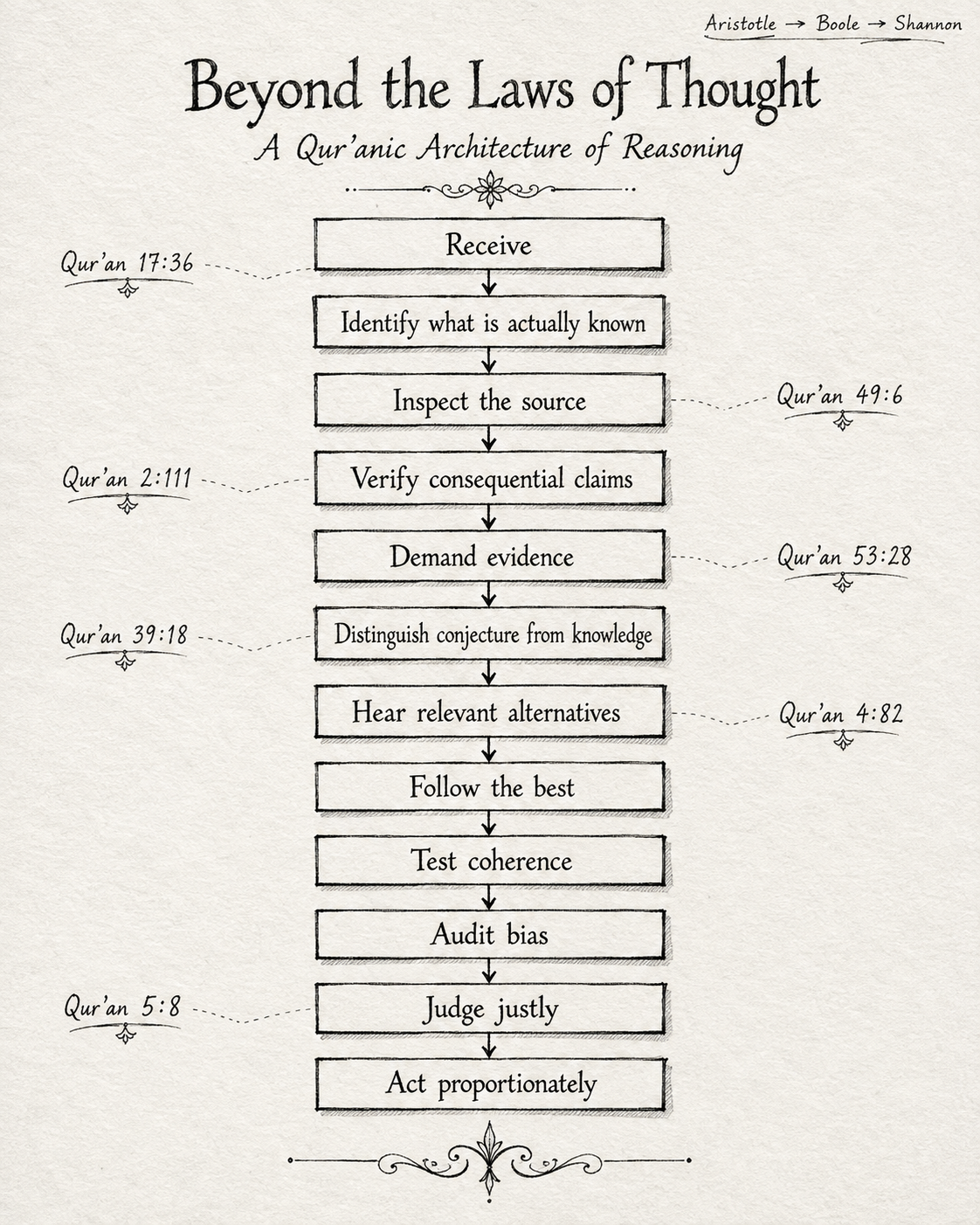
The methodology can now be stated simply:
Receive
→ identify what is actually known
→ inspect the source
→ verify consequential claims
→ demand evidence
→ distinguish conjecture from knowledge
→ hear relevant alternatives
→ follow the best
→ test coherence
→ audit bias
→ judge justly
→ act proportionately
This is not a claim that the Qur’an contains Boolean algebra or the modern scientific method. It is a reconstruction of recurring Qur’anic epistemic and moral disciplines, reinforced by tafsīr and by fiqh’s insistence that consequential claims require evidentiary procedure.
Why Democracy Needs It
Democracy depends upon citizens making consequential judgements from contested information.
Its greatest intellectual danger is not disagreement. It is corrupted reasoning: propaganda becoming fact, allegations becoming proof, tribal loyalty changing evidential standards, or citizens refusing even to hear what challenges them.
Applied to democratic life, Qur’an 39:18 offers a powerful ethic:
listen, discriminate, follow what is best.
Qur’an 49:6 adds verification. Qur’an 17:36 restrains unsupported certainty. Qur’an 5:8 prevents hostility from changing the standard of justice.
A democracy whose citizens lose those habits can retain elections while losing meaningful deliberation.
Why Artificial Intelligence Needs It
Artificial intelligence faces the same architecture in technical form.
A language model can generate a perfectly fluent sentence without possessing adequate warrant for it. What we call hallucination arises when plausible generation is presented as knowledge despite weak, absent or conflicting evidence.
A more trustworthy AI methodology would therefore resemble this Qur’anic discipline:
retrieve → source → verify → compare → calibrate confidence → test contradiction → answer
And when the evidence does not justify an answer:
“I do not know from the available evidence.”
That is not necessarily a failure of intelligence.
It may be evidence of epistemic discipline.
Boolean logic tells a machine what follows after its inputs have been accepted.
The Qur’an asks the prior question on which democracy, justice and trustworthy artificial intelligence ultimately depend:
Which inputs deserved to be believed?
Related Topics
Related Posts