

Founder of ALLMEP
Beyond the Plans: Our Map of Gaza Was Covered in Pink
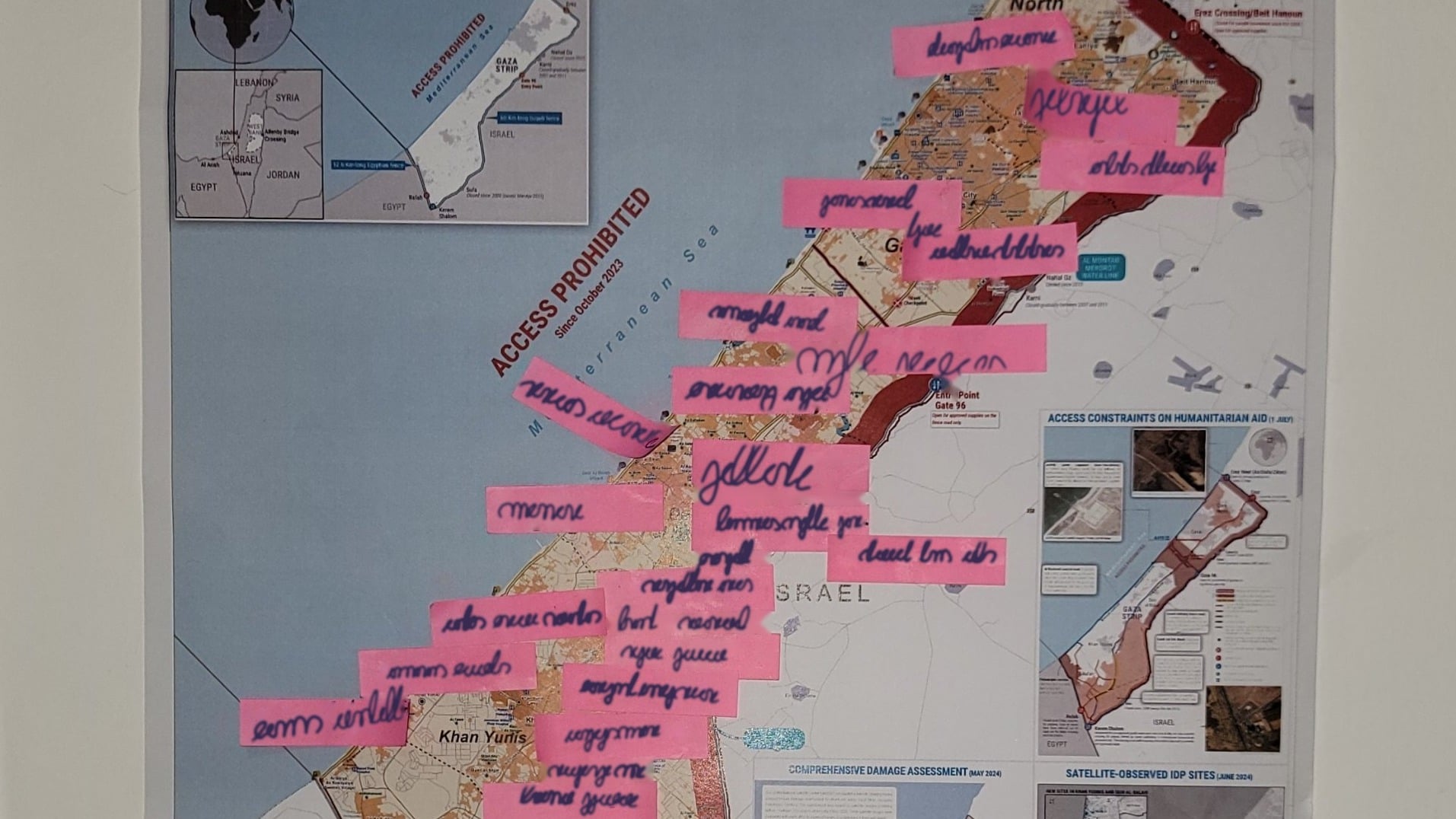
Illustration inspired by the wall map of joint projects in Gaza.
As floods sweep Gaza and politics shift in Israel and the US, an unseen network of Palestinians and Israelis is trying to address a harsh reality
This month, the rains came to Gaza. Floodwaters swept away tens of thousands of tents and killed at least five people. Last week, the Board of Peace declared “an immediate humanitarian emergency” and called on “the current Government of Israel” to let in shelter, drainage, and sanitation supplies at scale.
Across Gaza, aid groups are racing to distribute whatever tents, pumps, and blankets they have before the next storm. Some of these humanitarians are Palestinians and Israelis working in partnership. Almost no one knows it.
I sat with some of them last week outside Jerusalem. As I listened to the updates about their urgent winterization campaigns, I remembered a summer day a few months ago, when I watched those same partners map their work together.
Early that July morning, a half-dozen of us had piled into a black van. Among us: an Israeli doctor, a Palestinian civic leader, and a senior international official. Crossing a checkpoint, we wound through the narrow lanes of a West Bank town to a rare spot where Israelis and Palestinians can meet.
It was time to start.
What’s your name? Your organization? What do you do in Gaza? Please take a pink Post-it note and mark each of your projects on the wall map.
One by one, people rose and walked to the wall. The map of Gaza quickly filled with pink, revealing a picture largely missing from the public conversation. Almost no one knows about the local Palestinian and Israeli civil society organizations taking joint action on the ground.
A handful of notes marked Rozana clinics that have provided healthcare and medications to over 21,000 people in Gaza in 2026, led by Gazans and supported by Israeli partners. Elsewhere, off-grid “green shelters” run by Jumpstarting Hope, an Israeli-Palestinian partnership, have housed up to 12,000 people with solar power, clean water, and sewage treatment.
EcoPeace helped restore key water and sewage sources. Through the Gaza Support Network, people in Israel and around the world sponsor individual families; this month, its “Before the Rains” campaign is funding shelter, drainage, and blankets. Other projects provide schools and psychosocial support.
All of this happens in extraordinary conditions. More than a year into a declared ceasefire, Israeli air strikes continue, killing over 1,600 people, many of them civilians. Hamas has re-armed and consolidated power. Most Gazans are displaced, without basic water, electricity, and sanitation. Less than half of Gaza’s pre-war health facilities operate.
Our gathering brought together about a dozen organizations, reaching tens of thousands of people through joint Palestinian-Israeli projects.
That last part is critical, not only to Gaza’s recovery, but to whether it lasts. Are we just helping people survive until the next war, or will we make this war their last? Who will invest billions rebuilding homes, schools, and hospitals that will just be targets in the next round?
Recent elections may open a door inside Israel and bring positive pressure from the outside. In Israel, the far-right government lost its majority. Arab citizens turned out at a record 77 percent, empowered in large part by years of civil society work to educate on democracy, strengthen communities, increase equality, and turn out voters.
In the U.S., a new ALLMEP poll found that most midterm voters want the 20-Point Plan for Gaza to move forward. Seventy-eight percent want Washington to press Israel to allow aid and reconstruction, and 89 percent say pivoting to Israeli-Palestinian peace is important.
Whoever governs Israel next will inherit the same question: rebuild for a lasting peace, or “manage the conflict” until the next war?
Meaningful reconstruction requires conflict resolution, which has faced the same major obstacle for decades: the paralyzing conviction — deepened on both sides by this brutal war — that there is no partner on the other side.
International aid is indispensable. But locally-rooted joint efforts do more than meet immediate needs. They prove there are willing partners. They push back against dehumanization, mistrust, fear, and despair. It’s not talk; it’s action.
We cannot flatten or ignore the profound asymmetries of this conflict. Yet there will never be a just political future without people working across the divide to make it real. There are no zero-sum victories, only a choice between shared opportunity and endless bloodshed.
Which brings me back to one of those pink Post-it notes.
Vivian Silver, a renowned Israeli peacebuilder, spent decades living this message: No matter how maddening the situation, no matter how many setbacks, there is something each of us can do — and partners to do it with. She championed equal rights, self-determination, peace, and security for both peoples. On October 7th, she was killed in her home on Kibbutz Be’eri.
Months into the war, inside Gaza, Vivian’s name hung over a community kitchen feeding Palestinian families.
Imagine what that says to a Palestinian who finds food there for her family. Imagine what it says to Israelis — that Palestinians chose to honor Vivian’s memory through life-saving work in Gaza, refusing to let her murder extinguish what she stood for.
These acts are not an end point; they are an opening. They help answer the question paralyzing millions on both sides: Is there any partner to build a different future?
On that map, the answer was everywhere.