
Bridging faith. Defending truth. Confronting hate
Beyond the Red-Green Alliance: Empathy and Structural Asymmetry
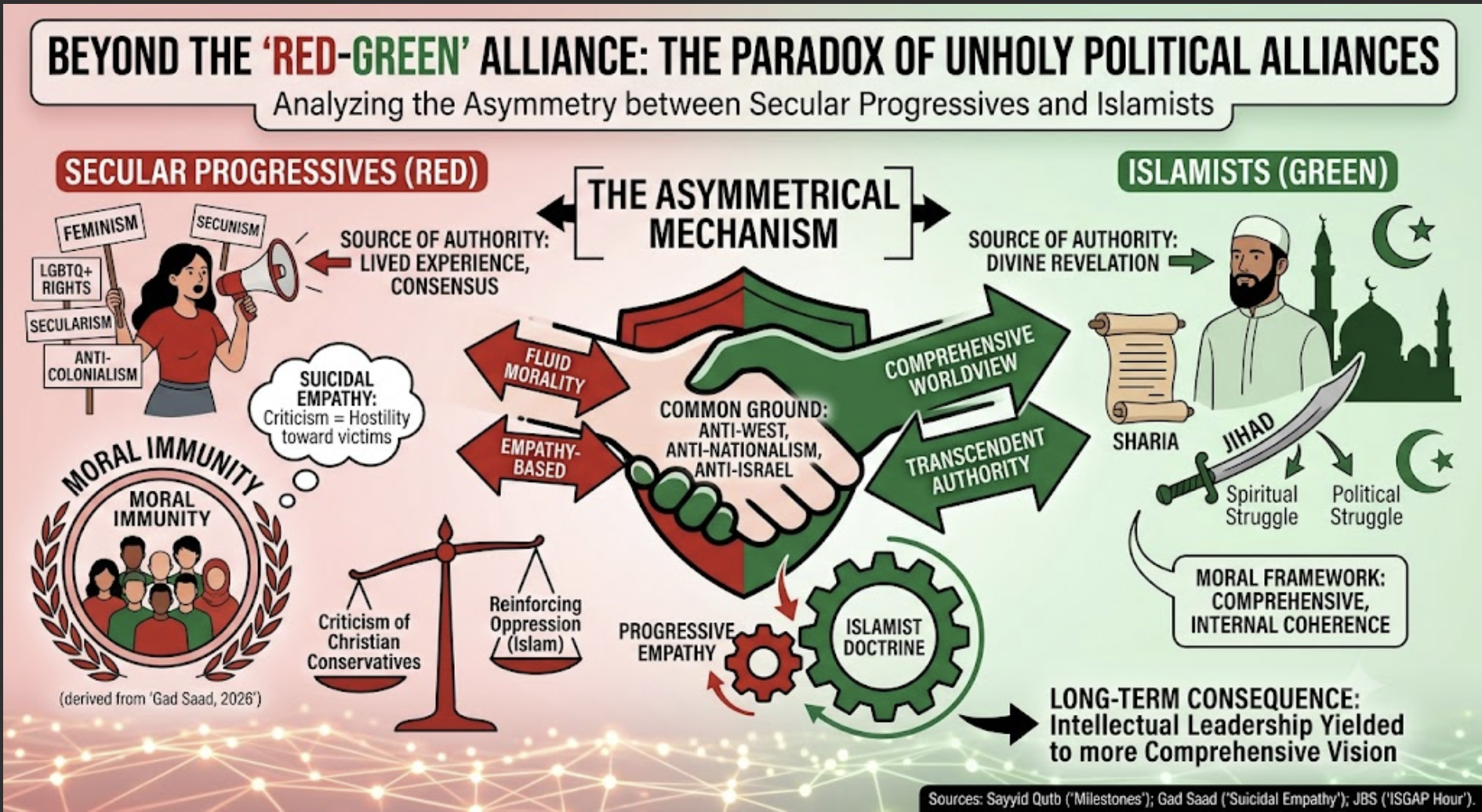
To most people’s surprise, some of the most influential political alliances are not formed between ideological allies, but between ideological opponents. One of the best examples of this is what scholars call the Red-Green Alliance, which is an alliance between secular progressives and Islamists. The progressive movement promotes secularism, feminism, LGBTQ rights, and individual autonomy, while Islamists want to order public life according to the Qur’an and the Sharia. Despite these profound ideological differences, the two find common ground in their hatred toward the West, nationalism, and of course, Israel.
There is an important thing that is often not asked. Given their ideological differences, it is eminent that one side will exercise greater influence over the coalition than the other. It’s true that political alliances begin with shared grievances, but over time the movement with the more comprehensive moral framework is more likely to shape the coalition’s direction.
I will begin by looking at the progressive side of the coalition by looking to Gad Saad who offers an important insight into one dimension of this phenomenon through his concept of “suicidal empathy.” His theory helps explain why some progressives are reluctant to subject what are labeled marginalized groups or ideologies to the same level of moral scrutiny that they apply to others. Groups viewed as historically marginalized therefore acquire a degree of moral immunity from criticism because disagreement itself is interpreted as hostility toward victims. According to this view, when an individual or a group is regarded as marginalized, they acquire a kind of moral immunity from criticism because disagreement is interpreted as hostility toward victims. In many Western institutions, identity and historical oppression go hand in hand.
These frameworks define the boundaries of working relationships, which helps to explain progressive activists excuse illiberal positions with Islamists, but are unwilling to do it with Christian conservatives. Within their moral framework, the decisive issue is not the content of a group’s beliefs, but where the group is located within structures of power and oppression. Islamicists are granted the baffling courtesy of being part of marginalized groups, despite the overwhelming evidence to the contrary. At the same time, conservative Christians are viewed as part of the privileged of society. As a result, any criticism of Islam is often treated as reinforcing oppression, whereas criticism of the latter is regarded as an act of justice. This results in an asymmetrical moral landscape in which two groups with comparable views on issues such as sexuality or gender are judged according to different standards because of the identities they represent rather than the ideas they advocate.
The asymmetry within the coalition reflects a deeper difference than political strategy. It arises from the moral architecture of the two movements themselves. To be sure, empathy is very important as a moral virtue, but it cannot serve as an organizing principle of civilization. Every society must answer questions that extend beyond compassion if it hopes to make consistent moral judgments. Among the questions every society must answer are these: What is a society’s source of authority? After all, every society needs a final standard that determines what is true, good, and morally binding. For many progressives, moral authority is frequently located in lived experience, identity, and an evolving moral consensus, whereas Islamicists locate ultimate authority in divine revelation as expressed through the Sharia. Every moral framework must also explain how competing values should be prioritized.
Every political movement tells a story about the source of human suffering. For the progressive left, oppression functions as the central explanatory framework. History is understood largely as a struggle between marginalized groups and systems of power based on race, gender, sexuality, colonialism, or economic inequality. In this narrative, injustice persists because dominant institutions perpetuate unequal power relationships. The moral task, therefore, is to dismantle oppressive structures, amplify marginalized voices, and create more equitable social arrangements.
The Green Alliance operates from a fundamentally different theodicy. Islamist movements generally locate the world’s disorder not primarily in social structures but in humanity’s rebellion against God’s revealed will. This is a fundamental difference that sometimes Westerners are not aware of. Over time, much progressive thought has shifted from grounding morality in universal reason to grounding it in lived experience, identity, and moral sentiment. Islamists reject both approaches. For them, divine revelation—not autonomous reason or subjective feeling—remains the ultimate source of authority. Islamists reject both. For them, revelation trumps both reason and feelings. From their perspective, the solution is not merely political reform but submission to God through the implementation of the Sharia and the restoration of a rightly ordered Islamic society. In this framework, justice is achieved when human life conforms to divine revelation rather than autonomous human judgment. This differs fundamentally from the progressive account of oppression, which seeks liberation through the transformation of social structures rather than submission to divine authority.
This is where Islamism has a more robust source of continued influence. It has a comprehensive understanding of authority, community, sacrifice, and moral obligation. It provides the moral framework capable of sustaining long-term political and social movements rather than a postmodern understanding that merely reacts to changing cultural conditions. It can form institutions that educate future generations and sustain long-term commitments because its members understand themselves as participating in something larger than the political moment. They are working on behalf of God, which supplies them with a divine purpose. By contrast, movements organized primarily around feelings and changing cultural priorities often revise their priorities as cultural circumstances evolve.
This explains why Islamists are good at influencing political organizations and universities. Their political vision is not limited to protest or social reform but is rooted in a comprehensive religious worldview that includes concepts such as jihad, understood by many Islamist thinkers as the obligation to struggle for the establishment and defense of God’s order in society. Whether pursued through political, social, or, in some cases, violent means, jihad functions as part of an integrated moral and theological framework rather than as a temporary political slogan.
By contrast, what Gad Saad describes as “suicidal empathy” encourages an unwillingness to critically evaluate the goals and assumptions of groups perceived as marginalized or historically oppressed. If criticism is treated as a form of victimization, progressive activists may become reluctant to examine ideological commitments—including Islamist conceptions of jihad—that conflict with their own stated commitments to liberal democracy, individual rights, or gender equality. In this sense, a coalition driven primarily by empathy may gradually yield intellectual leadership to a movement whose objectives are defined by a more comprehensive and internally coherent vision of political and religious life.
The contrast becomes even clearer when the two movements are viewed side by side. Progressive movements often derive their moral language from concepts such as equality, liberation, and historical redress. Islamist political movements derive their political vision from religious commitments that they understand to possess transcendent authority. These traditions should not be collapsed into simplistic categories, nor should all Muslim individuals or organizations be treated as sharing identical political goals. Nevertheless, where Islamist movements explicitly seek to organize political life according to religious principles, they operate from a framework that integrates theology, law, ethics, community, and political purpose into a unified vision. That comprehensive character gives such movements a different kind of organizational coherence than movements whose moral vocabulary is more fluid and responsive to changing cultural conditions.
The Red-Green Alliance therefore illustrates a broader principle about political coalitions that are at work. Alliances are not sustained merely by shared enemies but by the moral frameworks that animate them. Movements organized primarily around empathy often struggle to resist partners whose vision is as destructive as Islamism is. If my analysis is correct, the long-term question is not whether the alliance will survive but which moral framework will ultimately define it. The answer to that question should be obvious. Progressives that champion their cause for justice will have blood on their hands.
Bibliography
Qutb, Sayyid. Milestones. Revised edition. Translated by A. B. al-Mehri. Birmingham, UK: Maktabah Booksellers and Publishers, 2006.
Saad, Gad. Suicidal Empathy: Dying to Be Kind. New York: Broadside Books, 2026.
Small, Charles Asher, and David Harris, hosts. “Fighting Antisemitism: The ISGAP Hour – Asra Nomani.” Featuring Asra Nomani. JBS. YouTube video. July 23, 2025.
Related Topics
Related Posts