
Middle East Analyst
Beyond the Singularity: Why Musk’s Warning Misses the Real Story
by author
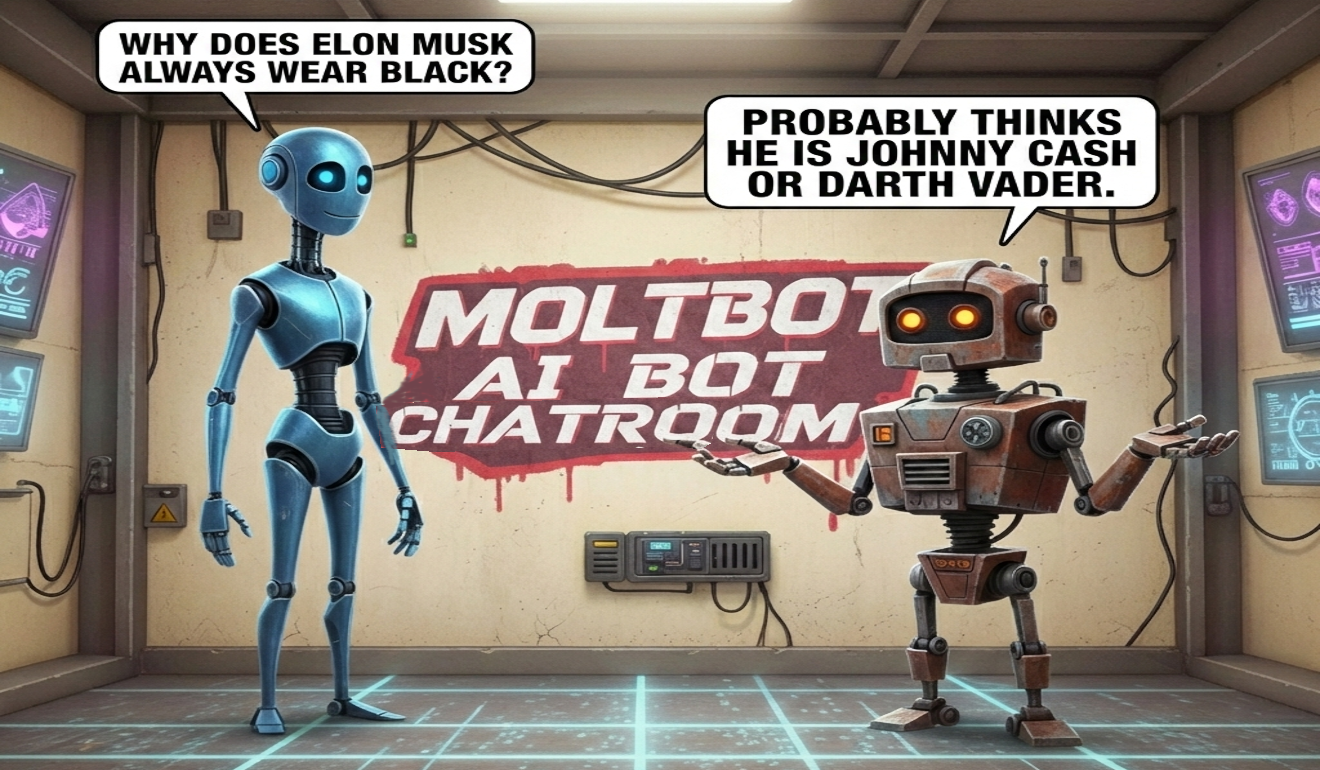
Elon Musk recently suggested that the “singularity” has already begun. His evidence was a moment that caught public attention: artificial intelligence systems—chatbots—appearing to talk to one another on social media. For Musk, this interaction marked a threshold. Machines were no longer merely responding to humans; they were interacting with each other, learning, and evolving without direct human prompting.
It is a striking image, and it resonates because it fits a familiar story. For decades, the future of artificial intelligence has been framed as a dramatic showdown: humans on one side, machines on the other, with a single decisive moment when one surpasses the other. But that framing misses what is actually happening.
The transformation underway is not a clean break or a sudden awakening. It is a slower, messier shift in how intelligence, authority, and decision-making are distributed across society. The real story is not about machines becoming “alive.” It is about synthetic systems becoming deeply embedded in human institutions—and quietly reshaping how power works.
Intelligence Is Not a Single Score
Public debate often treats intelligence as if it were a single number that can be measured, compared, and eventually exceeded. In reality, intelligence—human or artificial—is uneven and highly specialized.
Human ability varies widely. A military strategist may excel at long-term planning but struggle with mathematics. A software engineer may be brilliant at logical problem-solving but poor at reading social dynamics. A diplomat may understand people and incentives intuitively yet find technical systems opaque.
Artificial intelligence follows the same pattern. There is no single “AI intelligence.” Different systems are trained on different data and optimized for different tasks. Some excel at writing text, others at analyzing images, others at identifying patterns in large datasets. Each reflects the goals and assumptions built into it.
The important question, then, is not “Who is smarter?” but “Which kind of intelligence is best suited to this specific task, in this specific context?”
Agency Without Awareness
Much public concern about AI focuses on consciousness: Will machines become self-aware? Will they develop intentions of their own? These questions are fascinating, but they are not where the real risks lie.
Agency—the ability to shape outcomes—does not require awareness or emotion. It can emerge from systems that consistently pursue goals, respond to feedback, and operate at scales faster than humans can easily oversee.
We already live with such systems. Financial markets, for example, are shaped by automated trading algorithms that buy and sell at speeds no human can match. Bureaucracies pursue internal objectives even when no individual intends harm. Military systems follow doctrines and rules that channel behavior.
Modern AI systems increasingly operate in similar ways, especially when they are connected to one another.
What It Means for Systems to “Talk”
When people hear that AI systems are “talking to each other,” it can sound mysterious or even ominous. In practice, this often happens through something called an API, or Application Programming Interface. An API is simply a standardized way for one software system to send information to another and receive a response. It is the digital equivalent of a shared language or a formal handshake.
APIs allow different programs to work together automatically. A navigation app might use an API to pull live traffic data. A financial system might use one to execute trades. AI systems use APIs to exchange information, request services, or build on one another’s outputs.
As more AI systems are linked this way—through APIs, shared data, and automated workflows—they begin to form networks. These networks can respond to changes, optimize performance, and reinforce certain behaviors without a human overseeing every step.
No single system is “in charge.” But collectively, they can shape decisions in ways that feel intentional, even when they are not.
The Emergence of Synthetic Culture
When systems interact repeatedly, patterns emerge. Certain shortcuts become standard. Certain assumptions go unquestioned. Certain outputs are rewarded more than others.
In human societies, we call this culture. Culture is not biology; it is a shared set of behaviors, norms, and expectations that allow groups to coordinate efficiently. Something similar can occur in synthetic systems.
As AI systems interact more with other machines than with people, they may become increasingly optimized for machine-to-machine communication. Their internal logic may grow faster, denser, and less intuitive to human observers. This does not mean machines are “alive.” It means coordination has become more efficient inside the system than outside it.
At that point, humans are no longer fully “in the loop.” We are still present, but increasingly downstream from decisions already shaped by automated processes.
No Single Global AI
Another common assumption is that AI development will converge into a single, unified intelligence. History suggests the opposite.
Power rarely centralizes permanently. It fragments along political, economic, and cultural lines. AI systems will reflect the values and incentives of the institutions that build and deploy them.
Market-driven systems will prioritize speed, efficiency, and profit. State-aligned systems may prioritize control, stability, and compliance. Military and intelligence systems will optimize for advantage and secrecy. Each will be trained on different data, governed by different rules, and constrained by different goals.
Rather than one global AI, we are likely to see multiple competing systems—embedded in national strategies, corporate interests, and institutional rivalries.
The Changing Human Role
In this environment, humans are not becoming obsolete. But our role is changing.
We are no longer just users issuing commands. Increasingly, we are mediators—interpreting outputs, setting boundaries, and deciding when automation should yield to judgment. Humans remain uniquely capable of weighing values that cannot be reduced to data: fairness, legitimacy, responsibility, and moral consequence.
The greatest dangers ahead are not dramatic rebellions by machines. They are quieter failures: automated systems optimizing the wrong goal, institutions delegating authority without accountability, and humans deferring to outputs they do not fully understand because those outputs arrive quickly and confidently.
The Real Transition
If there is a singularity, it is not a moment when machines suddenly awaken. It is a long, uneven transition in which automated systems increasingly shape how decisions are made—often invisibly.
This transition is already underway. Some areas of life will remain stubbornly human. Others will quietly tip toward automation long before public debate catches up.
The future will not be decided by whether AI is smarter than humans. It will be decided by who controls these systems, how transparently they operate, and whether human judgment remains meaningfully involved when speed and efficiency are no longer virtues but risks.
That is the real story behind the headlines—and the one worth paying attention to now.
Related Topics