
Bir Tawil: A Conditional Pathway to Palestinian Sovereignty
In global diplomacy, repetition masquerading as principle produces failure. For eight decades, the international system has recycled the same territorial formulas in the Levant, despite their consistent inability to deliver either peace or sovereignty. During my work with African Union mechanisms addressing border anomalies and post-colonial sovereignty disputes, I encountered a geographic and legal anomaly whose relevance to the Israeli–Palestinian conflict has been systematically ignored: Bir Tawil.
Bir Tawil is not presented here as a shortcut, a provocation, or a unilateral land grab. It is presented as a conditional diplomatic space—one whose activation depends on consent, negotiation, and structured safeguards. Under the right conditions, it offers Palestinians something the current paradigm has not: the option of immediate, uncontested sovereignty rather than indefinite conflict over disputed land.
Bir Tawil’s Status: A Negative-Claim Zone
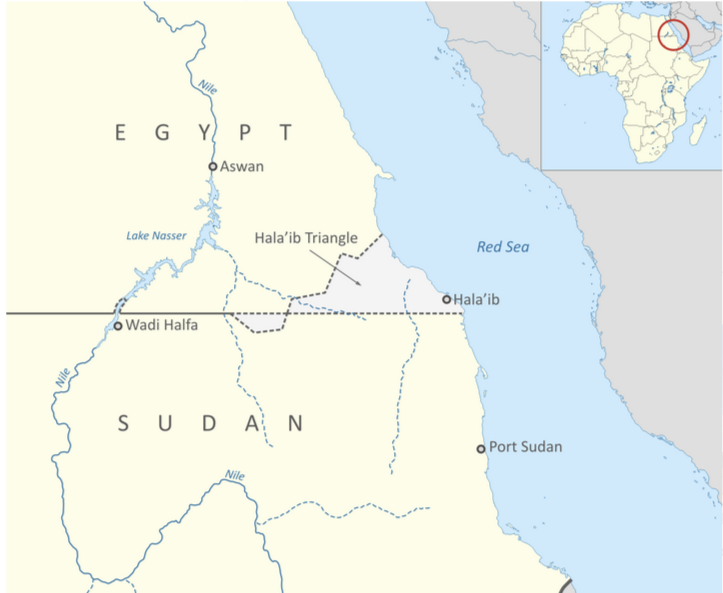
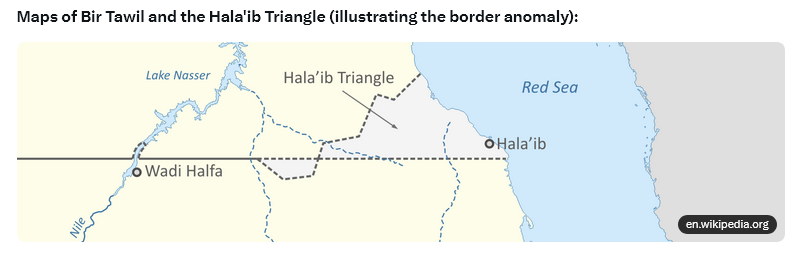
Bir Tawil is a 2,060-square-kilometer area between Egypt and Sudan that meets a rare functional test:
- No active sovereign administration
- No permanent resident citizenry
- No competing third-party claim
This condition results from mutually exclusive Egyptian and Sudanese interpretations of British colonial boundary arrangements from 1899 and 1902. Egypt adheres to the 1899 line, which places the Hala’ib Triangle under Egyptian sovereignty and Bir Tawil outside it. Sudan adheres to the 1902 administrative line, which reverses that outcome. Because each state prioritizes its claim to Hala’ib, neither asserts sovereignty over Bir Tawil. The territory remains legally dormant—not ownerless in theory, but unclaimed in practice due to negative claims.
This proposal does not rely on outdated terra nullius doctrine. It relies on a documented absence of asserted sovereignty, pending bilateral resolution.
Preconditions for Any Activation
No responsible proposal proceeds without explicit prerequisites. Bir Tawil cannot and will not be activated absent:
- Formal bilateral consent from Egypt and Sudan, potentially linked to final normalization of their border dispute
- Transit, access, and security agreements, including Egyptian corridor arrangements to external trade routes
- Multilateral oversight, involving the Arab League, African Union, and principal donor states
Egypt holds effective veto power. This is not a defect. It makes Egypt the keystone stakeholder. Participation offers Cairo tangible incentives: southern Sinai stabilization, transit revenue, enhanced regional leverage, and structured Gulf investment. This framework assumes negotiated consent, not unilateral assertion.
Phased Development, Not Slogans
Bir Tawil is inhospitable terrain. Any serious plan must acknowledge this.
Development would proceed in tested phases:
* Phase I: Water and energy sovereignty through desalination and solar generation
* Phase II: Secured logistics and transit via treaty-based corridors
* Phase III: Incremental urban and agricultural expansion contingent on performance metrics
The estimated cost to rebuild Gaza—approximately $80 billion—provides a benchmark. Even a portion redirected toward Phase I would establish viability without clearing rubble, unexploded ordnance, or contested jurisdictions. This is not utopianism; it is sequencing.
Security as a Design Constraint
Security objections are legitimate and must be addressed structurally, not rhetorically. Any Bir Tawil framework would require:
* A demilitarized founding charter
* External border monitoring modeled on the Sinai Multinational Force and Observers
* Prohibition on foreign militias, bases, or proxy forces
* Retained rights of defensive action by neighboring states in the event of material breach
This is a controlled sovereignty model. It is designed to prevent the emergence of another failed or weaponized entity.
Voluntary Participation, Defined Procedurally
Participation by Palestinians would be strictly voluntary, defined by procedure rather than sentiment:
* Individual opt-in
* Compensation and relocation assistance
* Guaranteed citizenship upon arrival
* Preservation of existing civil claims unless explicitly waived
This mirrors post-1945 resettlement frameworks used for Soviet Jewry, Vietnamese refugees, and Balkan post-conflict populations. No expulsion. No forfeiture. No coercion.
Reframing the Legal Environment
The persistent labeling of Judea and Samaria as “occupied” reflects enforcement disparity more than doctrinal clarity. Egypt’s administration of the Hala’ib Triangle—despite Sudanese claims—is treated internationally as a border dispute, not a belligerent occupation. The West Bank presents comparable ambiguity: Jordan’s 1950 annexation lacked broad recognition, and its 1988 renunciation left no clear reversionary sovereign.
Establishing a Palestinian sovereign entity in Bir Tawil, with consent, would shift the framework from occupation rhetoric to conventional state-to-state relations. Final-status issues would return to negotiation, as intended under Resolution 242 and the Oslo Accords, without the asymmetric legal pressure that currently distorts diplomacy and perpetuates conflict.
This comparison concerns enforcement reality, not doctrinal purity.
Institutional Incentives and a Strategic Exit
UNRWA operates under a mandate that presumes the permanence of refugee status. This reflects institutional logic, not malice: budgets and authority track the continuation of the problem they administer. Bir Tawil offers an exit ramp—if Palestinian institutions and donors choose it—from perpetual refugee management to sovereign state-building. Aid would become capital. Administration would become governance.
Palestinian Agency: A Defined Choice
This proposal is neither imposed nor assumed. It is an open offer for formal Palestinian consideration.
Palestinian leadership is presented with a clear choice:
* Continue the current strategy: territorial irredentism, armed struggle, international lawfare, indefinite refugee status, and recurring war in disputed land
* Or pursue uncontested sovereignty: a defined territory, exclusive jurisdiction, citizenship, and the obligations and benefits of statehood
Acceptance or rejection rests solely with them. Acceptance affirms a commitment to statehood. Rejection constitutes an affirmative choice to continue the existing framework. Either outcome clarifies intent. Neither permits ambiguity.
Conclusion: From Repetition to Decision
The Israeli–Palestinian conflict has not endured for lack of rhetoric, resolutions, or mediation. It has endured because the same territorial assumptions are treated as immutable despite repeated failure. Bir Tawil is not a ready-made solution. It is a structured alternative, contingent on consent, security, and choice.
It respects Egyptian sovereignty, acknowledges regional risk, and places agency where it belongs. Whether it advances depends not on sentiment, but on whether stakeholders are prepared to choose construction over repetition when repetition has demonstrably failed.