

Learn. Grow. Self-Actualize.
Birdhouses and Blowtorches: What’s Your Mission?
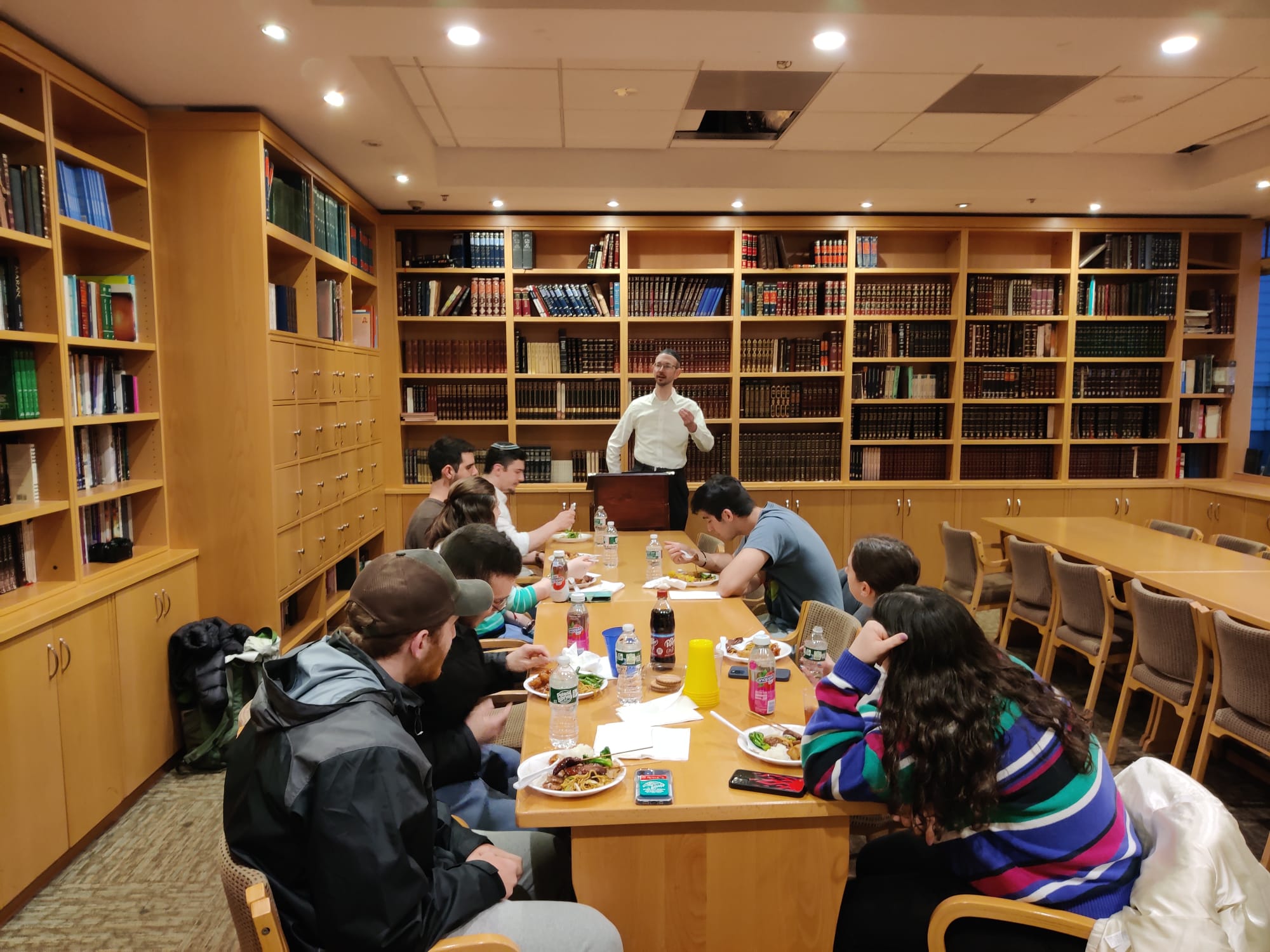
Rabbi Bob Barocas speaks to college students about finding their unique mission in life.
How do you know if you are living the life you were meant to live?
It is one of the most haunting questions a person can ask. Not whether you are successful. Not whether you are admired. Not even whether you are happy. But whether you are fulfilling the purpose for which you were placed in this world.
Many people drift. They accumulate degrees, titles, salaries, achievements. They compare themselves to others. They chase prestige. They imitate. They adjust to pressure. And somewhere in the background, a quiet voice wonders: “Is this really what I am supposed to be doing?”
The Gemara makes a startling statement. In Chagigah (5b), it says that Hashem “cries” over a person who is learning Torah when he should be working — and working when he should be learning Torah.
On the surface, this appears to be about the balance between Torah study and earning a living. However, our Sages understand it more broadly. The Almighty “cries” when a person lives an inauthentic life — when he or she pursues the wrong “tachlut,” the wrong purpose.
Not wrong morally. Wrong existentially.
We once had prophets to guide us. In Temple times, there was the Urim V’Tumim, a Divine mechanism that helped clarify the Divine Will. Today, there is no prophetic hotline to discovering our unique mission and purpose in God’s world. In our days, what can we do to identify it?
The Shoemaker Who Almost was
There is a well-known story about Rabbi Naftali Tzvi Yehuda Berlin, known as the Netziv, one of the great Torah leaders of the 19th century and head of the famed Volozhin yeshiva.
As a child, he was not a prodigy. One night, he overheard his parents discussing his academic struggles. The conclusion they reached was practical and reasonable: he would be apprenticed as a shoemaker.
The young boy burst into tears. He told his parents that he did not want to be a shoemaker and asked them to give him a chance.
His parents relented. He applied himself. The rest is Jewish history.
Imagine, though, if they had not given him that chance. Imagine the scene in shamayim (Heaven) after 120 years if he had been a shoemaker. He probably would have presented a pair of beautifully crafted shoes. And God would have said: “…but where are the students? Where are the books? Where is the Torah that only you could have taught?”
Of course, the story cuts both ways: If someone is meant to be a shoemaker — if that is truly his unique calling — and instead spends his life trying to become something else, the Almighty might very well ask that fellow: “Where are your shoes?”
The issue is not prestige. It is alignment.
The tragedy is not smallness. It is misdirection.
Birdhouses and Blowtorches
Imagine your job is to build birdhouses. You are exceptional with wood. You understand grain, structure, design. You are patient, precise, and skilled.
One day, you see your friend welding with a blowtorch. Sparks fly. Metal bends. It looks dramatic and powerful. You think: “I want that!”
So you take the blowtorch and apply it to your birdhouse.
You burn it to a crisp.
The problem was not the blowtorch. The problem was envy.
When we deeply understand our own strengths, jealousy fades. Not because others lack greatness, but because their tools are not ours. And ours are not theirs.
Every human being is given a unique bundle of strengths and talents. Not random. Not accidental. Divinely packaged.
The work of a lifetime is discovering what is already there (see also “The Power of Me” where I elaborate on this more).
The Venn Diagram of Your Life
Back to our question: In our days, what can we do to identify our unique mission?
A powerful framework for answering the question was given to us in the 11th-century work Chovot Ha’Levavot (Duties of the Heart), particularly in Sha’ar HaBitachon. It can be visualized as a Venn diagram of three overlapping circles:
-
Your strengths and talents
-
Your passions
-
What the world needs
Your unique mission lies at the intersection of all three.
1 – Strengths: What You are Naturally Good at
We live in a culture that trains us to identify weaknesses. Resumes and report cards can even reduce a person to deficiencies.
However, strengths are different. Strengths are not what you grind your way toward. They are what come naturally — even if they require refinement.
Communication. Emotional intelligence. Creativity. Athleticism. Analytical thinking. Ambition. Patience. Musicality. Integrity. Tenacity.
Your strengths may not be glamorous. They may not even be monetizable. Yet, they are stable and remain with you throughout life — even as circumstances change.
Identifying strengths requires quiet. It requires asking trusted friends. It requires reflection. In a world of noise — notifications, headlines, expectations — that quiet is increasingly rare.
Without making time to silently reflect, though, we can easy drift far away from who we are meant to be.
2 – Passions: What Fires You Up?
A passion is often something you would do even without external pressure. It is what produces “flow,” that state described by psychologist Mihaly Csikszentmihalyi in which time disappears and you are fully immersed.
The things you love doing, the causes you champion, and what makes you excited to wake up in the morning all fall under the banner of what you are passionate about. When you feel like that raging Lag B’Omer bonfire I wrote about before, then you know that you have tapped into part of what makes you passionate.
Importantly, you can be good at something and hate it. You can be passionate about something and lack talent. The intersection requires both alignment and joy.
Although your job can be your passion, it does not have to be. The modern assumption that identity equals profession is spiritually limiting at best and a big blockage to meeting your mission at worst.
3 – What the World Needs
This third circle grounds the first two.
The needs of the world exist on multiple levels. Sometimes they are global: peace, justice, and compassion. Sometimes they are local: a struggling colleague, a lonely neighbor, or a community lacking leadership.
We are not placed randomly in time. We all are alive right now, in this generation, in each of our particular countries and communities, for a reason. Put differently, the needs of your era shape your mission.
This does not mean everyone must “save the world.” It means each of us fills a gap.
One person may bring positivity through music. Another may bring clarity through scholarship. Another may bring stability through business leadership. Another may bring warmth to a single family.
Two Lives, Two Missions
Consider two very different examples.
Yaakov Shwekey is known for his music. However, his impact goes way beyond entertainment. His musical genius and talent, when combined with his deep passion for uplifting people, align perfectly in providing positivity and hope — exactly what our world needs in times of anxiety and fragmentation.
Then there was Rabbi Chaim Kanievsky, zt”l one of the towering Torah giants of our generation. His strength was an extraordinary mind and discipline for Torah study, his passion was immersion in learning, and the world needed (and still needs) a spiritual anchor, a figure of clarity and continuity. His life reflected that alignment and so much more.
Two different paths. Two different missions. Both authentic.
The question is not: Can you become them? The question is: Who are you?
After 120 Years
When we pass on, all of us will be taken to task for what we did or did not do with the talents and abilities God gave us.
We will not be asked: Were you famous? Did your TOI blog post go viral?
We probably will not even be asked: Were you flawless? (None of us are.)
However, I bet we will be asked: Were you YOU? Did you build the birdhouses you were meant to build? Or did you spend your life chasing blowtorches?
The work is not easy. It requires humility and courage. It may require pivoting. It may require resisting social pressure. It may require saying “no” to something impressive in order to say “yes” to something authentic.
The alternative, though, is quieter and far more tragic: reaching the end of life unsure whether you ever aligned with your purpose.
Every person is given a unique constellation of strengths. Every person feels the spark of certain passions. Every generation presents its own needs.
Where those three meet — that is your mission.
And the world is waiting for it.