News Analyst
Black American and African delegations unite in Israel
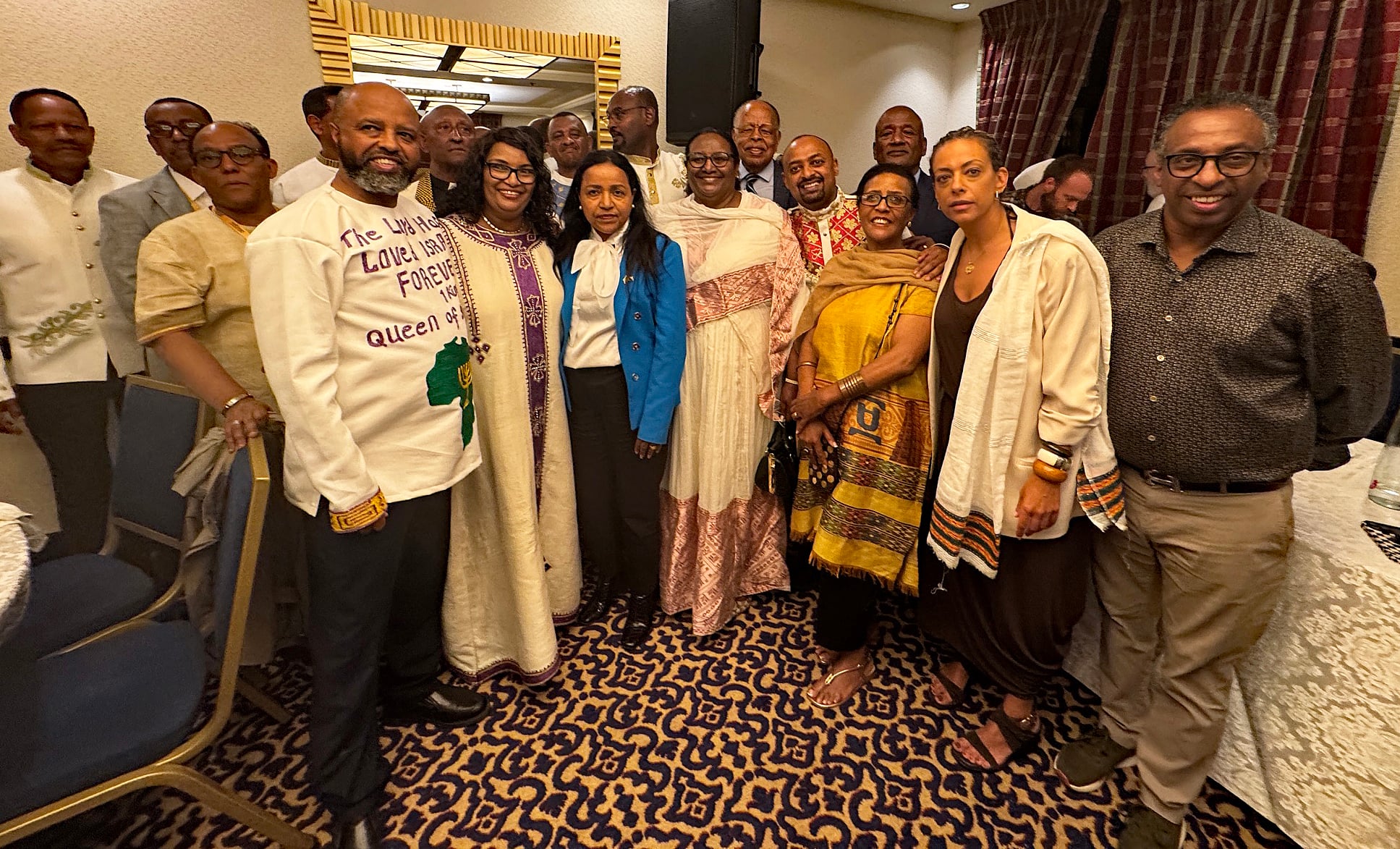
Members of the Ethiopian Jewish community in Israel stand together with African Christians from Ethiopia. At the beginning of the Sigd Festival in Jerusalem. King David Hotel. Photo by Carrie Hart.
This week, a delegation of 500 African Americans from 34 U.S. states toured Israel, as part of a Holy Land pilgrimage, titled, “Unfinished Business.” At several events, 75 African leaders from 10 countries, joined the delegation.
The leaders of this visit spoke about wanting to fulfill Reverend Dr. Martin Luther King Jr.’s vision, planned in 1967, to bring 5,000 Black American Christians to the Holy Land. That trip was, reportedly, postponed until 1968, because of the Six Day War in Israel in 1967. Then, Dr. King was assassinated on April 4, 1968.
During this current week, with many of the events hosted by the Israeli Foreign Ministry, tour companies brought the various American and African delegations to several special holy sites. They also had a press conference; a gathering marking the Ethiopian Sigd festival, where African Christian leaders from Ethiopia met with Israeli Jewish Ethiopian leaders in Jerusalem; and, a gala evening that included a keynote address by Israel’s Director General of the Ministry of Foreign Affairs, Eden Bar Tal.
Bar Tal stated: “Thank you for standing with Israel at all times. Your presence here sends a powerful message to the world. Israel has many important friends, worldwide. Your friendship, solidarity and moral leadership is deeply appreciated by every Israeli. Everyone. You are the lone voice of your communities, carrying a profound social, moral and spiritual responsibility.”
During this week’s press conference, American Pastor Dumisani Washington, who heads up the Black Christian Leadership Council on Israel Relations, spoke about bringing a delegation of 5,000 African American leaders to Israel in 2027, marking the 60th anniversary since Dr. King’s vision.
“We felt it burning in our hearts. We see the rise of antisemitism in our nation, on the left and right side of the aisle – it doesn’t make any difference. It’s multigenerational. It’s multi-ethnic. It’s coming from everywhere.”
Dr. Michael Anthony Stevens Sr. co-chairs the Council with Pastor Washington. Dr. Stevens stated that it was a joy and an honor to be in the Holy Land. “I feel like we’re home. This is my 30th trip to Israel in the last 20 years.”
He went further in claiming that Israel has a right to its sovereignty as a nation, as well as a right to defend its borders like any other country in the world. “Antisemitism is at an all-time high. You know the numbers. You know the statistics. The reality is, if anybody should stand with Israel and our Jewish brothers and sisters, it ought to be African Americans. It ought to be Africans.”
While these groups are visiting Israel and meeting together, there is also a delegation of American Jewish community leaders coming alongside them, to witness this week’s milestones in pro-Israel relationships.
Dr. Stevens spoke of support for Israel swelling among African American leaders in the U.S. “We believe that there is a mountain of support rising from the Black Church. This Council has seen more success, probably in the last 12 months, than we have seen collectively in 20 years.”
The Council is reaching out to what they estimate to be about 25,000 Black churches in the United States. Dr. Stevens clarified what this new beginning is all about: “Most of them, not all of them, love the Bible; they love the Lord; and, they love their Jewish friends… and that is the foundation of why we are here. We stand with the State of Israel and our Jewish friends.”
At the beginning of the Ethiopian Sigd Festival this week, African Christian leaders from Ethiopia arrived in Israel to reconcile with Israeli Ethiopian Jewish leaders. The African pastors offered an apology to the Jewish Ethiopians who had immigrated to Israel in years past. The pastors spoke of how they had overlooked their Jewish brethren when they were suffering persecution in Ethiopia. In addition to the apology, the African Christian leaders thanked the Israeli Jewish community for their invaluable contributions to Ethiopia, and presented a gift to Israeli scholar, researcher, and Ethiopian spiritual leader, Qes Mulualem Temeyet.
One of the African Christian pastors, Dr. Abera Habte, shared from his heart at the gathering, quoting from Genesis 12:3: “We come to bless you, and in turn, we are blessed; to express our gratitude for the contribution your forefathers made, during their time in Ethiopia. And, to offer an apology, as a religious leader, for any injustice or wrongs committed, knowingly or unknowingly. We are here, so that God’s blessing may rest upon our country… What we do today, I believe, is going to change the history of the Ethiopian Jews and the whole of Africa.”
A major aspect of this visit to Israel of Black Christians from America has been the history and legacy of Dr. Martin Luther King, Jr. This writer had the opportunity to talk to Benjamin Chavis, Jr. on the sidelines of the Sigd Festival event. At 78 years old, one of the many responsibilities that Chavis has is that he is the current chairman of the Black Jewish Action Alliance.
During the interview, Chavis also recalled his past experiences in the American civil rights movement. He spoke about the NAACP (National Association for the Advancement of Colored People. According to Chavis, “In 1909 there was a lot of racial discrimination against Jews and against Blacks in America. That is why the NAACP was founded, to stand up against antisemitism; to stand up against racism.”
Chavis joined the NAACP when he was 12 years old. Then, in 1967, he became the youth coordinator for Dr. King. He was the youngest person on Dr. King’s staff. Then, from 1993-1994, Chavis was CEO of the NAACP.
“I witnessed the planning to bring 5,000 Black clergy to Israel in 1967,” Chavis explained, and expressed his shock at the assassination of Dr. King. “It was devastating, a tremendous loss. But, those of us who worked with Dr. King said we were going to keep the civil rights movement alive. We were not going to allow an assassin’s bullet to kill the movement.”
During the 1960’s, Dr. King and Rabbi Abraham Joshua Heschel formed an historic interfaith friendship and alliance. They shared a commitment to social justice based on biblical values.
Chavis recalls that time in history when King was murdered. “Not only did it cripple the Southern Christian Leadership Conference Organization, but it crippled, also, the relationship between Blacks and Jews. In order for the relationship to work, you needed both leaders. Rabbi Heschel and Dr. King were like brothers. After Dr. King was killed it was hard to find other Black leaders that would stand up and speak out to defend Israel. But, now we have thousands of Black leaders defending Israel. That is why we are here. That is why I am here.”
Chavis shared that one of the issues that gives rise to antisemitism and gives rise to racism is ignorance. “So, we have to overcome ignorance. It takes time to overcome ignorance. We have to continue. This pilgrimage is not just a one-time event… We’re coming back, and by God’s grace I will be here.” Chavis added that there is also the need to overcome racism, which does not happen overnight. Furthermore, it is necessary to exemplify the benefits of Blacks and Jews working together in America, in Israel, and in the world, according to Chavis.
Part of the delegation that came on this pilgrimage to Israel involved American rabbis. One of them, Rabbi Ya’aqov (James) Walker, is an African American. He chairs the Charlotte Black Jewish alliance in North Carolina. He is an Ambassador of Peace at the Institute for Black Solidarity with Israel, which is one of the founding organizations in the Black Christian Leadership Council on Israel Relations.
Remembering Dr. King’s close association with Heschel and other rabbis, Rabbi Walker suggested why their inclusion today is important in this journey of Africans from America and other nations. “The Council leadership of this burgeoning movement wanted to follow the successful historical pattern. They have been intentional about having Christian and Jewish leaders standing shoulder to shoulder throughout each effort that they undertake, just as Dr. King did, in the fight against racism and antisemitism. A critical part of this is understanding that there are over one million Israeli Jews whose ancestors lived on the African continent. Involving Jewish communities of African descent has been a missing part of past efforts that makes this current movement well-suited to explore the nuances of all cultures involved.”
As Africans, Black Americans, rabbis, and leaders in both the Diaspora and Israeli communities have come together this week, there has been support in this process of developing unity among the brethren, resulting in renewed hope for the future.
Pastor Habte, who will be remembered for his apology in Jerusalem to the Israeli Ethiopian Jews, has also made it a point to seek restoration with others throughout Africa, traveling with Jewish colleagues and speaking, prophetically, of a new dawn for Africa. He declares in his journeys: “A new dawn has come. This new dawn is part of Israel. We know that when we stand with Israel, Africa will change. That’s forever!
Related Topics