


Blaring Your Own Horn – A Tale of Two Cities
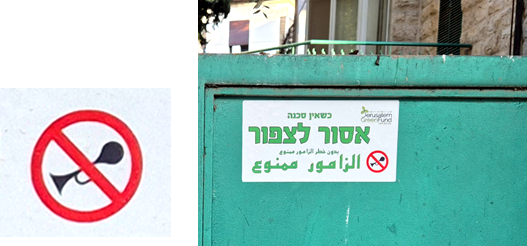
At 11 PM, Palmach Street is deserted. A car drives up to an intersection, slows to make the sharp right onto Tchernichovsky. Another car drives up behind. Unhappy with the pace of the first driver’s turn, he leans on his horn, loud and long.
At 11 PM on an empty street. Really?
***
Having grown up in New York, I am no stranger to car horns. But nothing like what goes on here.
For one thing, Israeli car horns, like Israeli speech, are pitched higher than their American equivalents. Honking here jars more.
A car with a lamed on top—Lomed, a student driver—has stopped to let a little old lady with a cane cross the street where there is no crosswalk. The car behind honks angrily. The honking driver does not actually want the student to run over the little old lady. He just wants everyone to share his frustration.

Jerusalem traffic is awful. Incessant construction of buildings and digging of light-rail tracks makes it ever worse. Impediments abound: a garbage truck that stops every half-block, a driver trying to back into a space—very slowly. It is enough to make you want to honk in frustration. Which half the street does. Hey, buddy, what’s the holdup there?
Most honking is for run-of-the-mill encouragement. A car has pulled over and is blocking a bus from making a turn. The traffic light has started to turn green, and the car in front takes more than a nanosecond to lurch forward.
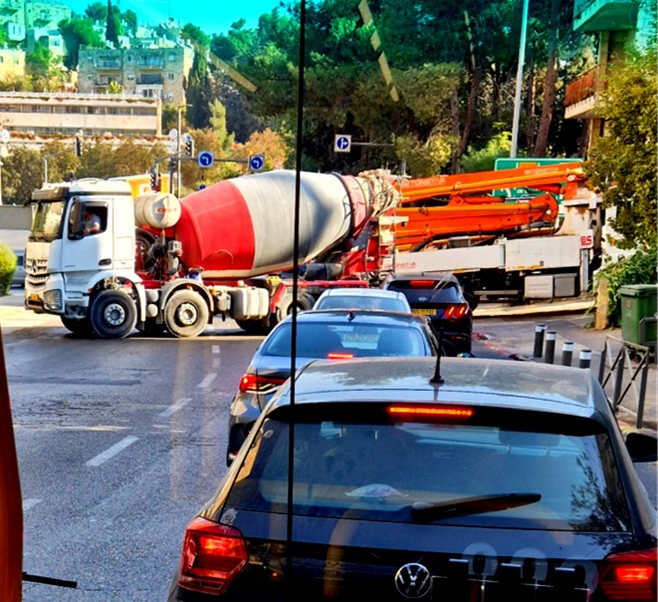
The height of absurdity is when the blockage is visible to all. A cement mixer is blocking the whole road. Everybody can see why no one is going anywhere. There is nothing to do but wait. And honk like mad.
Eventually the blockage dissolves and cars proceed, though not because of the honking.
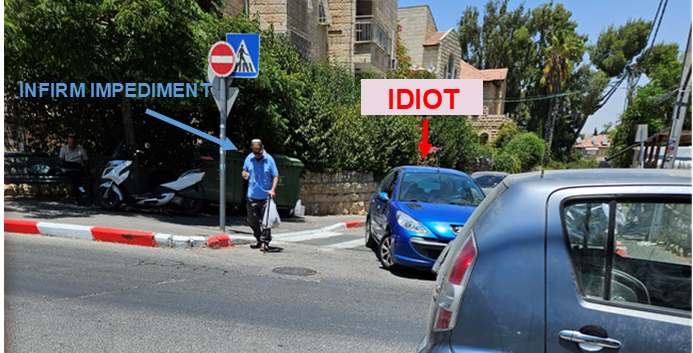
Parade example: Right across from where we live, an old man limps on his cane to cross to small side street. When he is halfway there, a car drives right up to him, stares him the face, and honks, over and over.
The man turns to the driver and spreads his arms in supplication. What do you want? This isn’t Lourdes, where the ill fling away their canes and waltz down the steps.
The man resumes his painful way to the opposite sidewalk.
Well, what can you do? Israelis are impatient, aren’t they? Israelis can be blunt, in-your-face, can’t they? Nothing to be done. It’s just how they are, right?
Maybe. Or maybe they might be influenced. By an offer they can’t refuse.
Which takes us to Italy.
***
Not long ago we were in Naples. (Italy, not Florida.)
Naples is a gritty town, with a reputation for violent crime and Mafia involvement (three competing branches) in civic affairs. Its buildings and monuments look tired and neglected, festooned with graffiti nobody bothers to remove.
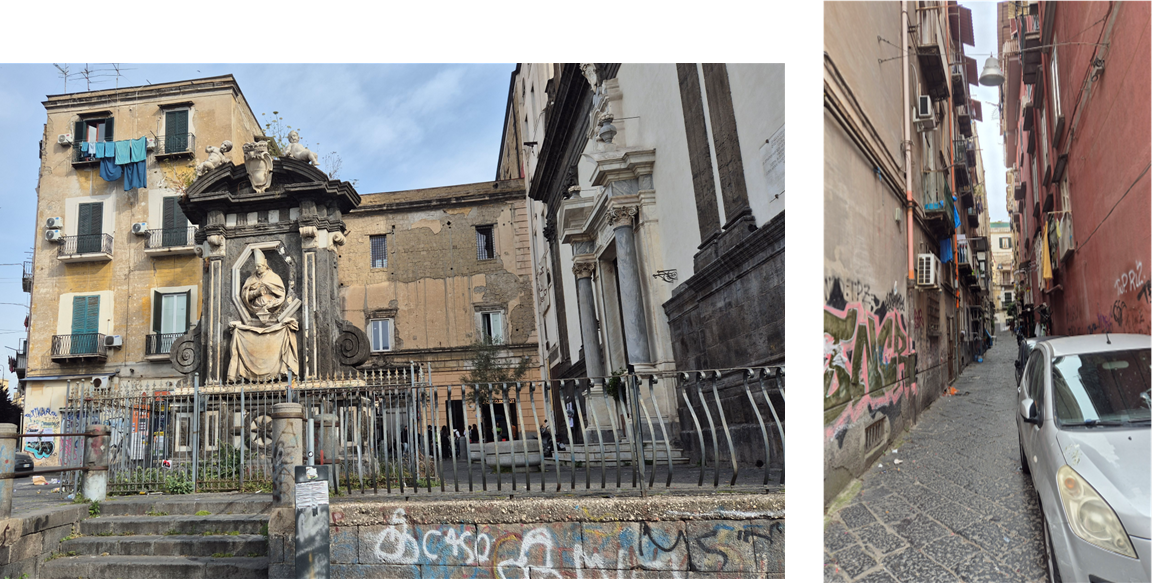
Drivers dart madly in and out of traffic. They do not stop for pedestrians in crosswalks, even the ones who walk with canes. On a busy street cars and motorbikes course in an endless stream. On and on they come.
In complete silence.
There is no honking. Not one honk. Just an occasional peep or two that sound like a small goat with heartburn.
Why?

***
When visiting a place and seeing unfamiliar behavior, you can be tempted to wonder what that behavior says about the people themselves.
For instance: They say Israelis yell a lot because they are under so much stress and pressure.
Plausible? Maybe. True? Who knows? There may be so many other factors that you don’t know about.
Israelis honk like mad. Is that because Israelis are impatient and aggressive?
Neapolitans barely honk at all. What does that show? That they are gentle and sensitive?
Imagine you are debating at the Oxford Union. The resolution is: Resolved: Southern Italians are gentler and more sensitive than Israelis. You take the Affirmative.
Your opponents, proudly arguing the Negative, are Marlon Brando and Al Pacino, the Godfathers.
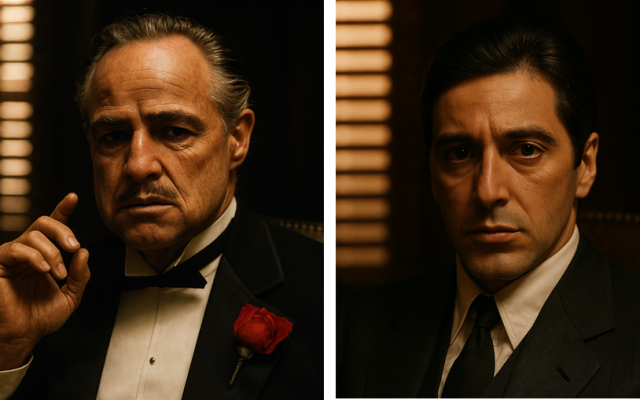
How do you like your chances?
***
It turns out that there is an actual reason people don’t honk in Naples. Except for emergencies, honking in Italy is illegal, punishable by a fine. The same is true in Spain, France (in Paris), the UK, Germany, Austria, Finland.
Yes, I know. People say Italians scoff at statutes. They say that in Naples, red lights are just polite suggestions. People say a lot of things. In and around Naples, nobody ran any red lights in the cars and buses I was in or the streets I was on, and nobody honked, even when maniacs on motorbikes cut them off. (Exception: On narrow, winding mountain roads, vehicles approaching a hairpin turn honk to let drivers around the bend know they’re coming.)
Israelis love Italy. Ben Gurion has four flights a week to Naples. What do Israelis like there?
Pizza. Gelato. Stylish women. Fine wines. Blessed calm on the streets. Just guessing.
***
I’ve been told that Israel has anti-honking laws. If so, no one seems to be enforcing them.
In July 2024 both Tel Aviv and Petach Tikva proposed high-tech implementation of bans against honking except for cases of emergency (like the bans in Europe.) They would deploy arrays of cameras and tiny microphones to geolocate the honking vehicle, whose owner would get a 295-shekel ticket in the mail. The only defense: Proof that the owner wasn’t in town. (Visiting Naples, maybe?)
I don’t know where such efforts stand. Israel has been rather busy for some time with other things.
But suppose laws like this were enacted and enforced. What would happen?
When you think about it, a lot of our public behavior is what other people let us get away with. Once there is a cost, social or financial, we may not behave that way so much.
OK, Israelis are impatient and blunt. Bless them, let them stay that way. But suppose that that ear-shattering and nerve-jangling expressions of impatience, however deeply gratifying, keep generating 295-shekel fines. Maybe Israelis might start acting as polite as southern Italians. Street life would be quieter.
And newly-honkless Israelis might channel their blunt impatience into other, more productive activities.
Like herding stray cats.

***
Linguistic Afterword
The Hebrew word for a horn is tzofar. A honker is a tzofer.
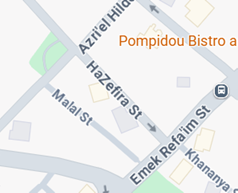
There is a street in the German colony called HaZefira which sounds similar but isn’t. HaZefira was a pioneering Hebrew newspaper in Warsaw. Its name does not mean “The Siren.” It means, “The Dawn,” and comes from the Aramaic word tzafra, morning. (See the second verse of the Friday night zemer Kah Ribon.)
It turns out that tzofar meaning “horn” was coined by the poet and editor Avraham Shlonsky (1900–1974.) He was known for his witty and often off-color word coinages.
Shlonsky called “horn” tzofar because he thought it sounded like shofar. (Please don’t ask.)
Shlonsky used his sense of humor to skewer his literary pals for lusting after prizes. The Hebrew word for prize is pras. His word for the love of prizes: Prastituzia.
My kind of guy, Shlonsky. If I had ever seen him cross the street, I would for sure have honked in tribute, and any fines be damned.