
Writer covering Israel–Africa, Jewish affairs, and Israel worldwide
Blue Badges, Old Lies: How the UN Rebranded the Blood Libel
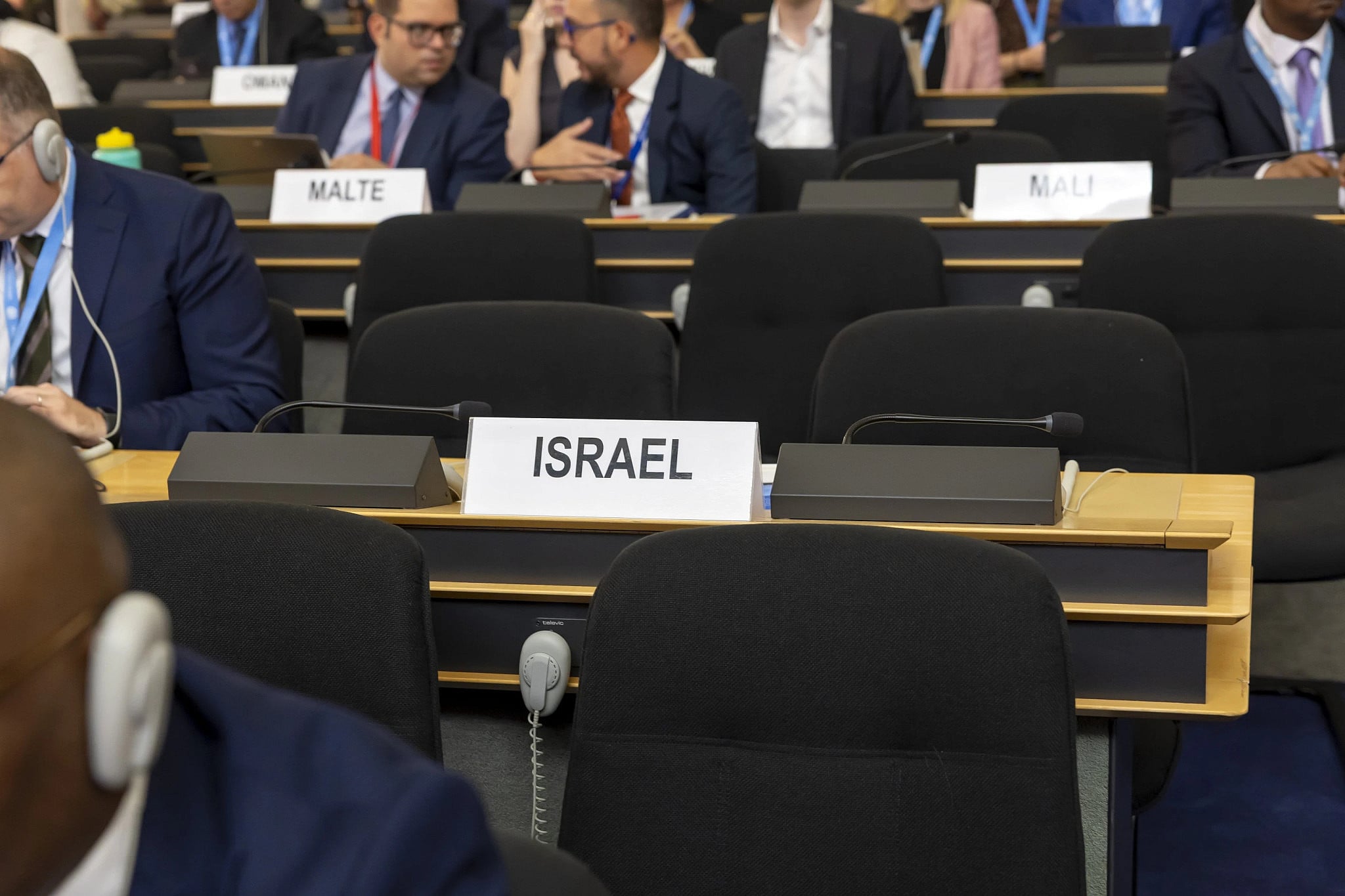
The empty seat of the Israeli delegation, during the 60th session of the Human Rights Council, at the European headquarters of the United Nations in Geneva, Switzerland, Monday, Sept. 8, 2025. (Salvatore Di Nolfi/Keystone via AP)
History’s oldest prejudice has proved astonishingly adaptable. It has survived kings, popes, and empires—and now enjoys observer status at the United Nations.
In twelfth-century Norwich, a young boy was found dead in the woods. No evidence pointed to the local Jews. None was needed. Truth was still knocking on the city gates while the accusation was already collecting believers. Jews had murdered a Christian child for ritual purposes. Facts eventually surfaced, but accountability never followed.
Today the mechanism hums with far greater efficiency, wearing blue badges instead of monastic robes. The United Nations has become the grand distributor of updated libels against the Jewish state, accusations that ignite diplomatic tempests, pressure governments, and isolate Israel while the true architects of suffering—jihadist strongholds embedded among civilians—operate with relative impunity. The pattern repeats with mechanical precision: sensational claim, global panic, quiet correction buried beneath the next headline. No sackcloth, no reckoning.
The oldest libel in history has simply received institutional branding.
Consider what happened during the Gaza war.
Tom Fletcher, the UN’s humanitarian chief, appeared on BBC Radio 4 and declared that 14,000 babies could die within forty-eight hours unless aid entered Gaza immediately. Fletcher never had to say, “Israel is murdering babies.” The headline-writing class kindly completed the sentence for him. Israel was supposedly standing between thousands of infants and certain death. Predictably, outrage erupted across capitals. Editorials were written. Demonstrators filled the streets. Diplomats discovered fresh reserves of moral indignation.
There was only one inconvenience.
The claim was fiction.
The underlying IPC assessment never said that 14,000 babies would die within forty-eight hours. It projected expected cases of acute malnutrition among children between six months and five years over an entire year—from April 2025 through March 2026. It was a projection of possible malnutrition cases, not an imminent death sentence, not infants exclusively, and certainly not a countdown to mass starvation over a single weekend.
In other words, the headline that raced around the globe existed only because the UN’s own humanitarian chief transformed a statistical projection into political theater.
The correction eventually arrived.
Naturally, almost nobody noticed.
That is how modern blood libels operate.
The medieval version claimed Jews drank children’s blood.
The modern version merely suggests they starve children by the thousands.
The medieval libels needed no central secretariat; rumors traveled on foot and by pulpit. Today the UN provides the infrastructure: the platforms, the rapporteurs, the permanent agenda items, the blue-helmeted legitimacy that transforms exaggeration into apparent consensus. It has assumed the role of ambassador for the oldest hatred in new robes, laundering regional animosities and institutional inadequacy through the language of humanitarian concern and international law.
The boy in Norwich was not ritually murdered for blood. The projected malnutrition cases were not 14,000 babies facing execution by starvation in 48 hours. Yet in both eras, the accusation itself becomes the event, shaping policy, stirring fury, and demanding gestures of appeasement that conveniently distract from uncomfortable domestic truths. Israel remains the inconvenient sentinel, guarding its narrow strip against forces that view its very existence as provocation.
This reflects an institution whose obsession has become almost comical were its consequences not so serious. Between 2012 and 2015, the UN General Assembly adopted ninety-seven country-specific resolutions. Eighty-three condemned Israel. The Human Rights Council spent much of its first decade directing more country-specific condemnations at Israel than at regimes whose combined record includes industrial-scale torture and public executions.
Across the Middle East, dictators butcher their own people while jihadists dream of global caliphates. Meanwhile, international diplomacy remains stubbornly fascinated by Israeli zoning permits and military operations.
If hypocrisy were renewable energy, the United Nations could solve Europe’s electricity crisis.
But international organizations are not unique in discovering the political usefulness of Israel. Western governments have learned the same lesson medieval monarchs mastered centuries ago. When domestic politics become uncomfortable, Israel often becomes remarkably convenient. Facing economic stagnation, immigration failures, integration crises, rising extremism, and increasingly restless electorates, governments across Britain, Canada, France, Australia and elsewhere have rushed toward recognition of a Palestinian state.
The gesture was marketed as courageous diplomacy.
Its political utility is rather more obvious.
Nothing changes on the ground.
Nothing restrains Hamas.
Nothing weakens Iran’s regional network.
But politicians acquire flattering headlines, activist pressure temporarily subsides, and public frustration finds a foreign target instead of a domestic one. The strategy is as old as the bazaars of Damascus. When the caravan is robbed, blame the Jew selling spices rather than the governor collecting taxes.
The scenery changes.
The politics never do.
The United Nations follows precisely the same instinct.
Having struggled to prevent wars, watched conflicts multiply, and presided over countless humanitarian catastrophes, it has discovered one remarkably dependable source of institutional relevance: perpetual condemnation of Israel. Every resolution creates the comforting illusion that someone, somewhere, is courageously confronting evil.
It simply happens to be the wrong evil.
Meanwhile, the organizations openly dedicated to Israel’s destruction continue operating from schools, hospitals, mosques, apartment blocks, and tunnel networks beneath civilian neighborhoods.
The defenders become defendants.
The aggressors become humanitarian exhibits.
The institution born from humanity’s promise of “Never Again” has become remarkably busy explaining why “Again” is apparently negotiable when the target is Israel. The verdict was written before the evidence was collected. It usually is. Because the accusation was never designed to discover the truth but to manufacture a culprit.
The medieval mob needed rumors. Today’s guardians of international virtue have something infinitely more respectable: the United Nations.
Related Topics
Related Posts