
A Midwestern Jewish Politico
Bondi, Blood, and Bibi’s Blame Game
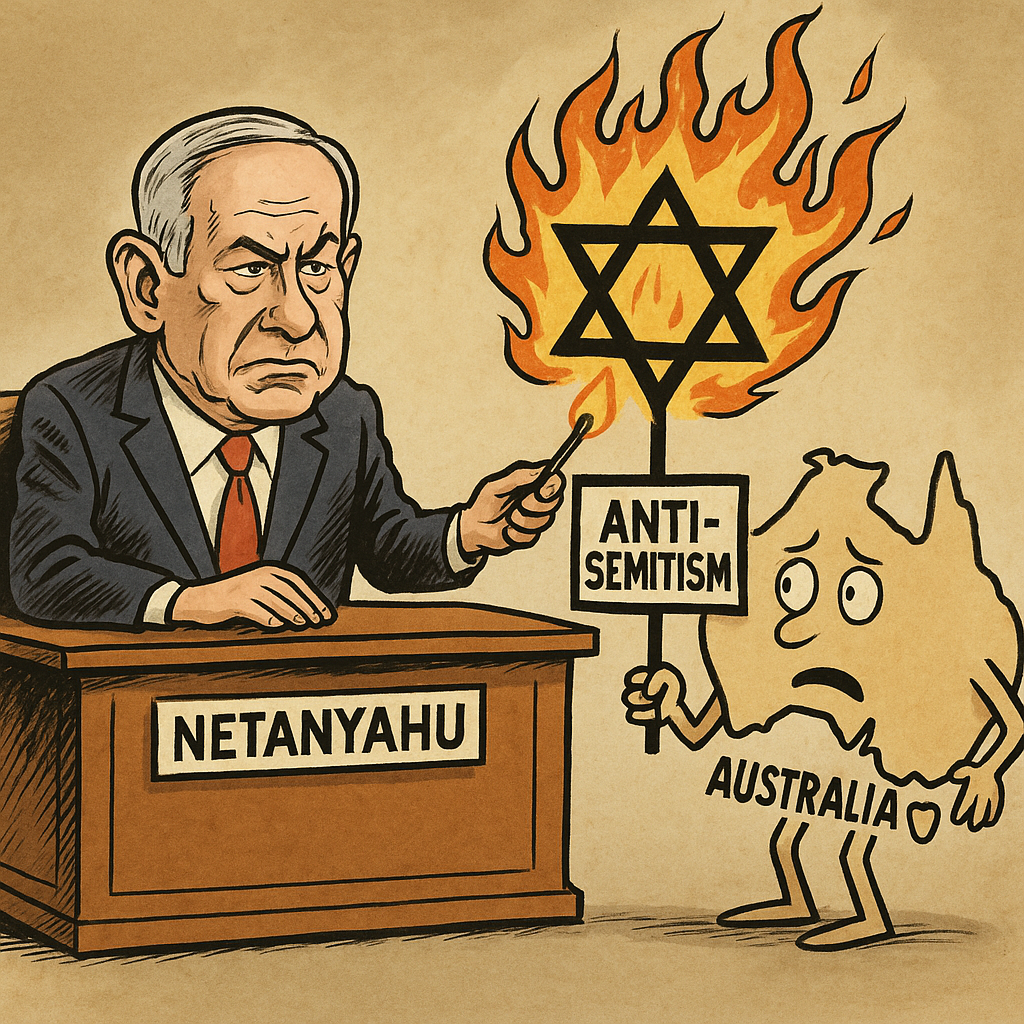
Netanyahu once again being the one to light the match on increases in antisemitism (ChatGPT 5.2)
I’m writing this as an Israel-loving, proud diaspora Jew who is grieving. Not abstractly, not politically, but viscerally… after the mass shooting at a Hanukkah celebration at Bondi Beach in Sydney, Australia on Sunday. 15 people were killed and many more were injured.
Let’s say the obvious clearly: this was an antisemitic act of terror. The target was Jews celebrating Hanukkah. That alone should have unified every responsible leader on earth around two priorities: protect Jewish communities and crush antisemitism wherever it’s spreading.
Instead, Prime Minister Benjamin Netanyahu chose a different instinct… a familiar one. He looked at a murdered Jewish community and saw a political opportunity: to point a finger at Australia’s Prime Minister Anthony Albanese, because Australia recognized the State of Palestine earlier this year (formal recognition took effect on September 21, 2025).
Netanyahu’s claim, per multiple reports, is that recognition “pours fuel” on an “antisemitic fire,” and that Albanese’s government “did nothing” to stop antisemitism. Albanese, asked directly whether he sees a link between recognition and the Bondi attack, said: No.
On this, Albanese is right and Netanyahu is being disingenuous.
Recognition of Palestine didn’t pull the trigger
Here’s what I refuse to accept: the idea that acknowledging Palestinian national aspirations is, by itself, an accelerant for antisemitic violence.
Australia’s recognition of Palestine was framed by the Albanese government as a step meant to support a two-state solution and international momentum toward peace. You can disagree with the timing, the diplomacy, the sequencing, the symbolism… fine. Argue it. Debate it. Protest it.
But blaming it for a father and son opening fire on Jews at a Hanukkah event collapses into a morally lazy logic: Jews are attacked, therefore a Palestine-related decision must be the cause. That’s not analysis. That’s narrative convenience.
Antisemitism isn’t a weather system that rains down because a government made a UN speech. Antisemitism is a worldview — a conspiracy habit, a cultural toxin, an ideological addiction — that can be dressed up in nationalism, Islamism, white supremacy, “anti-globalism,” or “anti-Zionism” depending on the audience. The Bondi attack is the responsibility of the perpetrators, and also of whatever networks, propaganda channels, and ideological ecosystems fed their hatred.
If leaders want to reduce antisemitic violence, they should focus on those inputs: radicalization, enforcement, intelligence, community protection, online incitement, and social normalization of Jew-hatred. Not scapegoat a diplomatic move they already opposed.
The ugliest part: weaponizing Jewish grief
There is something especially cruel about taking a Jewish massacre and turning it into a cudgel against a political opponent, particularly when the goal is to delegitimize any move toward Palestinian statehood, full stop.
That’s the pattern, and diaspora Jews recognize it because we live with its consequences. When antisemitism spikes, we get extra security at our synagogues, our kids’ schools, our community centers. We get the suspicious looks. The comments. The threats. The “go back to Israel” from people who don’t know we’ve never lived there — and the “go back to Europe” from people who pretend Israel is a European colony. We’re the ones who have to explain to our children why police are stationed outside a Hanukkah event.
So when Netanyahu uses our pain as a talking point, it doesn’t feel like leadership. It feels like political extraction… and as someone who loves Israel, I’m tired of being told that loving Israel requires me to accept this kind of cynical performance art.
Netanyahu fuels what he claims to fight
Here’s the part many people avoid saying out loud: Netanyahu’s approach to this war — and the rhetoric that often accompanies it — has been a gift to antisemites.
Not because Jews deserve blame for any government’s actions (we don’t), and not because Israel shouldn’t defend itself (it must). But because maximalist politics and prolonged devastation create the perfect propaganda environment for people who already want to hate Jews. They don’t need facts; they need footage. They don’t need nuance; they need a pretext.
And Netanyahu, over and over, gives them the conditions they can distort, remix, and weaponize — while simultaneously insisting that any push for Palestinian political horizons is “appeasement.”
If you want to drain the swamp that breeds antisemitic violence, you don’t do it by smearing every two-state gesture as a terror incentive. You do it by making it harder for extremists to recruit: by supporting credible political pathways, isolating terrorist groups, and strengthening legitimate partners — while fiercely protecting Jewish lives everywhere.
A better standard for diaspora Jews to demand
I’m not asking anyone to romanticize Palestinian statehood. I’m asking for basic honesty. Recognizing Palestine is not the same as endorsing Hamas. It is not the same as calling for Israel’s destruction. And it is not the same as “pouring fuel” on antisemitism.
What pours fuel on antisemitism is the global normalization of conspiratorial thinking — the idea that Jews are uniquely evil, uniquely powerful, uniquely deserving of collective punishment. What pours fuel on antisemitism is when leaders treat Jewish safety like a chess piece instead of a moral obligation.
So yes: condemn the Bondi killers. Mourn the dead. Protect the living. Strengthen gun laws if failures are found.
And also: stop the blame-shifting.
Because if Netanyahu’s reflex is to respond to Jewish blood with political accusations, then he’s not just failing to fight antisemitism — he’s modeling the very cynicism that makes the world feel like Jewish lives are always someone else’s argument.
We deserve better than that. Israel deserves better than that. And the victims at Bondi deserved better than being turned into a line item in a leader’s talking points.
Related Topics
Related Posts