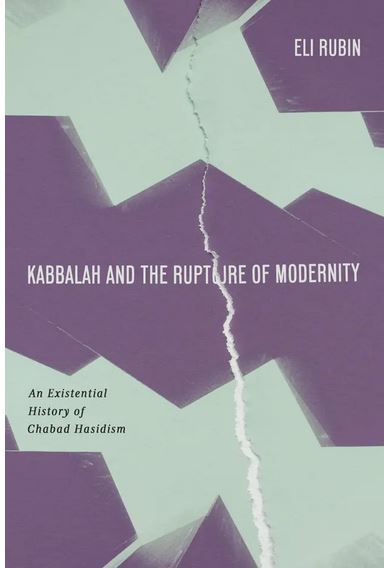
Book review: Kabbalah & the Rupture of Modernity: An Existential History of Chabad Hasidism
Root cause analysis is a problem-solving process meant to help identify the fundamental underlying cause of a problem. That the Vilna Gaon and the first Lubavitcher Rebbe (Shneur Zalman of Liadi, AKA Rashaz) didn’t see eye to eye is well known. But what was the root cause of their disagreement?
In Kabbalah and the Rupture of Modernity: An Existential History of Chabad Hasidism (Stanford University Press), Dr. Eli Rubin argues that it came down to what tzimtzum means.
Tzimtzum is the Hebrew term for contraction. As used by the Ari, it refers to how the infinite God has to self-limit himself to allow the world to come into existence. This, in turn, deals with infinite cosmic kabalistic concepts, divine emanations, and more.
At its core, tzimtzum attempts to address a seemingly insurmountable paradox: an infinite God in a finite world, and a God who transcends everything yet whose presence is felt and immanent.
Richard Feynman, one of history’s most outstanding scientists, believed that no one truly understands quantum mechanics in an intuitive, classical way, as its core concepts are alien to our everyday experience. Similarly, tzimtzum is alien to our everyday experience.
The Vilna Gaon and Rashaz understood tzimtzum in very different ways. Rubin writes in this remarkable work that the Gaon considered the Rashaz approach heretical.
Yet after all that, Rubin writes that Rav Eliyahu Dessler asked people whether they knew how to explain the substantive distinction between Rashaz and the Gaon. To which none of them could give a clear explanation.
So, why is the concept of tzimtzum so significant? Rashaz felt that the Gaon’s approach to declaring God’s infinite self to be absent from the created cosmos is to stumble into philosophical self-contradiction.
Rashaz’s approach to tzimtzum, Rubin argues, seminally shaped Chabad’s emergent self-image as a distinct stream within the broader Hasidic movement. This is at least part of the reason tzimtzum became such a central concept in Chabad’s intellectual history.
This is brilliant work avoids the disputes surrounding tzimtzum, instead exposing the underlying enigma that has made tzimtzum a source of new ideas.
The tzimtzum wars were intense centuries ago. What was once a contentious battle has not turned into normative Judaism. How do we know that?
One of the most influential figures in Jewish thought over the last two generations is none other than the educational entertainers Uncle Moishy and the Mitzvah Men. They taught countless Jewish children across the globe the fundamental idea that HaShem is here, HaShem is there, HaShem is truly everywhere. Uncle Moishy was able to convey the profound kabbalistic idea of tzimtzum in a way that made it accessible to children.
Although tzimtzum is a core concept within Chabad, the book demonstrates that it was not a monolithic concept. He traces how each Rebbe of Chabad molded and adapted the idea of tzimtzum.
Menachem Mendel Schneerson, the final Rebbe of Chabad, plays prominently in the book. Rubin highlights his brilliance and groundbreaking approach to numerous kabalistic concepts.
Parenthetically, Rubin writes that one of the Rebbe’s professors at the University of Berlin was Erwin Schrödinger, who developed the fundamental foundations of quantum theory.
Rubin is a unique scholar who understands the philosophy of Chabad both personally and academically. The author has packed a wealth of fascinating information and analysis into this groundbreaking work. It’s one of the most intriguing and engaging books that I have read in recent years.