Book review – Paradise Cove: They Escaped the Cuckoo’s Nest
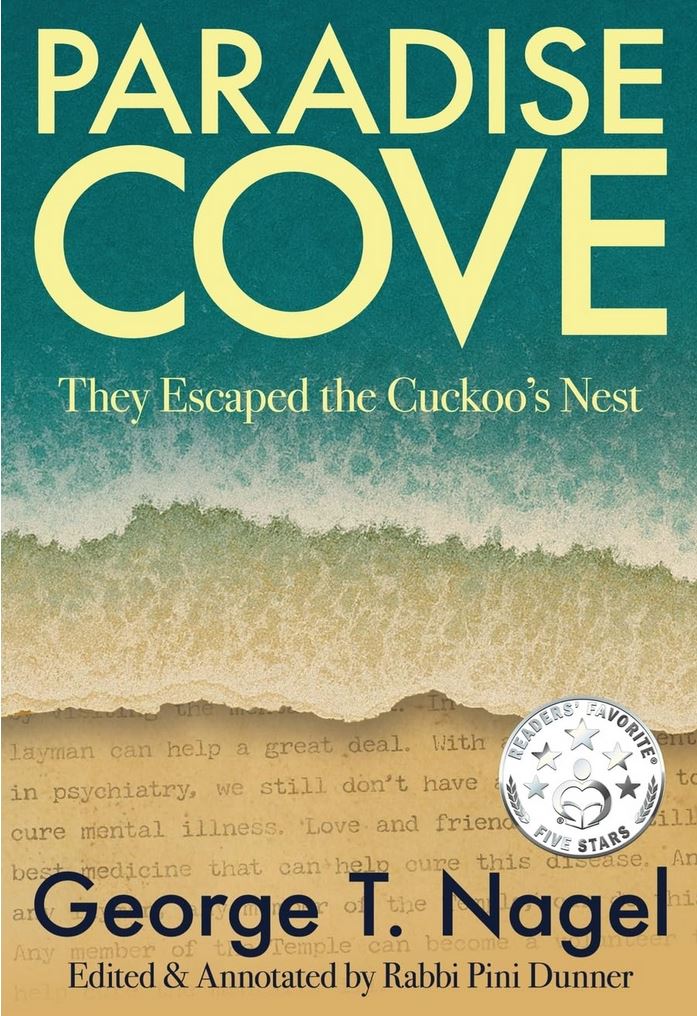
This idea of exodus and redemption is mirrored in Paradise Cove: They Escaped the Cuckoo’s Nest, where Rabbi Pinny Dunner tells the remarkable story of a man whose own exodus marked a journey away from and back to his true roots.
The book is from the Yabloner Rebbe, Rabbi Yechezkel Taub, and George Nagel. These are all the same person.
Yechezkel Taub was born into the Yabloner Hasidic dynasty in Poland. In the 1920s, he led many followers to Israel and started Kfar Hasidim, an agricultural village. The village faced many problems and failed repeatedly. He went to the United States to raise funds, but was unsuccessful. After Hitler invaded Poland, he lost all his Hasidim, and his identity and life’s work were shattered.
Struggling with those failures and the massive perceived guilt he felt for having disappointed those he felt he had let down, he eventually moved to Los Angeles and created a new life, changing his name and identity. There, he became George Nagel, yet another European immigrant in Southern California.
Rabbi David Bashevkin interviewed Dunner and Rabbi Moshe Weinberger on the 18Forty podcast. There, they discussed the Yabloner Rebbe and his astounding story of teshuva.
While Taub saw his efforts in Israel as a failure, he found success in Los Angeles real estate. At age 80, he returned to college and earned a BA in psychology. For his graduate work, he volunteered at a psychiatric facility.
There, in place of a master’s thesis, he chronicled his notes, which is what this book is about, of which Dunner has one of the few surviving manuscripts. The bulk of the book is from Taub, with Dunner adding footnotes that provide context for the discussion and biographical information about him.
In over 100 chapters, we see that, while he was writing under the name George Nagel, his leadership and guidance as the Yabloner Rebbe remained evident.
Toward the end of his life, he returned to Kfar Hasidim. The story’s bitter irony is that Taub saw his life as a disappointment, primarily because of the Kfar Hasidim fiasco. Little did he know he embodied the Mishna in Sanhedrin: “Whoever saves one life is considered to have saved the entire world.” If his followers had stayed in Europe, their end would have been there.
What is particularly tragic is that a leading Hasidic rebbe gave a speech in early 1944 that assured his followers they would be safe in Hungary. History shows they weren’t. Taub had absolutely nothing to be ashamed of. When Taub returned to Israel, he was welcomed as a hero by those whose lives he saved.
The book closes with Taub returning to Kfar Hasidim and a resident there, Chaim, telling him, “On behalf of everyone here, we want to welcome you home. You probably thought we were angry. You probably thought we blamed you for taking us from our homes in Poland, for bringing us here, for the hardships, the failure. But Rebbe, you were wrong. You saved our lives. If not for you, we would have been murdered by the Nazis, like the rest of our families were.”
Paradise Cove is a book and a story that defies categorization – it is singularly unique. The Talmud says that everyone can return. And this is the story of one who did.