
Book review – Reclaiming the Covenant: America’s Remarkable 250 Years and Assuring It Continues
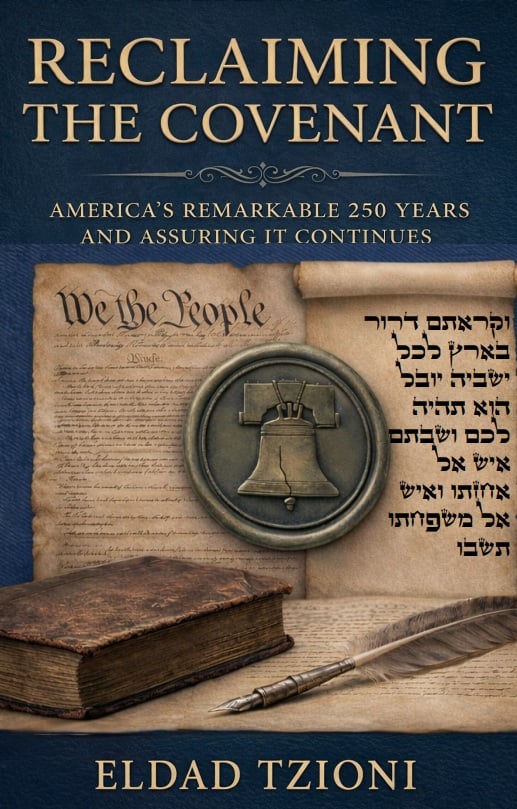
The Elder of Ziyon (AKA Eldad Tzioni) is one of the most important pro-Israel blogs. Aside from being male and American, not much else is publicly known about him.
I’ve been a fan of the Elder for many years. I interviewed him in 2024 here.
His previous works include Protocols: Exposing Modern Antisemitism and At Ptach Lo – An Analytical Haggadah, and his latest is Reclaiming the Covenant: America’s Remarkable 250 Years and Assuring It Continues (EoZ Press).
While we will be celebrating the holiday of Shavuot shortly, reaffirming the Jewish people’s commitment to the Torah, this insightful new book by Eldad Tzioni examines a different covenant: that of the United States.
America’s 250th anniversary (but don’t be that obnoxious one who uses the term semiquincentennial) is about 6 weeks away on July 4, 2026. This milestone marks 250 years since the adoption of the Declaration of Independence in 1776. And the book opens with the observation that the occasion of America’s 250th anniversary is the perfect time to take stock.
In the political landscape, the phrase used by the President, “the state of the Union is strong,” has been an annual fixture for decades. But recent national polling from the Marist Poll shows a divide among Americans regarding this sentiment. Depending on political affiliation and economic outlook, perspectives on national strength vary significantly, with ongoing discussions about checks and balances, international standing, and economic stability.
In this insightful book, Tzoni looks at the philosophical foundations of the US. The book is part political theory, part civic sermon, and part historical reflection. He attempts to answer a deceptively simple yet fundamentally profound question: what exactly made America different, and how can that difference survive?
His central thesis is that America is not fundamentally an ethnic nation, nor merely a constitutional republic, but a covenantal society: a nation bound together by shared obligations and accepted principles rather than blood, religion, or ancestry. From that premise, he constructs a sweeping interpretation of American history that draws heavily on biblical covenant theology, Jewish political tradition, Enlightenment liberalism, constitutional structure, and civic morality.
The result is a provocative and intellectually serious work that will appeal most strongly to readers interested in political philosophy, American civic identity, Jewish intellectual history, and constitutional thought.
The analytical tools he uses in the book are based on a framework he created called Derechology. The Hebrew word derech means a path that applies to people and nations as well as to geography.
America has a derech, and it is worthwhile to examine whether it remains consistent with its original conception 250 years ago.
One of the book’s greatest strengths is the clarity and force of its central framework. Tzioni argues that the American system works because it creates membership through acceptance of a covenant rather than inherited identity.
He sees this principle embodied in George Washington’s 1790 letter to the Hebrew Congregation of Newport, where Washington rejected mere toleration in favor of inherent equal membership. Tzioni treats this moment not as symbolic rhetoric but as the key to understanding the very nature of America.
Tzioni is particularly effective when tracing the covenantal idea through American history. His readings of Abraham Lincoln, Martin Luther King Jr., Emma Lazarus, and Irving Berlin are quite insightful. Rather than presenting them as isolated heroes, he frames them as successive interpreters of the same covenantal logic, each expanding or enforcing the promise embedded in the founding.
The sections on Jewish political tradition are quite compelling. Tzioni persuasively demonstrates the influence of Hebrew covenantal thought on early American political ideas, particularly through concepts of federalism, pluralism, and moral obligation. His discussion of the tribal structure of ancient Israel as a precursor to American federalism is interesting, albeit the parallels may not be as tight as the author makes them out to be.
While it is often seen as purely a legal document. He writes that the Constitution is that, but it is also a moral framework requiring civic virtues, including humility, corrigibility, restraint, and the equal application of standards.
As amazing as the American Convention is, he does write that there have been obvious failures since 1776. The most prominent being slavery. While America has flaws, too many to count, it is still the best model of nationhood that man has devised.
The American covenant has survived 250 years. It has survived a civil war that killed three-quarters of a million Americans, a Great Depression, two world wars, the assassination of presidents, the betrayals of Watergate, and the trauma of September 11. In each case, the threat came, the covenant held, and the republic continued. This record is genuinely remarkable and should not be minimized.
But he writes that survival is not the same as health. A body can survive repeated illnesses while accumulating damage that makes the next illness more dangerous. The covenant’s current threats are not external; no foreign adversary can destroy it, though many would like to. They are internal and particularly insidious because they operate in the covenant’s own language. The republic is not being attacked by people who hate America. It is being eroded by people who are certain they love it.
He does note that the American system has been remarkably good at self-correction. He notes that the covenant is valuable as it allows Americans to confront its breaches without abandoning the framework itself.
This book, like all the other writings of Elder of Ziyon, is thoughtful, insightful, and timely. The news media today are dominated by outrage cycles and ideological fragmentation. Here, he shows how to reground America via obligation, memory, and shared civic commitment. Certainly not an easy task.
The United States, like Israel, is going through trying times with questions of national identity, pluralism, constitutional morality, and the future of a liberal democracy. It’s a most important topic, and this is a most important book that clarifies the often-murky waters around it.