
Book review – The Eyes of Isaac: Ophthalmic Care through the Prism of Judaism
Analogies use two main ideas: the target (what you want to explain) and the source (the familiar idea used to explain it). The Maharal, in his commentary on agada, notes that Chazal never chose a source at random. They pick sources carefully to deliver a clear message. Rather, they are explicitly selected with precision to deliver a laser-focused message.
To illustrate the careful selection of sources in analogies, consider an example found in Nedarim 64b. There, four types of people are described as being “as if they were dead”: a pauper, someone suffering from the Biblical skin disease tzara’at, a blind person, and one who has no children.
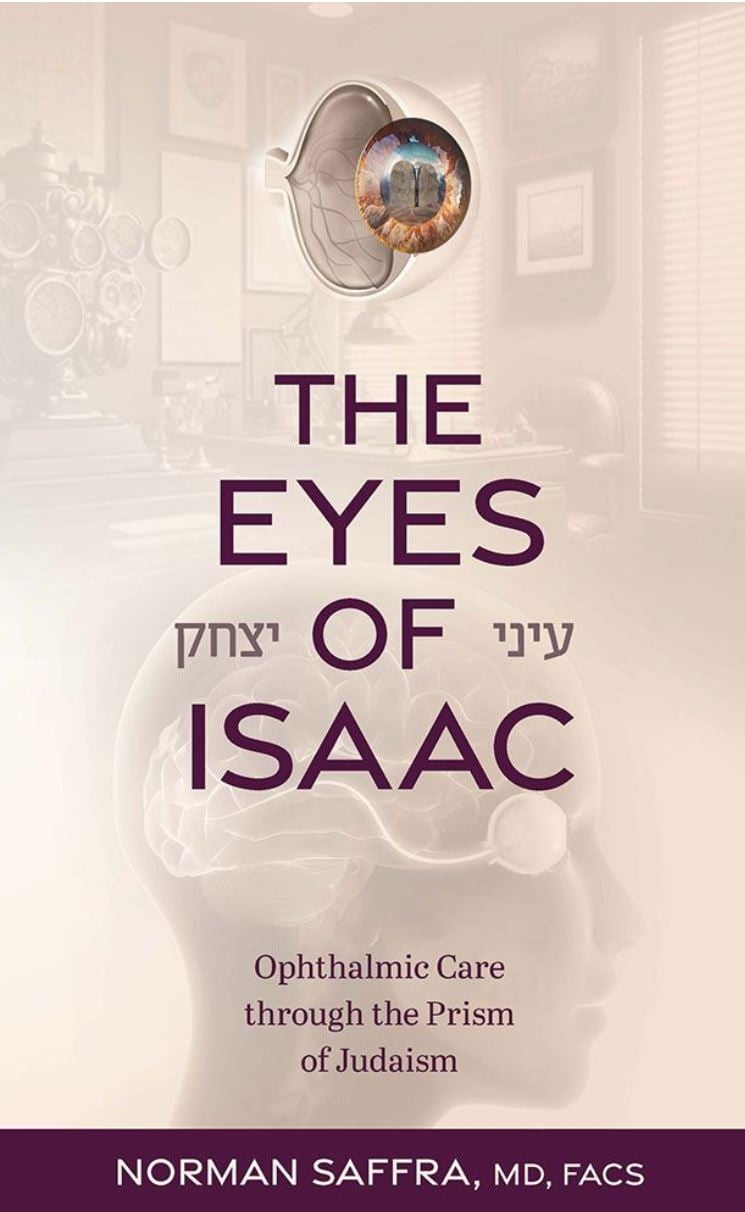
That a blind person is considered as if they were dead is mentioned a few times in The Eyes of Isaac: Ophthalmic Care through the Prism of Judaism (Feldheim), edited by ophthalmologist Dr. Norman Saffra, MD.
In this fascinating book, Saffra (full disclosure: he is my wife’s first cousin) has contributions from a number of eye care professionals and rabbis writing about eye care, ophthalmologic health, and the halachic interface between them.
The first part of the book provides a comprehensive overview of the eye and the visual system, as well as several common eye diseases.
Just as The Jewish Woman’s Health Handbook detailed the myriad dangers of smoking, in the chapter on diseases of the retina, Dr. Michael Potter, MD, writes that one of the most judicious things to do to avoid retinal problems is to stop smoking.
He writes that smoking is a significant risk factor for vision loss in most retinal diseases, particularly in diabetes and macular degeneration.
Turning back to the aforementioned statement in Nedarim, Saffra and Rabbi Yaakov Trump of the Young Israel of Lawrence/Cedarhurst reference Rabbi Chaim Shmuelevitz. He explained that the common denominator among these cases is their dependence on others and inability to give of themselves to their fellow. A blind person, for example, needs constant assistance, and this condition makes it hard for them to integrate into the seeing community.
About a third of the book focuses on ophthalmology and halacha written by Rabbi Boruch Fogel, professor of Judaic studies at Touro University.
Fogel writes about the halachic issues related to corneal transplants, how to deal with a detached cornea on Shabbos, and whether one is allowed to violate Shabbos for treatment, and numerous specific halachic applications related to eyesight.
Weighing a quarter of an ounce and the size of a ping-pong ball, the human eye is an extraordinary organ. There is so much packed into it, and it is so essential to our daily lives, that it’s quite easy to take it for granted.
In The Eyes of Isaac, Dr. Saffra and the contributors help readers appreciate the marvel of the human eye and the value of eyesight. This is a recommended resource for those interested in the topic and definitely a book one should set their sights on.