

The Institute for Safety in the Criminal Justice System
Boycott in the Guise of Academic Freedom
At the heart of Eurocrim 2025: Dr. Beatrice Coscas Williams calls for dialogue over boycott at the ESC conference in Athens, September 5, 2025
The Contradiction at the European Society of Criminology Conference in Athens
The European Society of Criminology (ESC) deserves recognition for the principled effort it has made to uphold academic freedom under extremely challenging circumstances. The Executive Board has consistently affirmed that institutional boycotts contradict the Society’s constitution and its mission to foster scholarly cooperation. In today’s climate of polarization, such a reaffirmation is itself an act of courage.
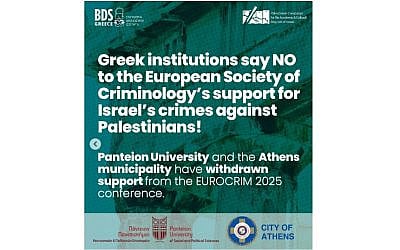
And yet, what unfolded last week at the Eurocrim 2025 conference in Athens revealed the gap between principle and practice. On September 5, during the General Assembly, the Board once again declared that an academic boycott of Israel was unconstitutional and could not be put to a vote. This decision was significant: it was taken despite an aggressive, highly organized campaign by BDS groups and allied organizations, supported by Greek institutions, student unions, and a petition signed by more than 300 criminologists.
A Tense Atmosphere
Despite the Board’s formal rejection of boycott, BDS activists were given wide space to operate inside and outside the conference halls. Flyers and brochures were distributed, filled with accusations of “genocide,” “apartheid,” and “war crimes.” “Discussion circles” were organized, demonstrations staged, and Israeli scholars found themselves targeted by attempts to interrupt their presentations.
What was particularly painful was the discovery that among the organizers of this campaign stood an Israeli academic. When colleagues attempted to approach him and speak, he refused to use Hebrew. Yet when he was pressed to respond to what had been said, he suddenly “remembered” his Hebrew and shouted: “Lehu mipo!” , “Get out of here!”
The paradox was unmistakable: on the one hand, the ESC stood by its constitution, refusing to institutionalize collective punishment. On the other hand, it could not protect its members from the intimidation and harassment that pervaded the conference space.
The Plenary Speech of Beatrice Coscas Williams
Against this backdrop, Dr. Beatrice Coscas Williams – a dual Israeli-French citizen and lecturer at the Western Galilee College in Akko – addressed the General Assembly. She began with a deeply personal note: her family has paid a heavy price in the war, and her niece survived the Nova massacre of October 7, 2023. Yet, as she emphasized, she did not rise to tell her personal story, but to highlight a broader truth – that Israeli scholars are being rejected not because of their ideas, but because of who they are.
“By doing so, you transform this conference from a place of academic dialogue and reflection into a place of hatred, intimidation, and silencing,” she said. “Boycott is not a tool of transitional justice. Boycott is not a tool for criminologists or victimologists. Our work is based on dialogue, on the exchange of ideas, and on the ability to listen.”
She illustrated her point with the example of her own classroom in Akko, where Jewish and Arab students engage in heated debates but then sit together in the cafeteria – proof that disagreement need not mean division. She noted that in Hebrew, the word for “boycott” is the same as the word for “bullying”: silencing, exclusion, rejection.
Finally, she shared her experience as a doctoral student in France, where a joint program brought together French universities, Israeli scholars, and Al-Quds University. When one French university withdrew in protest at Israeli participation, it was not the Israelis but the Palestinian students who lost their scholarships and were forced to abandon their studies. “Today, I can stand before you as a scholar,” she said, “but my Palestinian colleagues cannot. And the reason is simple: because of a boycott against Israeli academia.”
She concluded with an old saying: “It is better to light a small candle than to curse the darkness.”
Closing Thoughts
The events in Athens exposed a deep contradiction. On the one hand, the ESC Executive Board acted with integrity, rejecting an unconstitutional motion despite enormous pressure. On the other, the very space of the conference was overtaken by brochures, slogans, and activist messaging that created an atmosphere of exclusion and threats.
The speech of Beatrice Coscas Williams was a powerful reminder of the true costs of boycotts: they harm both Israelis and Palestinians, undermine the foundations of academic life, and deepen divides rather than build bridges.
For academia to remain true to its mission, it must go beyond principled declarations. It must also ensure that conferences are safe spaces where all voices can be heard without fear. Only then can it truly choose light over darkness.