

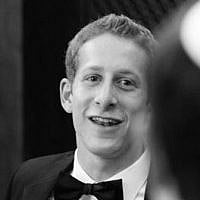
Brad Zarlin on Interviewing 2,000+ Survivors
If you’re a descendant of a Holocaust survivor or care about preserving Holocaust history, Brad Zarlin is a name you should know. Why? He’s perhaps the most prolific individual interviewer of Holocaust survivors in history.
Over nearly two decades, Brad has interviewed more than 2,000 Holocaust survivors, recording thousands of hours of firsthand testimony. Many of the people he interviewed had never shared their stories publicly before. Today, those interviews are preserved in the collections of the United States Holocaust Memorial Museum, creating an extraordinary archive for future generations.
I first learned about Brad’s work in 2014, when he spent more than eight hours interviewing my grandfather, Sam Newman z”l, a Holocaust survivor. That interview became one of the most important historical records our family has. It later served as the foundation for a book preserving my grandfather’s story for future generations (the book is available on Amazon here). Brad also interviewed several other members of my extended family (such as Alan Kupfer, Frida Neuman, and Sidi Newman), helping preserve stories that otherwise might have been lost.
On a personal level, I’m deeply grateful to Brad for taking the time to document my grandfather’s testimony. He’s someone who quietly dedicated years of his life to preserving the voices of thousands of Holocaust survivors, often with little recognition and entirely as a volunteer. I believe the work he’s done will be important for many decades, even centuries, to come.
The conversation below, adapted from a recorded interview and edited for clarity and readability, covers everything from how the project began and what Brad has learned from it to why he believes preserving firsthand testimony matters now more than ever.
Zev Newman: Approximately, how many Holocaust survivors have you interviewed?
Brad Zarlin: Somewhere over 2,000, up to maybe 2,200, but north of 2,000. Those were the completed ones, and then there were also a few hundred where they didn’t finish the interview. Sometimes you’d interview someone, and then for whatever reason they would stop. They would decide, I don’t know who you are, or their children would convince them not to do it anymore.
Zev Newman: How many hours of testimony have you recorded?
Brad Zarlin: I guess it’s hard to know but the average interview was somewhere over three hours. When Spielberg did his interviews, the average one was something like two and a half hours. But you got a different type of interview when I did it because when you talk to someone on the phone, they’re often willing to talk for longer than in front of a camera. They’re more relaxed. They’re not worried about how they look. The longest interview I did was around 16 hours. Some of these people are really extraordinary. I remember this one guy – I think he was head of a Holocaust group up in Boston, he’s pretty well known – I just called him out of the blue and asked him if he would do an interview. I then asked him when he’d want to do it. He goes, “right now.” We then talked for over four hours. He never went to the bathroom. Nothing.
With these interviews, it was always luck – how things were going to go. I was always nervous in the beginning when I would do interviews. I’d worry if the person did a great interview and then the kids would be angry at me. They’d say I have no right to invade their family’s privacy and this and that.
Luckily, I used to be in the brokerage industry, on Wall Street, so I could handle when people said negative things to me. Most people would have stopped, but I was able to continue. I was used to rejection.
Zev Newman: When did you start doing the interviews? And what originally inspired you to start doing them?
Brad Zarlin: I think the first interviews were done in 2006. I was on the internet looking up a book, unrelated to the Holocaust, and I came across this four-volume set of books called the Holocaust Registry, put out by the Holocaust Museum of Washington every 10 years. It listed the names of all the survivors who were alive. I believe the last one was printed in 2000. These books were only in 10 or so libraries around the country, and one of those libraries was close to where I lived, at Touro Law School in Huntington, Long Island. I went over there, and not being a student, I had to sneak past the guards, which wasn’t that easy. The guards were these older Jewish guys, and you had to wait until they moved away and weren’t guarding. Similar to the Holocaust.
In that library, I found three or four rooms filled with Jewish books, many of them on the Holocaust. I noticed that many of them had never been opened. There were thousands of books, and among them I found that four-volume set, and I copied a few pages. My last name begins with a Z, so I always give the end of the alphabet the benefit.
I went to RadioShack and bought one of those cords with a suction cup that let you record phone conversations. It cost about $10. I figured, “Why don’t I try interviewing one of these people while they’re still here?”
One of the Holocaust Registry volumes listed which concentration camps each survivor had been in during the war. I found a man who had been in either 10 or 12 camps. He lived in Charleston, South Carolina, so I called him and asked if he’d be willing to do an interview. He said yes. He had incredible stories. Even after interviewing more than 2,000 survivors over the years, I still think back to that interview because of how remarkable his experiences were.
He’d survived an extraordinary number of camps, and people like that were operating on another level. They had an incredible instinct for survival. I remember one story he told me. He was being transported in the dead of winter in an open rail car. A German kapo next to him wasn’t feeling well and demanded his blanket. He knew that if he gave it up, he’d die. Instead, he fought the kapo and threw him off the train. The Nazis then machine-gunned the kapo.
When the interview ended, I asked him how many times he’d been interviewed before. He said, “Never.” I couldn’t believe it. I’d just spent hours listening to this incredible life story, and no one had ever recorded it. That was the moment I decided I was going to try to interview 1,000 Holocaust survivors.
Ironically, I later discovered this survivor had actually been interviewed by Steven Spielberg’s foundation. He was the only survivor from a family of roughly 160 people. I eventually realized why he’d told me he’d never been interviewed. He wanted me to keep going. If he’d said, “Spielberg already interviewed me,” I might have assumed everyone else had already been interviewed too and stopped before I ever got started.
Zev Newman: I’m curious, was there anything in your own background that drew you to this work? Were there Holocaust survivors in your family, or was it more of a personal interest?
Brad Zarlin: I have some distant relatives who were in the Holocaust, but no close family members. My grandparents came to the United States before the war. I think three were from Russia and one was from the border of Russia and Poland.
Growing up, I had a cleft lip, so I dealt with kids not always being kind to me. I wasn’t invited to parties and was treated differently. That gave me an understanding of what it’s like when people are cruel to someone simply because they’re different. I could relate to that aspect of human nature.
I also think that almost everyone who’s deeply interested in the Holocaust has a personal reason for it. People like to think they’re interested purely because it’s an important historical event, but in my experience there’s always something more personal that draws them to it.
Zev Newman: After conducting thousands of interviews, what did you learn about recording Holocaust testimony?
Brad Zarlin: Recording history is a complicated thing. In the beginning, I didn’t know what to ask people. I didn’t know if certain questions would be too painful or whether I’d accidentally upset someone. Every interview felt like a gamble.
What surprised me was how many survivors had an incredible sense of humor. I’d joke with them sometimes. If someone told me they had low blood pressure, I’d say, “Forget the doctor. Just call me and we’ll talk about the Holocaust. Your blood pressure will go right back up.” Most of them appreciated that. Humor was one of the ways many of them had survived.
At the same time, they listened very carefully to every word you said. You had to be thoughtful in how you asked questions because they tended to take things very literally.
I learned that personal testimony changes depending on who’s listening. In the early years of doing interviews, survivors were often remarkably candid. They’d tell me about being beaten by guards, losing their teeth, and other brutal experiences. But over time, many realized their children and grandchildren might eventually hear these recordings, and they began leaving certain things out.
Zev Newman: You mentioned humor as something you found in so many survivors. Were there other common traits or themes you noticed that seemed to help people survive?
Brad Zarlin: Luck was always part of it, but there were definitely other patterns. For one, being physically smaller could actually be an advantage. Everyone received the same amount of food, so someone who was 5-foot-4 had a better chance of surviving than someone who was 6-foot-2 trying to live on the same ration.
Connections mattered too. If you knew someone who could help you, even in a small way, it could make a tremendous difference. Many of the survivors were also incredibly strong. Some had been bricklayers in Auschwitz and then years later, spent decades working as bricklayers in America. You could hear that toughness in their voices.
At the same time, luck showed up again and again. I remember one woman who desperately needed a new pair of shoes, and somehow a brand-new pair showed up right next to her while sitting in the latrines.
There were also details that surprised me. Most people know the Nazis tattooed numbers on prisoners’ arms. One survivor told me the Germans decided that wasn’t efficient enough, so they experimented with a machine that stamped the number on prisoners’ chests instead. It didn’t work very well, but it worked on him, and he carried that number on his chest for the rest of his life. I also remember one survivor whose tattoo added up numerically to 18, the Hebrew number associated with life. You’d think he would have recognized the significance of that, but he never had.
Zev Newman: Did you ever discover survivors by chance?
Brad Zarlin: A few times. For example, there was an elderly man I’d see walking with a walker near a beach in Oyster Bay. Eventually I stopped and talked to him. He turned out to be a Holocaust survivor, and he’d never been interviewed before.
Another time I was in a dollar store next to a Trader Joe’s. An older man dropped his credit card, so I picked it up and handed it back to him. I asked where his accent was from, and he said Poland. It turned out he’d survived Auschwitz and had worked as a bricklayer there. I tried to interview him, but he declined. I even spoke with his son, hoping he might encourage him, but it never happened. I still think he had an incredible story that was never recorded.
Zev Newman: Have any of your interviews had an impact beyond preserving history?
Brad Zarlin: Yes, and those moments have been incredibly rewarding. One woman I interviewed, whose last name happened to be Newman as well, never finished her interview. After it was posted online, I received a call from a woman in Australia. She’d listened to the interview and recognized two boys who were mentioned. She thought one of them might have been her father. It turned out her father had survived the Holocaust as an orphan and had been sent to Australia after the war. The family assumed everyone else had died.
Because of that interview, they discovered they had first cousins living in the United States. Twelve relatives flew from Australia, and a similar number came from New York to meet up in Los Angeles. Today the cousins stay in regular contact. Before that interview, they had no idea the others existed. Creating connections like that has been one of the most meaningful parts of this project.
Zev Newman: What has it meant to you to see families use these interviews?
Brad Zarlin: That’s always been one of the most rewarding parts. In the early years, families would tell me they played portions of the interviews at bar mitzvahs or family gatherings. It was gratifying to know the recordings were becoming part of their family’s story. One survivor had been a barber after coming to the United States. He was a wonderful storyteller. When he turned 100, his family played parts of his interview during his birthday celebration.
Another survivor had never been interviewed before I spoke with him. After he passed away, his family gave the recording to their rabbi, who used it as the foundation for his eulogy.
Some families would call just to thank me. Others never contacted me at all. But knowing these interviews have helped preserve memories for future generations has always made the work worthwhile.
Zev Newman: You mentioned interviewing both adults and children who lived through the Holocaust. Did you notice differences between people who experienced it as children versus those who were adults?
Brad Zarlin: Oh, absolutely. There were big differences. Some of the hidden children, especially those who experienced abuse, carried that with them for the rest of their lives. It even affected the way they spoke. Their speech patterns were different. After interviewing so many people, I could often tell someone had been a hidden child just by the way they talked.
The older survivors had lived a normal life before the Holocaust, so they had that foundation. Many of the children didn’t.
Another thing I noticed is that some Holocaust organizations aren’t interested in interviewing people unless they personally remember the war. I found that interesting because I interviewed many people who were born right around the Holocaust. They grew up hearing what had happened to them from their families, and many of them had remarkable stories that were worth preserving.
Zev Newman: After interviewing so many survivors, do you think there are lessons we still don’t talk about enough?
Brad Zarlin: One thing that’s always troubled me is the idea that if we simply get everyone to walk through a Holocaust museum, we’ve solved the problem. I don’t think it’s that simple. If we’re serious about preventing something like the Holocaust from happening again, we have to understand the psychology behind it.
For example, before the gas chambers, the Germans carried out mass shootings. It was difficult to find people who were willing to murder women and children. From what I’ve read and been told, they often looked for heavy drinkers and addicts because those were the people who were more willing to carry out the killings. Whether it was alcohol or drugs, addiction played a role, and I don’t think we talk about that enough. If we’re going to prevent events like the Holocaust, we have to understand those kinds of factors.
Zev Newman: Were there any testimonies that have stayed with you over the years?
Brad Zarlin: I interviewed several people who had been experimented on by Josef Mengele. One woman told me she and a set of twins were the only people selected from an entire transport of hundreds of prisoners. She believed Mengele chose her because she had unusually distinctive hair. She also told me that on her first night in Auschwitz, she slept on a cot in Mengele’s room. Not only did she meet him immediately, but she spent that first night in his room. I heard all sorts of extraordinary stories over the years.
Zev Newman: What were some of the biggest challenges you faced in finding survivors and getting them to participate?
Brad Zarlin: One disadvantage I had was that nobody knew who I was. A lot of people thought I was doing the interviews to make money, which wasn’t the case.
Once people understood what I was trying to do, many of them wanted to help. I’d ask survivors for referrals, and some would literally open their phone book and read me every survivor’s name they knew. They’d give me 20 or 30 names. Others wouldn’t give me anyone.
Earlier on in my project, technology was different. After an interview, I’d have to digitize it and try to send a copy to the family. Sometimes the survivor wouldn’t even give me their children’s contact information, so their own family never knew the interview existed. Imagine if I’d interviewed your grandfather and no one in your family ever found out. That happened a lot.
Zev Newman: Did interviewing Holocaust survivors ever inspire you to start asking your own family more questions?
Brad Zarlin: Absolutely. A few years ago, I heard a story about one of my grandfathers that I’d never known before. Apparently, before he met my grandmother, he had dated the sister of a well-known Jewish gangster. I don’t know if it’s true. But when my grandfather came out of the subway, these gangsters would tip their hats to him.
My grandfather wasn’t anything like them. He worked as a presser in New York’s Garment District and never made much money. The only thing he had in common with those men was that he was incredibly strong. He could beat almost anyone in an arm wrestle until the day he died.
I also interviewed my grandmother’s last surviving sister. During that conversation, I learned who my father had actually been named after. I’d never heard the story before. He was named after a melamed, a Jewish teacher, back in Europe. I don’t know much more than that, but I never would have learned that if I hadn’t asked. Once someone is gone, those stories often disappear with them.
Zev Newman: Did your interview style change over the years as you did more interviews and figured out what worked?
Brad Zarlin: Definitely. In the beginning, I didn’t know what to ask people. If I listen to some of those early interviews now, I get annoyed because I realize all the questions I forgot to ask. Another thing that changed was that, over time, many survivors’ children would prepare their parents before the interview. I actually thought that was a disadvantage. You got more interesting answers when people responded off the cuff.
Survivors also talked to one another over the years about their experiences. You could see how certain descriptions became almost universal. For example, when they talked about Mengele, many would describe him in very similar ways, such as saying he was a handsome man. I found those similarities interesting because you wondered how much came from their own memories and how much came from years of discussing those experiences with other survivors.
Zev Newman: Did you ever come across people whose experiences gave you a completely different perspective?
Brad Zarlin: Yes. I interviewed one woman who, as far as I know, was the only non-Jewish American survivor listed in the Holocaust Registry. She was Italian. Before the war, her family traveled to Italy to visit her elderly grandparents. When the war broke out, the Germans killed her father because they believed he was a spy. Her mother survived, and she was eventually sent to Auschwitz.
After the war – unlike many survivors – none of her friends in the United States were Holocaust survivors. She hadn’t spent decades talking about her experiences with other survivors, so the way she described events was different. She used different language and often had a different perspective. Many Jewish survivors spent years surrounded by other survivors. Over time, they naturally developed a shared way of talking about their experiences. She hadn’t, and I thought that made her testimony especially interesting.
Zev Newman: After everything you’ve done, would you encourage other people to record family histories?
Brad Zarlin: Absolutely. There are so many opportunities to interview people and preserve stories that would otherwise be lost. I don’t know whether anyone can make a living doing it. I certainly didn’t. I was fortunate that I could afford to spend the time because I’d done well enough financially. But I do think recording people’s stories is important. Once those stories are gone, you can’t get them back.
Zev Newman: After interviewing more than 2,000 survivors, what are some of the biggest lessons you’ve taken away?
Brad Zarlin: I guess one lesson is to be curious about people and their stories. I’ve learned how to ask questions and how to keep asking them. Almost everyone has a story that’s worth hearing if you take the time to listen. I recently visited Sagamore Hill, Theodore Roosevelt’s home, and was talking with one of the docents. He was amazed by how many questions I asked. I wasn’t a history major, and I never even liked history much in school, but doing these interviews taught me how to be curious.
Zev Newman: Did interviewing so many survivors change the way you think about survival itself?
Brad Zarlin: I think so. If you ask most Holocaust survivors why they survived, they’ll usually tell you it was luck. Luck was certainly part of it, but I don’t think that’s the whole story. Many of the people I interviewed were physically strong, and they made smart decisions under impossible circumstances. Sometimes they survived because someone, whether it was a German or someone else, decided to help them. Maybe they reminded that person of a son who had been sent off to war, so they were given extra food or protected in some way. When you spend enough time talking to survivors, you realize there were many different reasons people survived.
Zev Newman: Were there stories that especially stayed with you?
Brad Zarlin: There were so many. I interviewed one man who survived a death march where roughly 900 people started and only three survived. He was one of those three.
Another survivor had been beaten so badly by a German guard that he went completely blind. His brother hid him on the top bunk of the barracks while the other prisoners went out to work. The guards avoided climbing up there, fearing they would catch typhus. Later, when they were forced onto a death march, he walked the entire way holding his brother.
I interviewed another man who, after the war, somehow ended up driving one of the top Nazi leaders’ Rolls-Royce around the displaced persons camps for a period of time. You heard stories like that all the time.
There was a whole group of people that I interviewed. They all had one thing in common: during the war, they all survived in a hole in the ground, like in a farm, and they all befriended each other after the war. For some period of time, I kept interviewing these people who survived in a hole in the ground.
Zev Newman: What are your hopes for the interviews you’ve recorded?
Brad Zarlin: I hope people are still listening to them decades from now. It wasn’t as easy as you might think to get the interviews into Holocaust centers. I eventually got the United States Holocaust Memorial Museum in Washington to accept them, and they’ve been part of the collection there for a number of years. Anyone can listen to them, just like you can listen to your grandfather’s interview. I’m grateful the interviews are preserved and available for future generations.
Zev Newman: What do you think can still be done with these interviews?
Brad Zarlin: I think there’s a lot that can be done. Some families have already used them in creative ways. One family put together a film using the interview, along with photographs of the town, synagogue, and places their relatives came from. I thought that was really interesting.
I’d also love to see some of these interviews turned into movies. Some of the stories would make incredible films. For example, I interviewed one survivor who was just seven years old during the war and survived some of the worst concentration camps. As far as I know, he’s still alive today, and he’d love to see his story made into a movie.
I also think these interviews could inspire different kinds of art. People hear the same story in different ways, and I think there’s a lot of creative potential in that.
Your family transcribed the interview and turned it into a book.
When I started doing this, I didn’t know much about history. The fact that I was able to build this collection makes me think almost anyone with an interest in history can do something meaningful. It may not make you any money, but you can still create something that’s historically important.
Zev Newman: Why do you think recording firsthand testimony is still so important?
Brad Zarlin: There are a lot of people who are part of history, and no one ever takes the time to talk to them. If you can get direct testimony from people who actually lived through events, you have a chance to get closer to the truth. I think that’s incredibly important. One of the biggest problems today is that people often believe whatever they’re told. That’s another reason firsthand accounts matter. They give future generations the opportunity to hear directly from the people who were there.
Zev Newman: My grandfather touched on this a little in his own interview, but after speaking with so many survivors, what do you think they wanted future generations to understand about the Holocaust?
Brad Zarlin: That prejudice often comes from not really knowing people. Throughout history, people have targeted groups they saw as different or, in some cases, more successful than themselves. I think everyone has prejudices to some degree. The important thing is what happens when people actually get to know one another. When people interact one-on-one, a lot of those prejudices begin to disappear.
There’s a program called Seeds of Peace that brings Jewish and Arab teenagers together for a few weeks. I think programs like that are important because once people actually meet each other and spend time together, many of the assumptions they had begin to change. That’s one of the ways you fight the kind of prejudice that can lead to events like the Holocaust. Some Holocaust survivors even married Germans after the war because those were the people who had hidden or helped them during the war. Once they knew each other as individuals, they saw each other differently.
Zev Newman: How did you end up finding so many survivors to interview?
Brad Zarlin: It was mostly referrals. One woman at the United States Holocaust Memorial Museum was kind enough to regularly send me the four-volume Holocaust Registry, which listed survivors’ names. From there, I’d look up phone numbers, usually focusing on people with less common last names because they were easier to find. The online White Pages also listed people’s approximate ages, which helped. Once I’d interview one survivor, I’d ask for referrals, and that’s how the project continued to grow. I think that’s actually how I eventually found your grandfather.
Zev Newman: Interviewing more than 2,000 survivors must have taken an emotional toll.
Brad Zarlin: It wasn’t always easy. Sometimes I’d interview a survivor, and afterward they’d tell me they couldn’t sleep that night. You didn’t always know what to say. For most survivors, though, talking about their experiences was actually helpful. I’d say that for the vast majority, the interview was a positive experience. There were only a small percentage, maybe one or two percent, who became very upset afterward.
Zev Newman: After hearing so many testimonies, what convinced you this work mattered?
Brad Zarlin: I realized there were still so many survivors whose stories had never been recorded. A lot of people assumed Steven Spielberg had interviewed everyone, but that simply wasn’t true. Your grandfather is a good example. I looked at it as an opportunity to preserve something important in my spare time. I wasn’t getting paid to do it. I just thought these stories needed to be recorded before they disappeared.
Wrapping Up
Holocaust survivors are leaving us. With each passing year, fewer firsthand witnesses remain to tell their stories. That’s what makes Brad Zarlin’s work so remarkable. Armed with little more than a phone and curiosity, he spent nearly two decades preserving the voices of more than 2,000 survivors. Many of them had never shared their stories publicly before.
On behalf of my family, I’m deeply grateful that Brad took the time to interview my grandfather, Sam Newman z”l, along with several other members of my extended family. Those recordings have become an irreplaceable part of our family’s history.
If you have an older relative whose story has never been recorded, let this interview be a reminder to ask the questions while you still can. As Brad says, once someone is gone, those stories often disappear with them.