

Israel as a global geostrategic axis
Brazil’s Elections: The Historic Presence of Anti-Israel Candidates
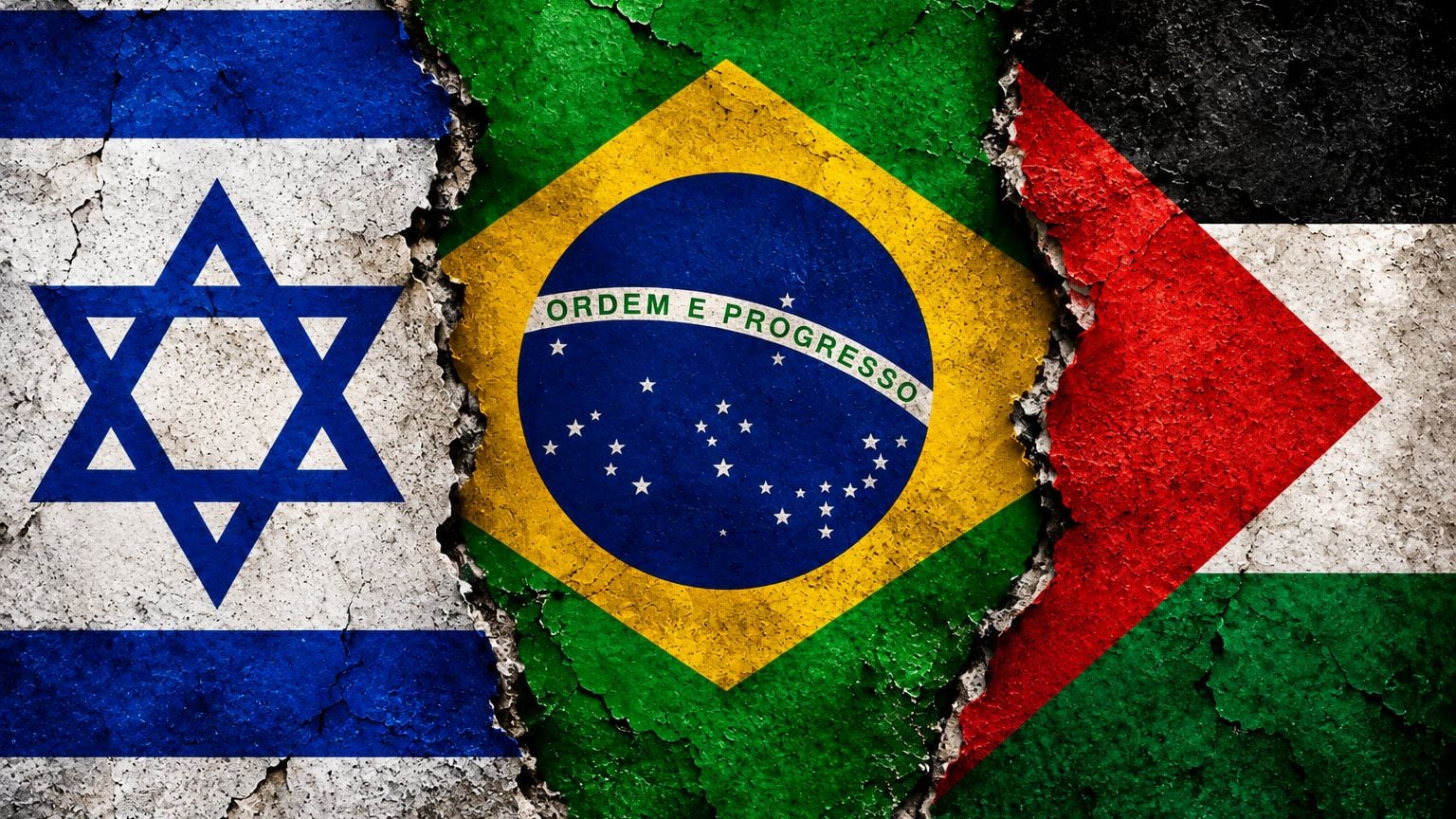
Illustration reflects how Middle Eastern geopolitics is directly influencing the Brazilian electoral system (AI-generated image)
Writing this article, I remembered my training at Yad Vashem, when the institution entrusted us with the role of ambassadors for the world’s largest Holocaust memory institution. On that occasion, I addressed the fact that Brazil was reliving a dark chapter of the Getúlio Vargas era (1930–1945)—whose government maintained a restrictive immigration policy toward Jewish refugees, documented in the infamous secret Itamaraty circular ‘no Jews are accepted,’ which prevented thousands of people from escaping the Holocaust.
Brazil goes to the polls in October to elect a president and the entire federal legislative body. The country is living through the deepest political and institutional crisis in its history: the Lula government is entangled in corruption cases, arrests, allegations of judicial weaponization against the opposition, and a General Government Gross Debt that has already surpassed pandemic-era levels — an unprecedented setback for the country’s public finances.
Adding to this crisis, there is something else that deserves attention in the 2026 electoral cycle: a network of far-left anti-Israel candidates and pressure groups who have built political identities around hostility to the Jewish state. Several have ties, whether direct or through institutions, to prominent figures in Hamas and Hezbollah. What follows is a documented survey.
Lula da Silva
The presidential race pits incumbent Lula (Workers’ Party, PT) against center-right candidate Flávio Bolsonaro (Liberal Party, PL), son of former president Jair Bolsonaro. The clearest dividing line between the two lies in their foreign policy orientation: alignment with the West and support for Israel.
Lula carries the unwanted distinction of being the first Brazilian president declared persona non grata by Israel, after comparing Israel’s military campaign in Gaza to the Nazi Holocaust — remarks that triggered a prolonged diplomatic rupture, including the recall of ambassadors on both sides. Israeli Prime Minister Benjamin Netanyahu responded that, by drawing that comparison, Lula “disgraced the memory of the 6 million Jews murdered by the Nazis and demonized the Jewish state like the most virulent anti-Semite” — a statement issued by the Prime Minister’s Office and widely reported by international news agencies.
The episode revived scrutiny of a decades-old interview Lula gave to the Brazilian edition of Playboy in July 1979, in which the then-union leader, asked which historical figures he admired, cited Gandhi, Che Guevara and Fidel Castro — and, controversially, said he admired in Hitler “the drive, the strength, the dedication.” He also cited Ayatollah Khomeini’s “determination” in overthrowing the Shah’s regime.
Hamas itself publicly celebrated Lula’s 2022 election: political bureau official Basem Naim called him a “freedom fighter” and described his victory as “a win for all oppressed peoples around the world, particularly the Palestinian people,” citing Lula’s record of positions in international forums on the Palestinian cause.
Celso Amorim — special presidential adviser and Lula’s chief foreign policy strategist — wrote the preface to the Brazilian edition of Engaging the World: The Making of Hamas’s Foreign Policy, by researcher Daud Abdullah, in which he credits Hamas’s international diplomacy with the potential to play “a central role in restoring Palestinian rights.”
In February 2023, the Lula government authorized two Iranian warships, the Makran and the Iris Dena, to dock at the port of Rio de Janeiro, overriding a public request from the United States that Brazil deny entry to the vessels — a decision that generated tension with Washington.
In short, Lula’s foreign policy has, over the decades, strengthened ties with dictatorial, jihadist and autocratic regimes accused of crimes against humanity. Lula has therefore turned Brazil into an international embarrassment, marked by unprecedented diplomatic crises.
Thiago Ávila
Probably the most media-visible figure on this list, Ávila has already been detained twice by Israeli authorities — in 2025 and again in April of this year, in the Global Sumud Flotilla case. The far-left activist attended the funeral of Hezbollah leader Hassan Nasrallah in Beirut, as one of roughly a hundred content creators reportedly summoned by the group to cover the event, posting tributes describing Nasrallah as an “inspiring” anti-colonial reference and openly calling him a “martyr.” He denies the legitimacy of the State of Israel, openly advocates its annihilation (“from the river to the sea”), and frames the actions of Hamas and Hezbollah as legitimate “anti-imperialist resistance.” He is running for federal deputy for São Paulo in 2026 on the PSOL/REDE ticket.
Rui Costa Pimenta
Founder and national president of the Workers’ Cause Party (PCO) and a 2026 presidential candidate, Pimenta traveled to Qatar for an official meeting with Hamas political chief Ismail Haniyeh and senior official Musa Abu Marzuk, describing Hamas in interviews not as a terrorist organization but as “a Palestinian government in exile.” The PCO systematically backs Iran and its regional allies — the so-called “Axis of Resistance,” including Hezbollah and the Houthis — framing its position as opposition to “American imperialism and Zionism.”
Ualid Rabah
President of the Palestinian Arab Federation of Brazil (FEPAL), on leave from that position to run for federal deputy for Paraná on the Workers’ Party (PT) ticket, Rabah publicly described the October 7, 2023 attacks as a “self-defense operation,” called Israel a “Nazi project” and a “den of murderers,” and referred to the Gaza Strip as an “extermination camp.”
João Daniel
A PT federal deputy from Sergipe running for re-election, Daniel attended the Global Anti-Apartheid Conference for Palestine in Johannesburg and drew backlash for posting photos alongside Basem Naim, the same Hamas political-bureau spokesman referenced above. He and allied movements, including the Landless Workers’ Movement (MST) and the Brazil-Palestine Institute (Ibraspal), defended the trip as part of a broader human rights and anti-imperialist agenda.
Pressure Groups
Ahmed Shehadeh, president of the Brazil-Palestine Institute (Ibraspal), has publicly refused to classify Hamas’s armed actions as terrorism and has been a vocal critic of the Brazilian government’s response after October 7. (Shehadeh is the brother of the late Salah Shehadeh, founder of Hamas’s Izz ad-Din al-Qassam Brigades, killed in a 2002 Israeli airstrike — a family connection worth noting as context, though it is Ahmed’s own public statements, not the family tie itself, that form the basis of scrutiny here.)
Sayid Marcos Tenório, Ibraspal’s vice president and a former congressional aide, chairs the Brazil-Iran Friendship Institute, maintains ties to Iranian officials and Hezbollah-linked figures, and denies Hamas’s terrorist designation.
Mohamed El-Kadri, head of the Latin-Palestinian Forum, has declared support for Hamas’s Al-Qassam Brigades, stated that “Zionism is worse than Nazism,” and argues that Israel “is not a country, but a terrorist organization.”
Rawa Alsagheer, Syrian-born national coordinator of Samidoun (the Palestinian Prisoner Solidarity Network), also coordinates Masar Badil, organizing boycott (BDS) campaigns and street actions against Western governments and institutions linked to Israel.
Pedro Ferraracio Charbel, one of the founders of BDS Brazil and a parliamentary aide to Guilherme Boulos (PSOL), has pushed for the cancellation of military agreements, the severing of diplomatic ties, and international boycotts of Israel.
Closing Thoughts
Together, this network illustrates how Middle Eastern conflicts and anti-Israel narratives are being imported directly into the Brazilian electoral system. Even in the face of this concerning scenario, there is reason for hope in the historic and fraternal alliance between Brazil and Israel: Jewish refugees fleeing the Inquisition arrived on Brazilian shores as early as 1500, practicing their faith in secret synagogues at the risk of their lives, long before the country’s independence. Brazil takes pride in its role in the founding of Israel—Brazilian diplomat Oswaldo Aranha, who presided over the UN General Assembly session that approved the 1947 partition plan, remains one of the most revered non-Jewish figures in Israeli history.
Shema Yisrael שְׁמַע יִשְׂרָאֵל